

A poorly written maintenance contract can cost you thousands in unexpected repairs and disputes. At Osa Property Management, we've seen property owners in Costa Rica lose money because their contracts lacked clear terms and protection.
The right maintenance contract protects both you and your service provider. This guide walks you through what to look for, what to avoid, and how to secure an agreement that actually works.
What Makes a Maintenance Contract Valid in Costa Rica
In Costa Rica, a maintenance contract becomes legally binding the moment both parties agree to its essential terms. The Civil Code requires four elements: the parties must have legal capacity, the object must be lawful, the cause must be lawful, and both sides must genuinely consent. When a contract fails to meet essential legal requirements-such as capacity, lawful object, or lawful cause-it may be declared null or voidable. This means a verbal agreement between you and a maintenance provider can technically be enforceable, but we strongly recommend writing everything down. A written contract protects you far better because it creates clear evidence of what was promised, prevents misunderstandings, and makes enforcement straightforward if disputes arise.
Why Written Contracts Matter
Without documentation, proving what was actually agreed becomes nearly impossible in court. Costa Rican law recognizes the autonomy of will, which means you and your service provider can negotiate almost any terms you want, as long as they don't violate the law or public order. The foreseeability principle limits recoverable damages to losses that were foreseeable when you signed the contract, so spelling out exactly what could go wrong and how you'll handle it matters significantly.
What Happens When Breaches Occur
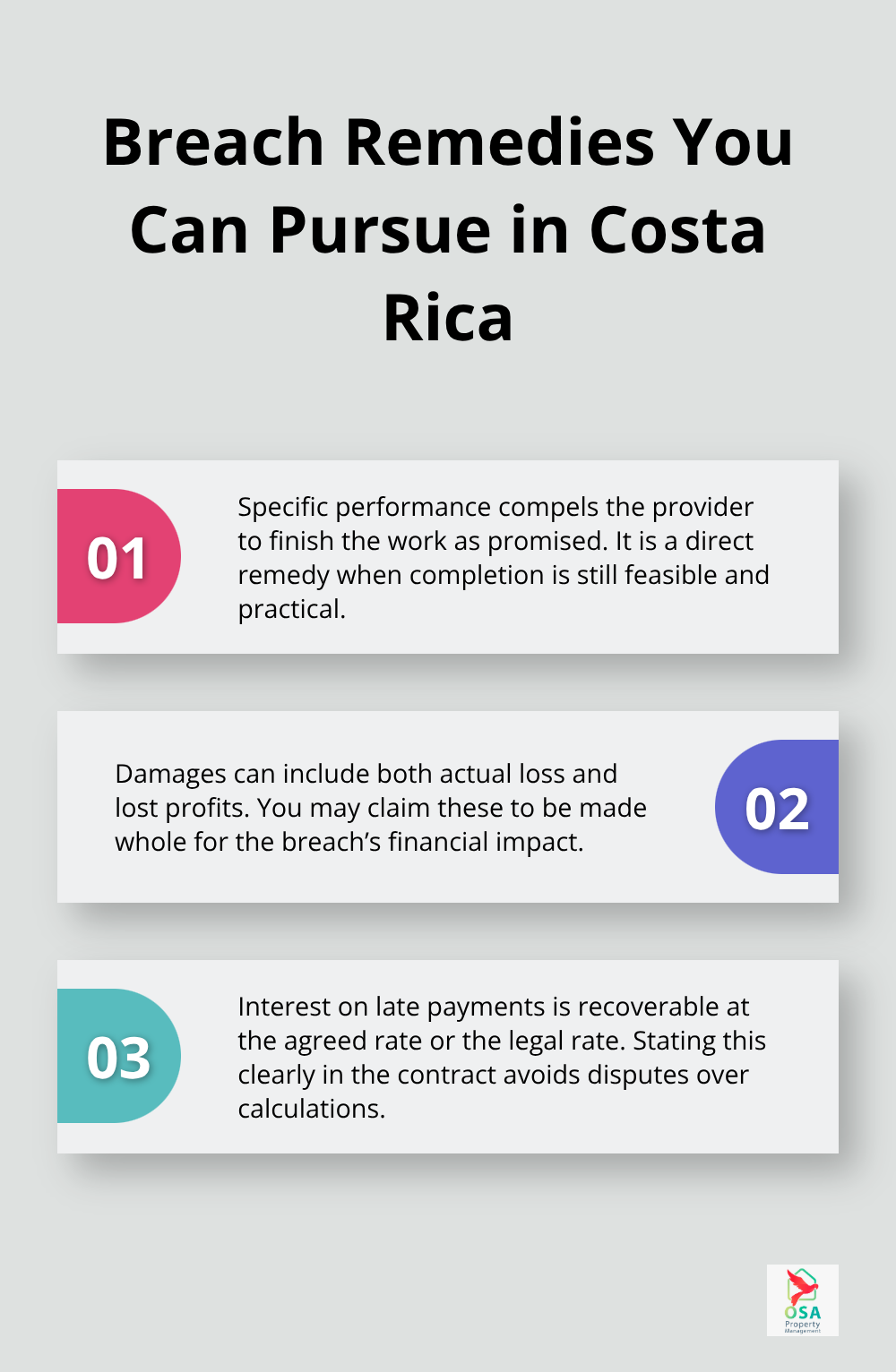
When a breach occurs, you can pursue specific performance (forcing the provider to complete the work) or contract resolution with damages. Damages are divided into actual loss and lost profits, and you can claim both in breach actions. Interest on late payments is also recoverable, whether it's a rate you agreed to or the legal rate, so specify this clearly in writing.
Understanding Prescription Periods
If the maintenance provider is a merchant or operates commercially in Costa Rica, the Commercial Code may apply instead of the Civil Code, which carries a shorter four-year prescription period for claims rather than ten years. This distinction affects how long you have to pursue legal action if something goes wrong.
Structure Your Contract Around Real Obligations
Your maintenance contract must define exactly what services the provider will deliver, how often, and at what cost. Vague language like "occasional maintenance" or "as needed" creates endless disputes because each party interprets it differently. Instead, specify preventive maintenance schedules, what equipment or systems are covered, and what falls outside the scope. If remodeling or major repairs are needed, the contract should state whether the provider handles those or refers them elsewhere.
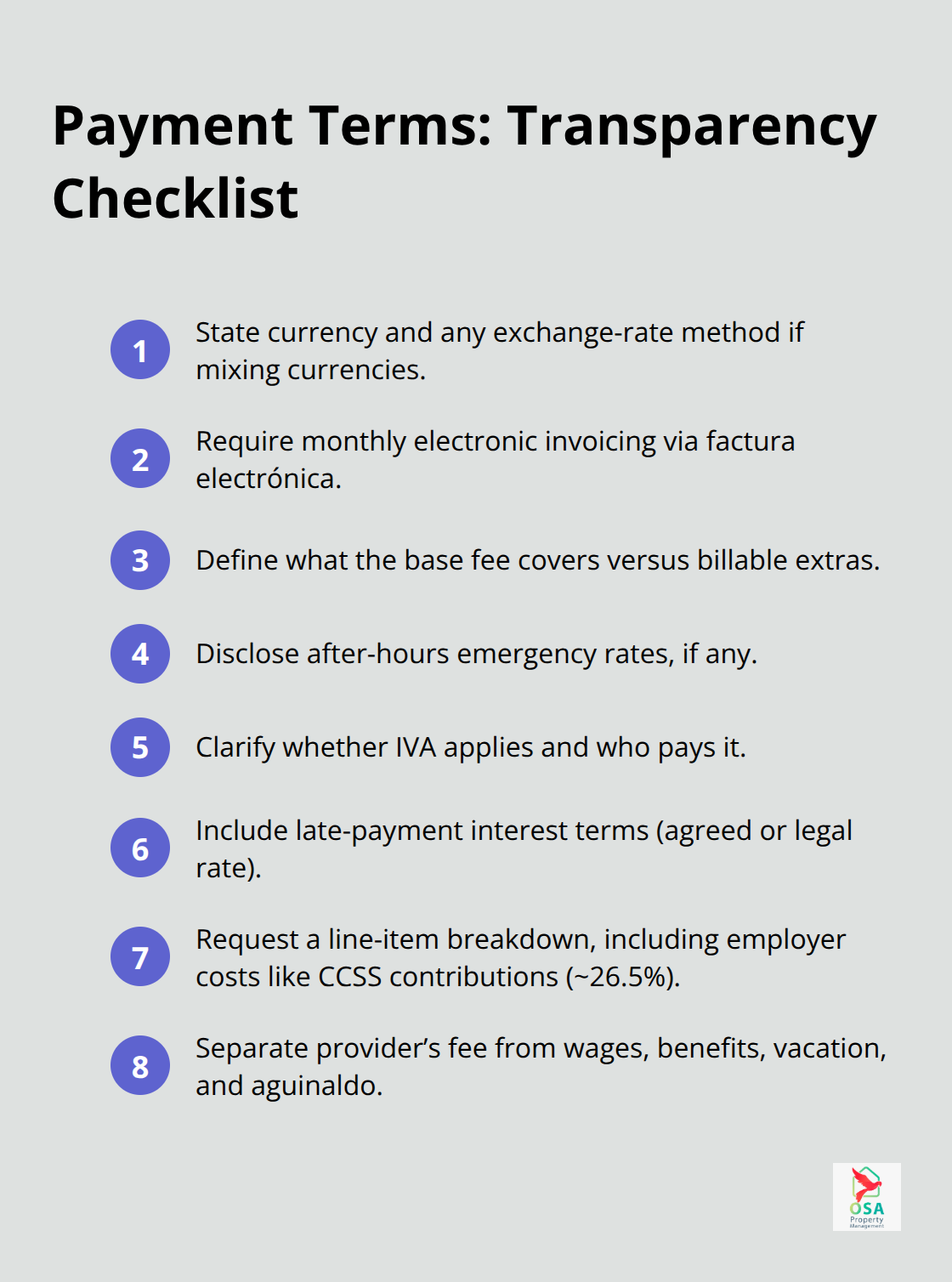
Payment terms must include the fee amount, invoicing frequency, currency, and whether IVA (value-added tax) applies. Require the provider to issue factura electrónica, the electronic invoice system Costa Rica's tax authority mandates. Performance metrics matter too-define response times for emergencies, completion deadlines for scheduled work, and how you'll measure whether the provider is actually meeting your needs. Include clear party identification with legal names and tax registration numbers to prevent the contract from being invalid due to incorrect identification. Costa Rican courts will enforce what you write, but only if the terms are specific enough to be understood and applied. A well-drafted contract also reduces the need for litigation because both parties know exactly what's expected. With these foundations in place, you're ready to examine the specific terms that protect your property and your investment.
What Your Maintenance Contract Must Specify
A maintenance contract in Costa Rica lives or dies by its specificity. Property owners who sign agreements that sound comprehensive often discover something breaks, and suddenly the provider claims it falls outside their scope. The difference between a contract that protects you and one that leaves you exposed comes down to how precisely you define what work gets done, who pays what, and who bears the risk when things go wrong.
Define Your Scope of Work with Precision
Start with scope of work, and be ruthlessly detailed. Instead of writing "general maintenance," specify exactly which systems the provider covers: plumbing, electrical, fenestration, locks, furniture, and any minor mechanical work. Define whether preventive maintenance happens monthly, quarterly, or on another schedule, and list exactly what preventive tasks occur each time. If the contract covers only corrective maintenance-fixing things after they break-state that explicitly. Distinguish between what the provider handles directly and what they supervise or refer out. Major repairs, remodeling, and capital improvements should be clearly labeled as outside the base contract, with a separate process for approval and pricing if they arise. Costa Rican law requires the object of the contract to be lawful and clearly defined, so vague language creates legal vulnerability on top of operational confusion. Include response time commitments for emergencies-for example, acknowledgment within two hours and arrival within four to eight hours depending on location-because response times directly affect your property's condition and tenant satisfaction if you rent it out.
Structure Payment Terms for Complete Transparency
Payment structure demands equal precision. Specify the total monthly or annual fee in Costa Rican colones or US dollars, whichever you prefer, and state the currency exchange rate methodology if you mix currencies. Require the provider to invoice monthly via factura electrónica, which Costa Rica's tax authority mandates and which protects both parties for compliance purposes. Break down what the fee covers versus what triggers additional charges-for instance, specify whether emergency calls outside normal hours cost extra and at what rate.
Allocate Liability and Insurance Protections
Liability and insurance protections must address the real risks. Require the provider to carry general liability insurance with minimum coverage amounts appropriate to your property's value-typically not less than the equivalent of three to six months of your annual maintenance budget. Verify they hold valid CCSS registration if they employ Costa Rican staff, because CCSS non-compliance creates liability for you as the property owner. Include indemnity clauses stating the provider covers losses or damages arising directly from their negligence or breach, while you cover losses from your own actions or third-party causes unrelated to maintenance. Specify who is responsible if maintenance work damages other parts of your property-for example, if plumbing work causes water damage to flooring. Define what happens if the provider causes injury to themselves or others on your property; their insurance should cover this, not yours. Force majeure provisions matter in Costa Rica because natural disasters, earthquakes, and extreme weather are real risks; state clearly that neither party is liable for delays or failures caused by events beyond reasonable control.
These three foundations-precise scope, transparent payment structure, and clear liability allocation-transform a maintenance contract from a source of friction into a working agreement. With these elements in place, you're ready to identify the red flags that signal a poorly drafted contract and learn how to protect yourself before you sign.
Red Flags and How to Avoid Costly Mistakes
Vague Language Creates Endless Disputes
Maintenance contracts with vague language rank among the costliest mistakes property owners make in Costa Rica. Phrases like "as needed," "general upkeep," or "reasonable maintenance" sound fine until something breaks and your provider claims it falls outside their responsibility. Costa Rican courts enforce what's written, but only if it's specific enough to interpret. A contract stating the provider handles "plumbing maintenance" creates ambiguity: does that include replacing corroded pipes, or only fixing leaks? Does it cover annual inspections, or only emergency repairs? The provider's answer will differ from yours the moment a bill arrives.
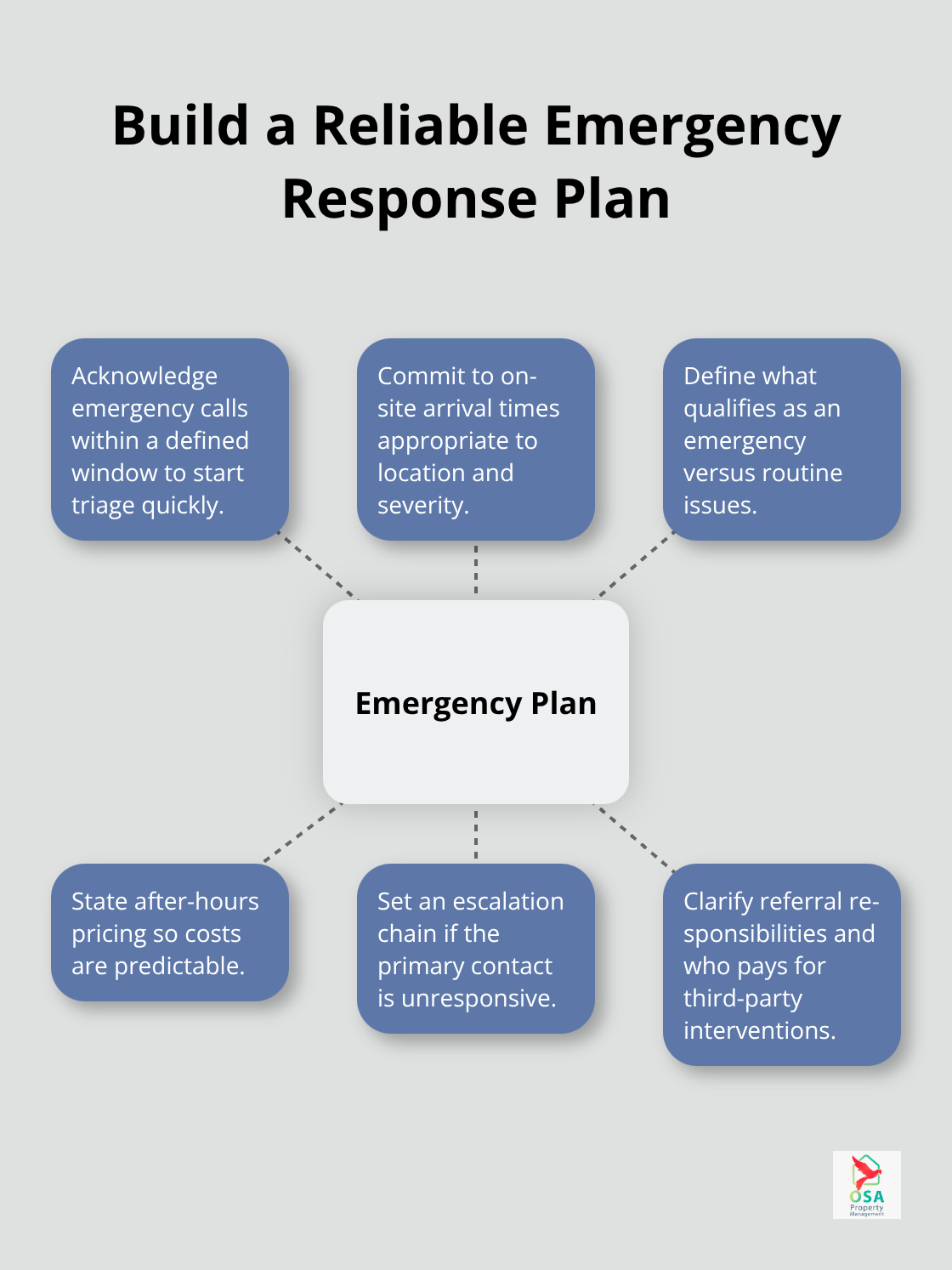
Specify exactly which systems they cover, what preventive tasks occur on which schedule, and what constitutes an emergency versus routine work. If the contract doesn't name response time commitments for emergencies-for instance, acknowledgment within two hours and arrival within four to eight hours-you have no recourse when the provider takes a day to show up after your water line fails.
Missing Emergency Response Protocols
Emergency response protocols separate a functional contract from a useless one. Your maintenance agreement must state exactly how quickly the provider acknowledges emergency calls and how soon they arrive on-site. Define what qualifies as an emergency: water leaks, electrical failures, and security breaches typically warrant immediate response, while a squeaky door does not. Specify whether emergency calls outside normal business hours cost extra and at what rate. Without these details, you discover during a crisis that your provider considers "emergency" to mean "sometime this week," which leaves your property exposed and your tenants frustrated.
Include escalation procedures: if the primary contact doesn't respond within the stated timeframe, who do you call next? What happens if the provider cannot handle the emergency and must refer you elsewhere? State whether the provider covers the cost of emergency referrals or whether you pay separately. These provisions transform an emergency from a chaotic scramble into a managed situation.
Inadequate insurance coverage Exposes You to Liability
Inadequate insurance coverage creates even greater exposure than vague language. Require your maintenance provider to carry general liability insurance with minimum coverage of at least three to six months of your annual maintenance budget. Verify the policy is active before work begins and request proof of CCSS registration if they employ Costa Rican staff. Without this documentation, you assume the liability if their work damages your property or injures someone on your premises.
Request a certificate of insurance naming you as an additional insured, which protects you if the provider's work causes damage. Confirm the policy covers the specific work your provider performs-some policies exclude certain tasks like electrical work or roof access. If the provider subcontracts work to others, verify that subcontractors also carry adequate insurance. Discovering mid-crisis that your provider is uninsured turns a manageable repair into a financial catastrophe.
Force Majeure Protections Matter in Costa Rica
Force majeure clauses address the real risks Costa Rica faces: earthquakes, tropical storms, and flooding occur regularly and can halt maintenance work. State clearly that neither party owes damages for delays caused by events beyond reasonable control, but specify that routine maintenance continues unless conditions make work physically impossible. Define what constitutes force majeure-natural disasters, government actions, and extreme weather typically qualify, but minor inconveniences do not. Without this clause, a provider could claim a rainstorm prevented them from showing up, and you'd have limited recourse. With it, both parties understand that some delays are unavoidable while others are not.
Final Thoughts
A clear maintenance contract in Costa Rica protects you against thousands in unexpected costs and disputes. We at Osa Property Management have watched property owners avoid serious financial damage simply because they took time to define scope, payment terms, and liability before signing. The contracts that fail are the ones written hastily or copied from templates that don't fit Costa Rican law or your specific property needs.
Securing a solid agreement starts with treating the contract as a working document, not a formality. Write down exactly what services the provider delivers, when they deliver them, and what you pay, then require proof of insurance and CCSS registration. Include emergency response timelines and escalation procedures so you know who to call when something breaks at midnight, and specify payment structure with line-item transparency (especially if the provider employs Costa Rican staff) so your accountant can track expenses accurately. Define liability clearly so both parties understand who bears the cost if something goes wrong.
Maintenance contracts Costa Rica are governed by real legal principles-consent, lawful cause, and clear terms matter. Costa Rican courts enforce what you write, but only if it's specific enough to interpret, and a vague contract protects no one. If you manage property in Costa Rica and want professional oversight of maintenance relationships, Osa Property Management handles this complexity for you.
To be contacted by an Osa Property Management representative and to learn more about our services, please send an email to info@osapropertymanagement.com or send a WhatsApp message to +17633068981 or +50671001006 / Para que un representante de Osa Property Management se ponga en contacto con usted y obtener más información sobre nuestros servicios, por favor envíe un correo electrónico a info@osapropertymanagement.com o un mensaje de WhatsApp al +17633068981 o al +50671001006.
Vacation rentals: https://costaricalasvillas.com