

Rental income in Costa Rica comes with tax obligations that many landlords overlook. IVA, or sales tax, applies to most rental properties, and getting it wrong can result in significant penalties.
At Osa Property Management, we've seen firsthand how confusion around Costa Rica IVA guidelines costs landlords money. This guide walks you through registration, filing deadlines, common mistakes, and what compliance actually looks like.
How IVA Works for Your Rental Property
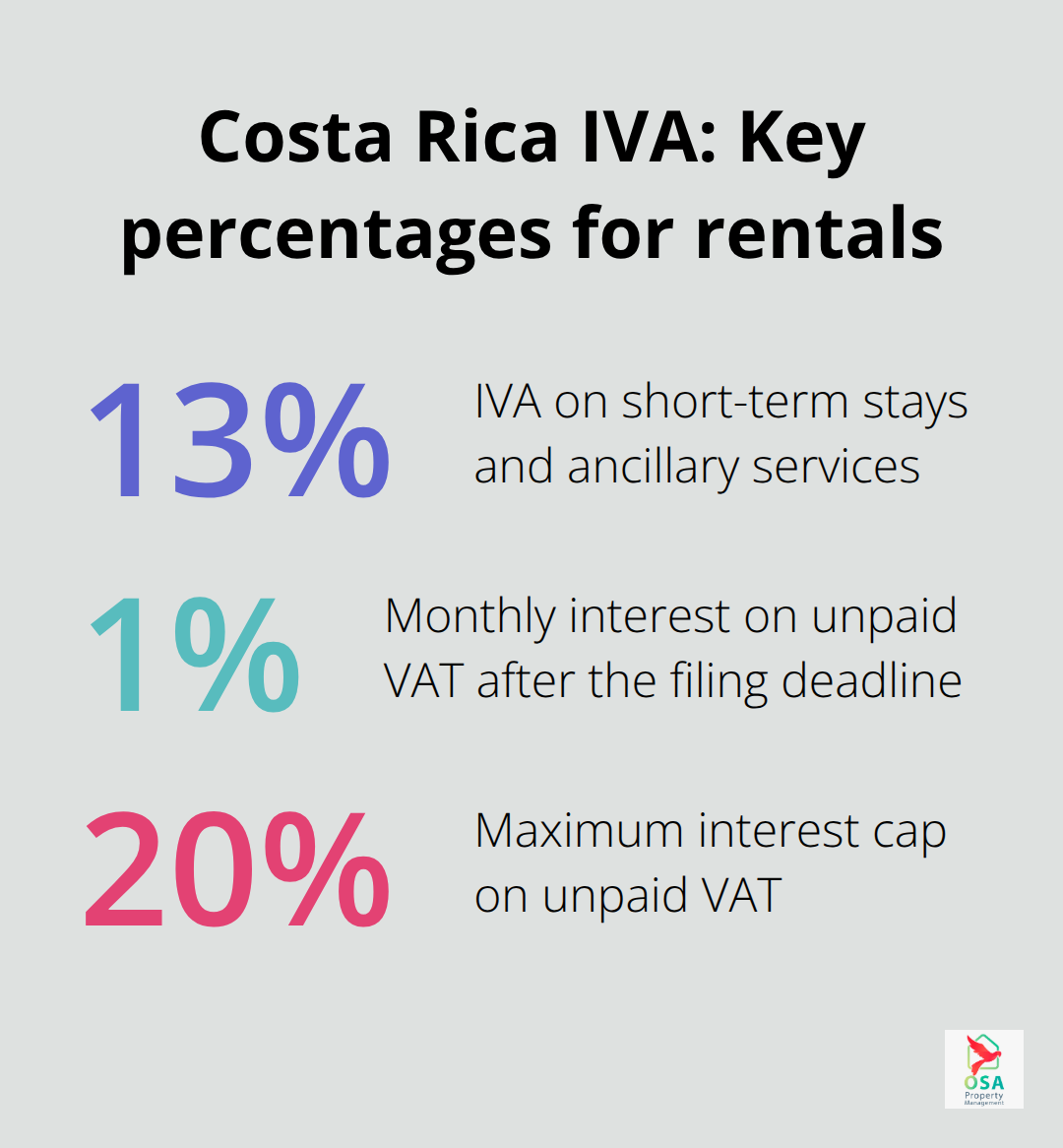
IVA, or Impuesto al Valor Agregado, is Costa Rica's 13% sales tax that applies to short-term rentals under 30 days. This matters because the tax doesn't belong to you-it's money you collect from guests and remit to the Ministerio de Hacienda monthly. Many landlords treat IVA as income, which is the first mistake. If you rent a property for $1,000 per night, guests pay $1,130 total. That extra $130 goes to the government, not your pocket. The distinction changes how you manage cash flow, pricing, and accounting.
Registration Triggers Everything Else
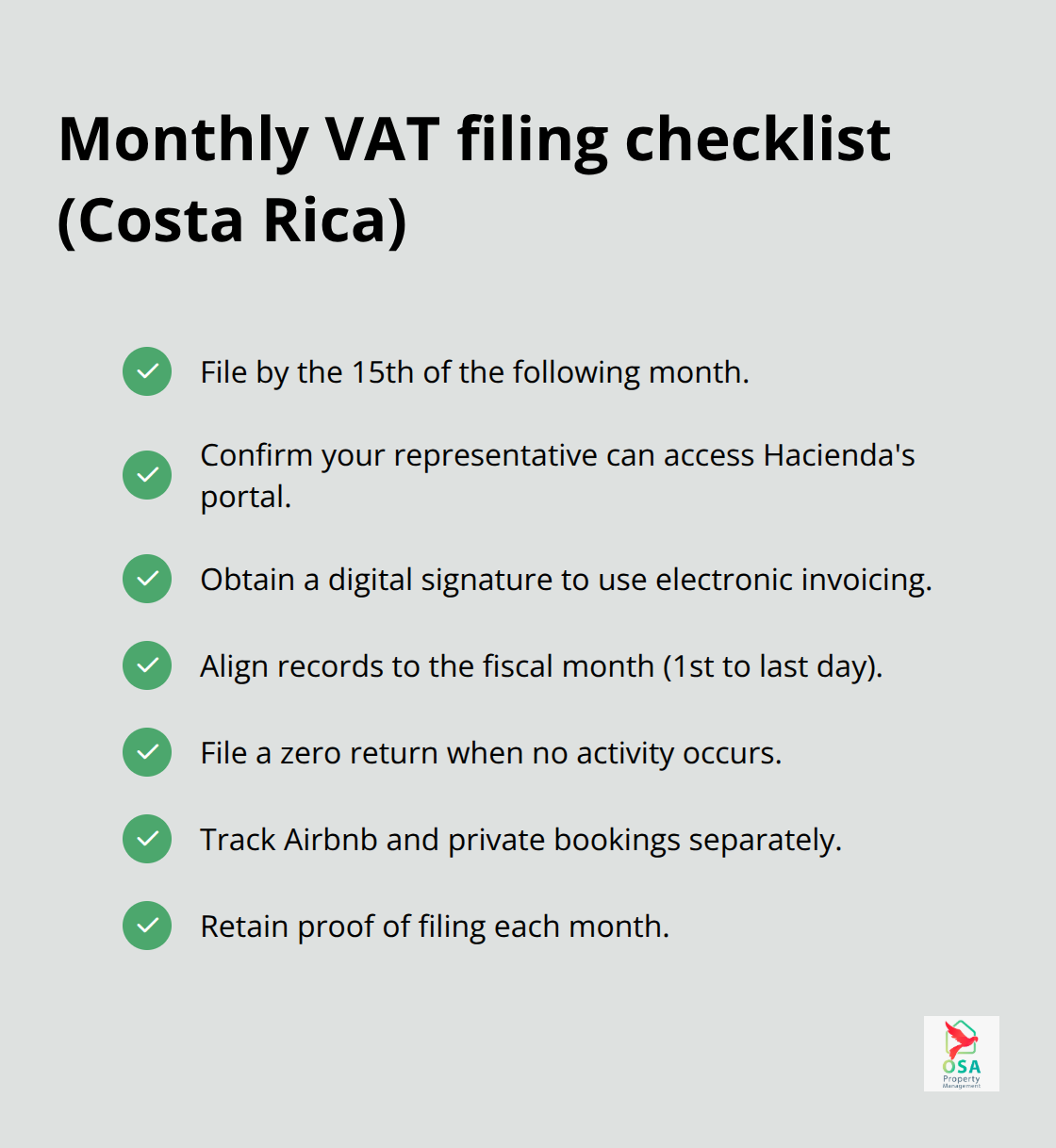
You cannot charge guests or file IVA returns without registering first. Non-residents must obtain a NITE tax identification number from the Ministerio de Hacienda and appoint a local representative to handle filings. This step is non-negotiable-operating without it exposes you to fines starting at 215,500 colones per month, escalating to 1,293,000 colones for sustained non-compliance. Residents can register directly online, but the process still requires enrollment in the mandatory electronic invoicing system called factura electrónica. Once registered, you must file monthly VAT returns by the 15th of the following month; missing this deadline costs 1% monthly interest on unpaid amounts, capped at 20%. The Costa Rican tax system cross-references Airbnb reports with your filings, so accuracy matters immediately.
Separate VAT From Your Income
The practical reality is straightforward: set up a dedicated rental account and reserve the 13% VAT immediately after each booking. If you comingle VAT with operating revenue, you'll face a cash shortage when remittance is due on the 15th. Many landlords raise advertised rates by a full 13% instead of absorbing 3-5% of the increase themselves, making their properties less competitive. A better approach is to raise base rates by 8-10% and absorb the remaining tax impact, then enhance your value proposition through free airport transfers, welcome packages, or local experiences to justify the higher price. Track each rental, its length, and whether ancillary services apply-this determines which VAT rate and filing category applies. Electronic invoicing through Hacienda's portal is mandatory for private bookings, while Airbnb generates invoices automatically but you still must declare the income and file monthly returns showing what you received. Maintain records for at least four years; the tax authority audits tourist-area properties like those in Manuel Antonio or Uvita more frequently than others.
What Comes Next in Your Compliance Journey
Registration and account separation form the foundation, but the real complexity emerges when you file your first monthly return and discover which expenses qualify for deduction. The next section covers the specific obligations that landlords face after registration-the filing deadlines, documentation standards, and how to structure your records so the tax authority finds no issues during an audit.
IVA Obligations After Registration
Filing Requirements and Deadlines
Once you register with the Ministerio de Hacienda, monthly VAT returns become mandatory. Non-residents who appointed a local representative must verify that person obtained their own tax identification number and can access Hacienda's online portal on your behalf-this step is non-negotiable. Residents can file directly but still need a digital signature from a Costa Rican bank to access the electronic invoicing system. The Ministerio de Hacienda requires you to file monthly VAT returns by the 15th of the following month, meaning your January receipts are due by February 15th. Missing this deadline triggers 1% monthly interest on unpaid VAT amounts, capped at 20%, plus potential penalties up to 50% of the minimum monthly wage. The fiscal month runs from the 1st to the last day of the calendar month, not by property booking dates. File a zero return even in months with no rental activity-this prevents the tax authority from flagging your account as inactive or non-compliant.
Invoice Generation and Documentation
Airbnb properties simplify invoicing because the platform automatically generates electronic invoices and reports gross rental income to Hacienda, but you still must declare that income in your monthly filing and show what VAT was collected. Private bookings require you to manually issue electronic invoices through Hacienda's portal before guests arrive or immediately after checkout. Every invoice must clearly show the 13% IVA as a separate line item, the guest's information, rental dates, and whether ancillary services were included. Keep receipts for every expense related to your rental-property maintenance, management fees, insurance, utilities, mortgage interest, property taxes, and since 2025, energy-efficient upgrades like solar panels or efficient appliances. The tax authority cross-references Airbnb data with your filings, so discrepancies between platform reports and your declared income raise red flags immediately.
Record-Keeping and Accounting Systems
Maintain records for at least four years because audits in tourist areas like Manuel Antonio, Uvita, and Ojochal happen more frequently than elsewhere. Use cloud accounting software such as QuickBooks Online or Xero to track income and expenses in real time-this eliminates manual errors and generates VAT-ready reports automatically. Separate ancillary-service revenue from base rental income on your invoices and accounting records; this simplifies monthly filings and reduces audit complexity. If you operate multiple properties, maintain separate bank accounts per property and track each one independently. Deductible expenses reduce your taxable rental income, but only if properly documented with electronic invoices from service providers. For example, if you pay a contractor 10,000 colones for repairs, request an invoice showing the 13% IVA separately-that VAT becomes a deduction on your monthly return. Photograph and archive receipts digitally; real-time tracking ensures you claim all eligible deductions and dramatically reduces audit risk.
Professional Support for Tax Compliance
Hiring a local Costa Rican accountant or tax attorney typically costs between $300 and $600 annually but pays for itself through identified deductions and ensures your filings meet current regulations. Tax rules evolve annually, and professionals stay current with those changes. They handle monthly VAT returns, coordinate with Hacienda on your behalf, and flag potential audit risks before they become problems. This investment becomes especially valuable if you operate properties in multiple cantons or manage ancillary services alongside base rental income. The complexity of tracking separate VAT rates, maintaining compliant invoices, and filing on schedule makes professional guidance a practical necessity rather than an optional expense. Your next step involves understanding which expenses actually qualify for deduction and how to structure your accounting to maximize legitimate tax benefits while maintaining the documentation standards that auditors expect.
Where Landlords Go Wrong With IVA
Misclassifying Rental Length and Services
The most damaging mistake occurs when landlords treat short-term and long-term rentals identically for tax purposes. If you rent a unit for 25 days, IVA applies to the entire stay. If the same guest stays 31 days, IVA does not apply.
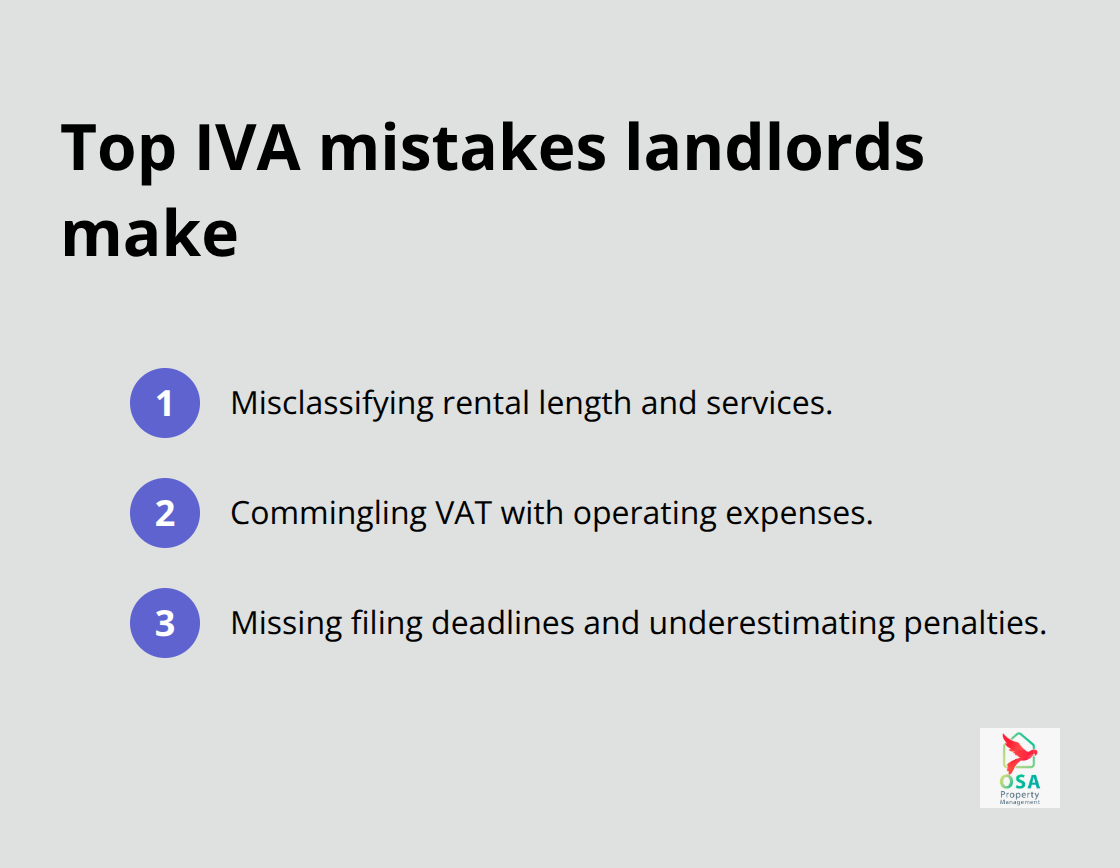
Your rental agreement and Airbnb listing must clearly state the actual booking length. If you offer flexible check-in or allow guests to extend stays verbally without updating your records, you create ambiguity that auditors exploit. Additionally, ancillary services complicate classification. A private chef experience on a long-term rental remains subject to 13% IVA, even though the base rent isn't. Many landlords invoice the chef service and base rent together on a single line item, making it impossible to separate VAT rates during an audit. The tax authority then assumes the worst and applies the 13% rate to your entire rental income for that month. Separate your invoices by service type and rental length every single time.
Commingling VAT With Operating Expenses
The second critical error involves mixing VAT with operating expenses and income in ways that destroy your audit trail. When you receive $1,130 for a $1,000 rental, $130 belongs to Hacienda. If you deposit that full amount into an account where you also pay property maintenance, utilities, and management fees, your monthly reconciliation becomes chaotic. One landlord received $50,000 in gross rental income over three months but paid $8,000 in property expenses from the same account. When the auditor asked which portion of the $50,000 was VAT and which was taxable income, the landlord couldn't provide a clear answer. The result was a reassessment that assumed 13% of the entire amount was VAT, leaving only $43,500 as income, yet the landlord had already remitted VAT based on actual bookings. The mismatch triggered penalties for underpayment.
Cloud accounting software like QuickBooks Online or Xero forces you to categorize every transaction at the point of entry, making this mistake nearly impossible if you use the system correctly. Set up separate accounts: one for rental income (where you immediately reserve VAT), one for operating expenses, and one for personal use. This structure takes 30 minutes to establish and eliminates 90% of audit complications.
Missing Filing Deadlines and Penalties
Missing monthly filing deadlines carries real financial consequences that many landlords underestimate. The Ministerio de Hacienda requires VAT returns by the 15th of the following month. A landlord with $20,000 in rental income during January must file and remit VAT by February 15th. Missing that deadline triggers 1% monthly interest on the unpaid amount, capped at 20%, plus potential penalties up to 50% of the minimum monthly wage (currently 450,200 colones annually or roughly $790 per month). For a landlord owing $2,600 in VAT for that month, the interest alone reaches $26 immediately, then compounds.
Properties in tourist areas like Manuel Antonio, Uvita, and Ojochal face higher audit frequency because tax authorities prioritize high-volume rental zones. If your filing is late or missing, you appear on their watch list. Non-residents who appointed a local representative must verify that person actually filed on time-don't assume. Request proof of filing from your representative within two business days of the deadline. If your representative missed the deadline, you remain liable for penalties, so choose your representative carefully. We recommend working with a local accountant who specializes in short-term rentals rather than appointing a generic representative. The cost difference is minimal, typically $300 to $600 annually, but the accountability is incomparably higher.
Final Thoughts
Costa Rica IVA guidelines demand consistent attention, but the core responsibilities remain straightforward: register before collecting rent, file monthly returns by the 15th, separate VAT from income, and maintain detailed records for four years. These four actions eliminate most audit risk and compliance problems. The mistakes outlined earlier-misclassifying rental length, commingling VAT with expenses, and missing deadlines-are entirely preventable through disciplined accounting and clear documentation.
Staying compliant means treating VAT as a liability you hold temporarily, not as revenue. Set up a dedicated rental account, reserve 13% immediately after each booking, and use cloud accounting software to categorize transactions automatically. Separate ancillary services from base rental income on every invoice, file even when you have zero rental activity that month, and verify that your local representative actually filed on time if you operate as a non-resident. A local accountant or tax attorney costs $300 to $600 annually and handles monthly filings, identifies deductions you'd miss, and flags audit risks before they materialize.
We at Osa Property Management manage these obligations for our clients across Tarcoles, Jaco, Dominical, Manuel Antonio, Ojochal, Uvita, and Golfito. Our team handles VAT filings, accounting, tax compliance, and bill payment so you focus on guest experience and property performance. If managing Costa Rica IVA guidelines feels overwhelming, professional property management removes that burden entirely while maximizing your rental income through compliant operations.
To be contacted by an Osa Property Management representative and to learn more about our services, please send an email to info@osapropertymanagement.com or send a WhatsApp message to +17633068981 or +50671001006 / Para que un representante de Osa Property Management se ponga en contacto con usted y obtener más información sobre nuestros servicios, por favor envíe un correo electrónico a info@osapropertymanagement.com o un mensaje de WhatsApp al +17633068981 o al +50671001006.
Vacation rentals: https://costaricalasvillas.com