

Costa Rica’s rental VAT system confuses most property owners. The tax rules are strict, the deadlines are real, and mistakes cost money.
We at Osa Property Management help owners navigate this landscape every day. This guide breaks down your Costa Rica rental VAT obligations so you can stay compliant and keep more of your income.
When VAT Applies to Your Rental and When It Doesn’t
VAT in Costa Rica follows one clear rule: short-term rentals pay it, long-term rentals don’t. If guests stay fewer than 30 days, you collect 13% VAT from them and remit it monthly to the tax authority. If tenants sign leases longer than 30 days, VAT does not apply-instead, you report rental income under the progressive income tax system. This distinction shapes your pricing, compliance, and cash flow. Many owners treat both rental types identically, which leads to underpayment, penalties, and audits.
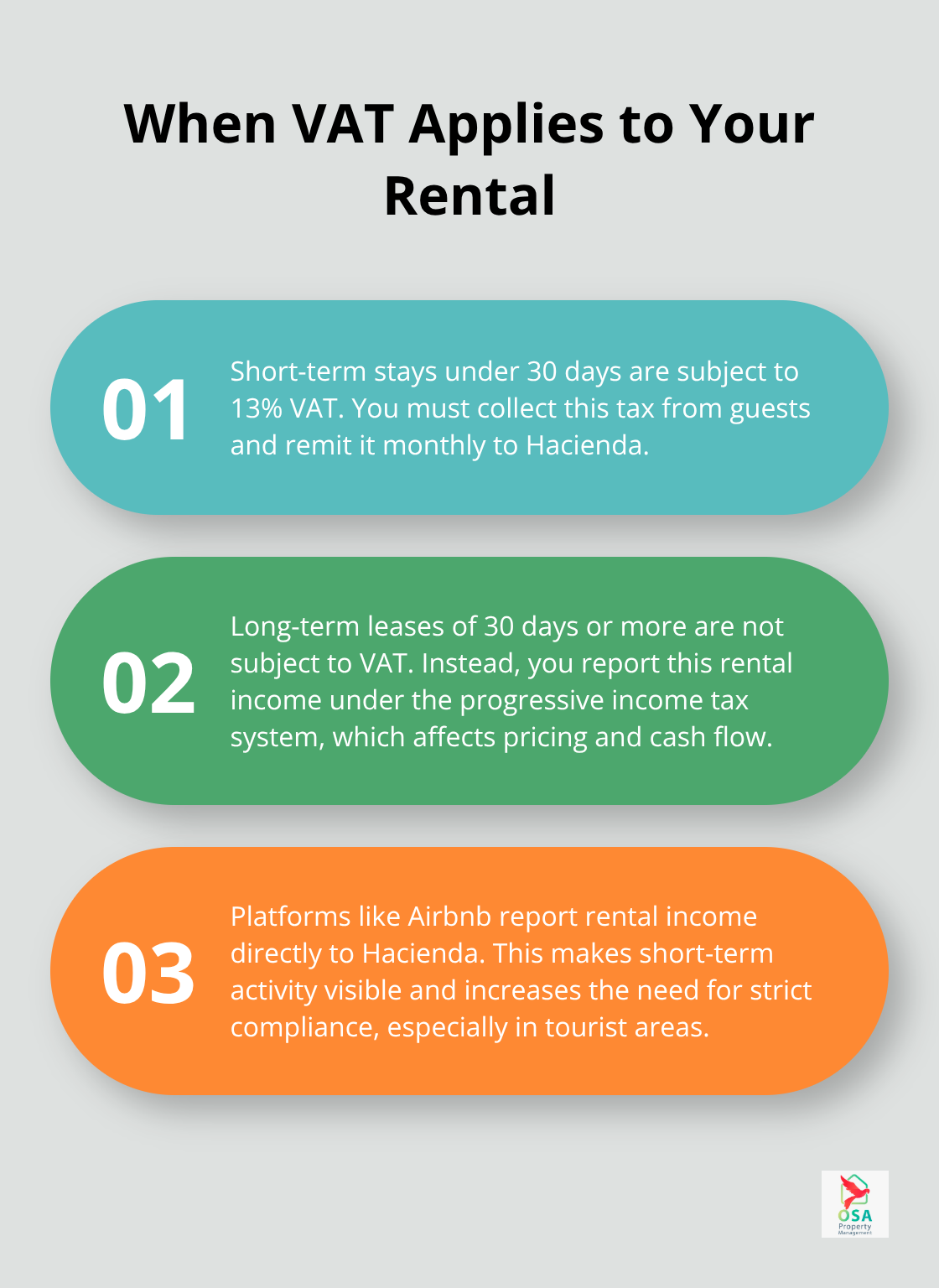
Vacation rental platforms like Airbnb report rental income directly to tax authorities, so short-term activity cannot remain hidden. If you operate a short-term rental in tourist areas like Manuel Antonio, Jaco, or Uvita, VAT compliance becomes non-negotiable.
Who Must Register for VAT
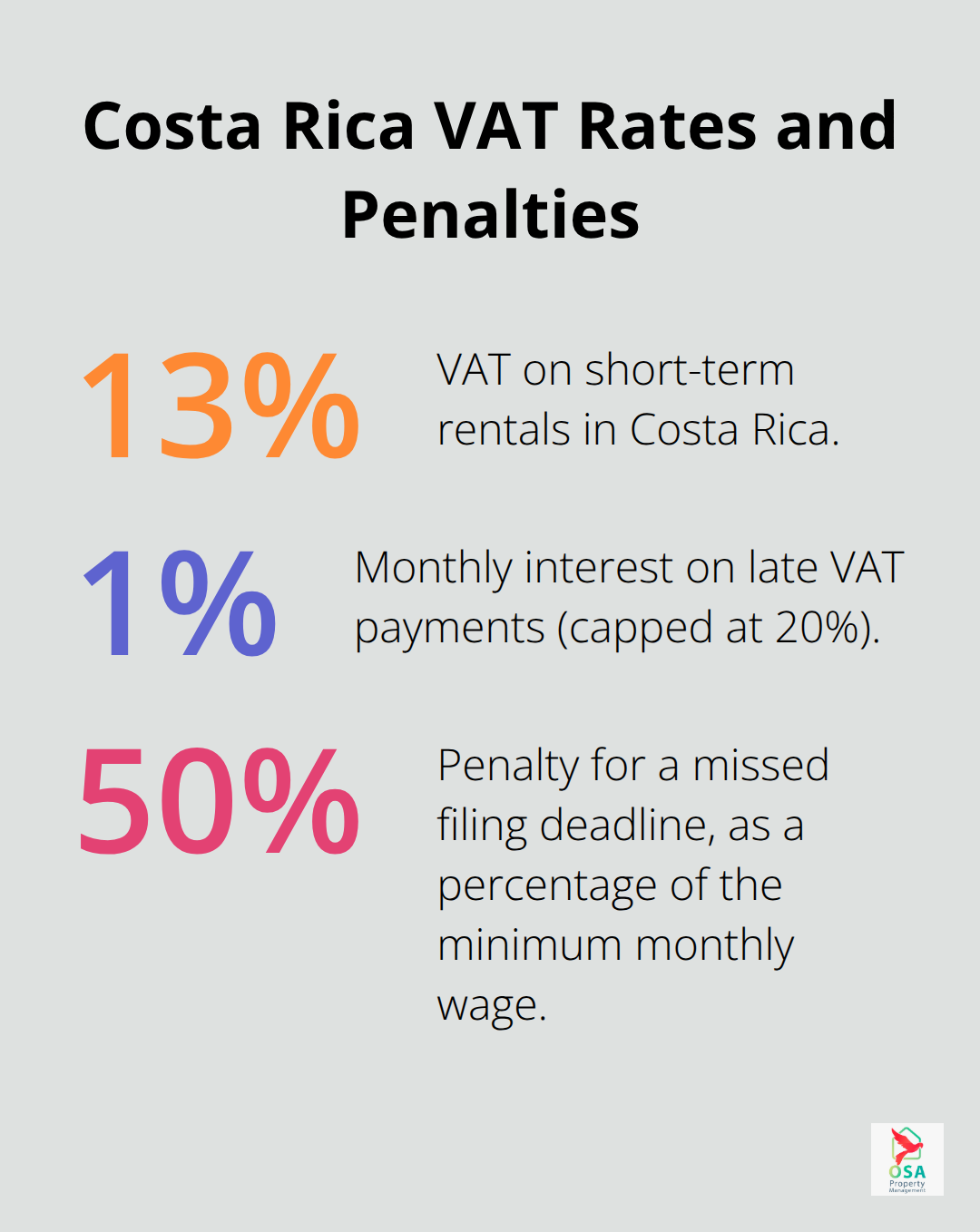
You must register for VAT with Hacienda if you collect rent from guests staying under 30 days. Registration happens electronically and provides you with a tax identification number (RUT). Once registered, you file monthly VAT returns by the 15th of the following month-missing this deadline costs you up to 50% of the minimum monthly wage in penalties. Late VAT payments trigger an additional 1% monthly charge, capped at 20%.
Property owners who rent long-term only do not need to register for VAT but must still file income tax declarations. Non-resident owners must appoint a local representative (NIT) to handle tax matters on their behalf. The electronic invoicing system (factura electrónica) is mandatory for every reservation-platforms like Airbnb generate these automatically, but private bookings require you to issue them through Hacienda’s system with a digital signature from a Costa Rican bank.
How Much VAT You Actually Collect
A guest books your property for $1,000. You collect $1,130 total-the extra $130 is the 13% VAT you owe Hacienda. That $130 is not your income; it belongs to the government. Many owners spend this money accidentally and face penalties when remittance comes due. The correct approach separates VAT immediately when payment arrives. Set up a dedicated bank account for rental income and mark VAT funds as reserved. Your pricing strategy matters here: if you advertise $1,000 nightly, guests see $1,130 at checkout because VAT is included in the displayed price per Costa Rican law. If you advertise $1,130 nightly, you overstate your rate and lose bookings to competitors. Ancillary services like private chefs, tour bookings, or spa treatments are also subject to 13% VAT and require separate invoicing with proper documentation. Track every service carefully-mixing service revenue with base rental income on invoices creates audit flags and compliance headaches.
Pricing Strategy and VAT Transparency
Your guests expect transparency about what they pay. Costa Rican law requires that you include VAT in your advertised nightly rate, not add it at checkout. This means a $1,000 property actually generates $885 in net rental income after VAT is removed (the 13% VAT on $1,000 equals $130, leaving $870 in base income plus $15 in VAT collected on the VAT itself). Platforms like Airbnb handle this calculation automatically, but private bookings demand that you price correctly from the start. Ancillary services complicate pricing further-a private chef service priced at $200 becomes $226 with VAT included. Invoice each service separately to avoid mixing taxable and non-taxable revenue streams. This separation protects you during audits and simplifies your monthly VAT filings.
Next Steps: Registration and Documentation
Registering for VAT opens the door to monthly compliance obligations that demand attention. The electronic invoicing requirement and monthly filing deadlines create a system where documentation becomes your proof of compliance. Understanding what records you must keep and how to organize them determines whether tax season brings confidence or stress.
What You Must Do to Stay VAT Compliant
Register for VAT Before Your First Guest Arrives
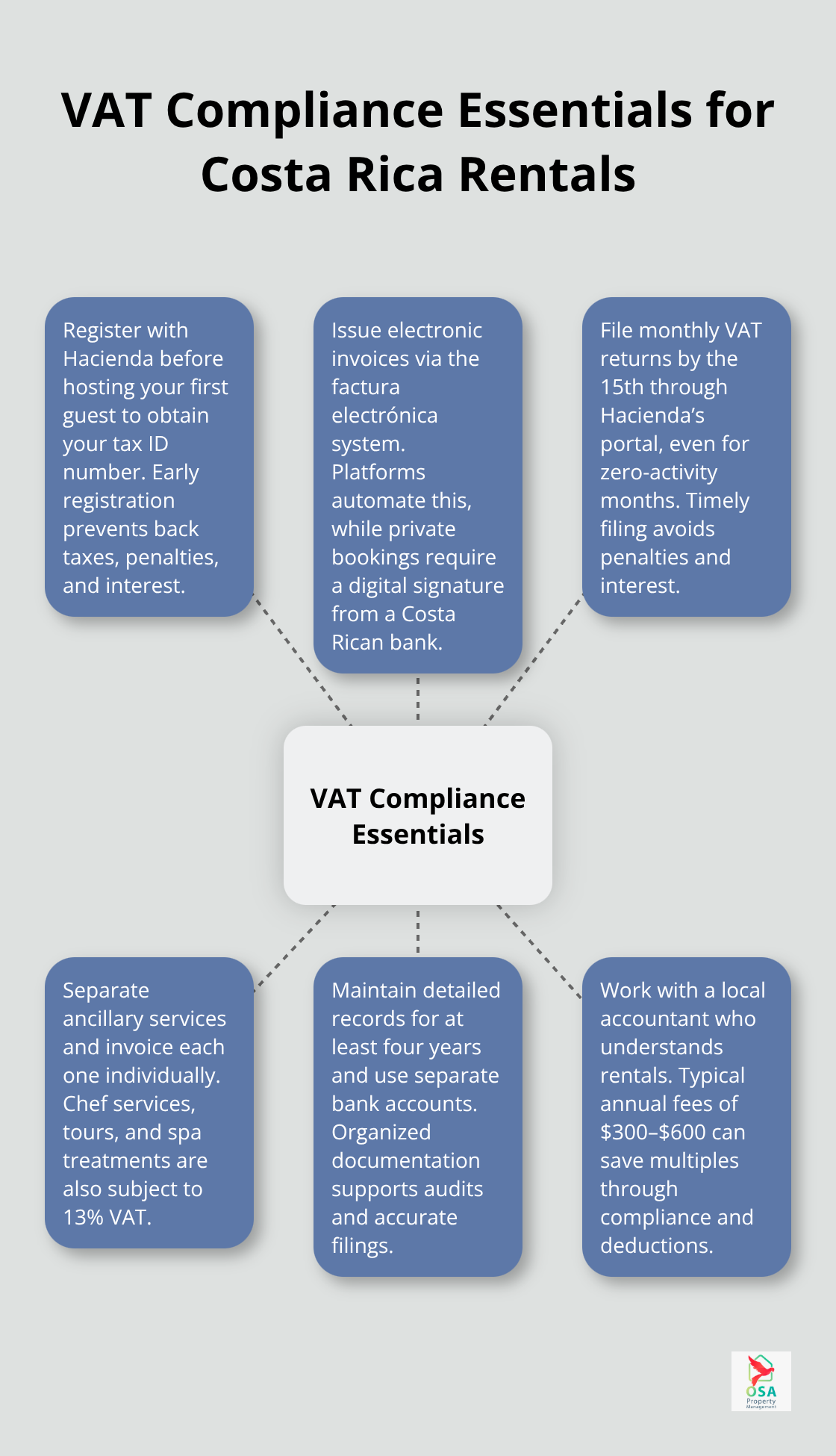
Register for VAT with Hacienda happens entirely online through the tax authority’s digital system. You receive a tax identification number (NITE) once approved, which you’ll use on every invoice and filing for the rest of your ownership. The registration process takes days, not weeks, but many owners delay it until after they’ve already collected rent illegally. That mistake triggers back taxes, penalties, and interest charges that compound monthly. Non-resident owners cannot register directly; you must appoint a local representative with power of attorney to complete registration on your behalf. The timeline is predictable when you act before your first guest arrives.
Issue Electronic Invoices for Every Reservation
Electronic invoicing through the factura electrónica system becomes mandatory the moment you register. Platforms like Airbnb generate invoices automatically and report your income directly to Hacienda, so the system already tracks you. Private bookings require you to issue invoices manually through Hacienda’s portal using a digital signature from a Costa Rican bank. If obtaining a digital signature creates friction, you can grant power of attorney to a local professional to issue invoices on your behalf. This service costs roughly $50 to $150 per month, a worthwhile expense compared to audit penalties.
Organize Records That Survive Audits
Maintain detailed records of every reservation confirmation, payment receipt, and invoice for at least four years. The Costa Rican tax authority cross-references platform reports from Airbnb with your filed returns, so discrepancies trigger immediate investigation. Separate your rental bank account from personal finances; mixing funds creates audit flags and complicates expense deduction claims. Use cloud-based accounting software like QuickBooks Online or Xero to track income and expenses in real time, generating monthly reports that align with your VAT filings. Track ancillary services separately from base rental income because they require individual VAT invoices and different reporting treatment.
File Monthly Returns by the 15th
File monthly VAT returns by the 15th of the following month through Hacienda’s virtual portal. A single missed deadline costs you up to 50% of the minimum monthly wage in penalties, roughly $395 USD based on the 2026 minimum wage. Late VAT payments add 1% monthly interest capped at 20%, so a $1,000 VAT payment due in February but paid in April costs you an extra $20 in interest alone. Submit declarations even during months with zero rental activity; submitting a blank return keeps you compliant and prevents penalty accumulation. The fiscal month runs from the 1st to the last day of the calendar month, and your remittance window is narrow. Set calendar reminders for the 10th of each month to prepare your filings and avoid last-minute scrambling. If your Spanish is limited, hire a local accountant to file returns for you; costs typically range from $30 to $75 per monthly filing, far less than the penalties for noncompliance.
Separate Ancillary Services from Base Rental Income
Ancillary services like private chefs, tour bookings, or spa treatments are also subject to 13% VAT and require separate invoicing with proper documentation. Track every service carefully-mixing service revenue with base rental income on invoices creates audit flags and compliance headaches. Invoice each service separately to avoid mixing taxable and non-taxable revenue streams. This separation protects you during audits and simplifies your monthly VAT filings.
Proper documentation and timely filings form the foundation of VAT compliance, but they also reveal opportunities to reduce your overall tax burden. Understanding which expenses you can deduct and how to structure your rental business determines whether you pay more tax than necessary.
Reduce Your Tax Burden Without Breaking the Rules
Deductible expenses are where most property owners leave money on the table. The Costa Rican tax code allows you to subtract legitimate rental-related costs from your gross income before calculating your tax bill, yet many owners either forget to claim them or misunderstand what qualifies. Property maintenance and repairs reduce your taxable income, meaning a roof repair that you properly document saves you taxes depending on your income bracket. Property management fees, insurance premiums, utilities you pay on behalf of tenants, mortgage interest (not principal), property taxes, and advertising costs all qualify. Starting in 2025, energy-efficient upgrades like solar panel installations and water-saving systems became deductible, a change that rewards owners who invest in long-term operational savings. Depreciation also works in your favor: residential rental properties depreciate over 50 years and commercial properties over 40 years, allowing you to deduct a portion of the building value annually even though the property may be appreciating. Keep separate receipts and electronic invoices for every expense, organized by category. A plumbing repair without documentation is worthless at tax time, but the same repair with an electronic invoice becomes proof that reduces your tax obligation.
Track Everything in Real Time, Not at Tax Time
Waiting until December to organize nine months of receipts guarantees missed deductions and filing errors. Cloud-based accounting software like QuickBooks Online or Xero eliminates this problem entirely. These platforms integrate with your bank account, automatically categorizing income and expenses, then generate tax reports that align with Hacienda’s filing requirements. When you photograph receipts and log expenses weekly, your monthly VAT filing takes 20 minutes instead of three hours. The software also flags duplicate entries and suspicious transactions, protecting you from accidental misreporting that triggers audits. Maintain separate bank accounts for rental activity and personal spending; mixing funds creates the false appearance of unreported income and gives tax auditors reason to dig deeper. If you operate multiple properties, create separate accounts for each one. Your accountant will thank you, and your tax liability will reflect your actual deductible expenses rather than an inflated estimate based on incomplete records.
Work with Accountants Who Know Costa Rica’s Rental Market
Hiring a local Costa Rican accountant or tax attorney costs $300 to $600 annually but saves you far more through legitimate deductions and compliance strategies you would otherwise miss. A competent professional knows which expenses qualify in your specific municipality, understands the difference between short-term and long-term rental tax treatment, and catches changes in tax law before they affect you. They also manage the monthly VAT filings, quarterly income tax payments due February 20, May 20, August 20, and November 20, and the annual return due December 15, eliminating deadline stress. Non-resident owners especially benefit from this guidance because foreign ownership introduces complications around tax treaty eligibility and double taxation that require specialized knowledge. The cost of a mistake-penalties reaching 50% of unpaid taxes plus monthly interest-far exceeds professional fees. Interview accountants about their experience with vacation rental properties specifically, not just general business accounting. Ask whether they use digital invoicing systems and cloud-based filing. Request references from other property owners in your area. A quality accountant becomes a strategic partner who identifies tax-reduction opportunities you never considered.
Final Thoughts
Costa Rica rental VAT compliance requires three core actions: register before your first guest arrives, file monthly returns by the 15th, and track every expense with electronic invoices. The 13% VAT you collect belongs to Hacienda, not your business account, so you must separate these funds immediately to avoid cash-flow crises when remittance comes due. Deductible expenses like maintenance, property management fees, insurance, and energy-efficient upgrades reduce your taxable income significantly, yet most owners claim only a fraction of what qualifies.
Set up a dedicated rental bank account, choose cloud-based accounting software, and schedule monthly filing reminders on your calendar to prepare your property for tax season. Photograph every receipt, organize expenses by category, and maintain separate documentation for ancillary services so you capture all legitimate deductions. Non-resident owners should appoint a local representative immediately to handle registration and ongoing filings, while owners in tourist areas like Manuel Antonio, Jaco, or Uvita face higher audit rates and must prioritize compliance even more carefully.
A local accountant familiar with Costa Rica rental properties costs $300 to $600 annually but identifies deductions and compliance strategies that save multiples of that investment. We at Osa Property Management handle Costa Rica rental VAT filings, accounting, and tax compliance for property owners across Tarcoles, Jaco, Dominical, Manuel Antonio, Ojochal, Uvita, and Golfito. Contact Osa Property Management to discuss how professional management simplifies your rental VAT obligations and maximizes your deductible expenses.