

Owning property in Costa Rica comes with unique challenges that many landlords underestimate. Finding the right Costa Rica property manager can mean the difference between steady rental income and constant headaches.
We at Osa Property Management know that selecting a partner to handle your investment requires careful evaluation. This guide walks you through what matters most when making that decision.
What to Look for in a Costa Rica Property Manager
Experience in Your Specific Region Matters Most
Regional expertise outweighs general Costa Rica knowledge every time. A manager who understands Uvita’s seasonal tourism patterns, Manuel Antonio’s competing vacation rental market, or Jaco’s expat tenant preferences will optimize your income in ways a generalist cannot. Ask potential managers how many properties they manage, which platforms they use, and what their average occupancy rates are across their portfolio. Verify their track record by requesting three client references from properties comparable to yours and asking those clients about year-over-year income growth and occupancy consistency. Casago brings over 20 years of vacation rental experience in the region, while Osa Property Management operates across multiple communities from Tarcoles to Golfito with over 20 years of market expertise and a team of over 40 full-time employees.
Services Should Match Your Goals, Not Their Template
Too many property managers force owners into rigid packages when your needs may differ entirely. A vacation rental in Manuel Antonio requires aggressive marketing and frequent guest turnover management, which typically costs 20-30% of rental income. A long-term residential lease in Ojochal needs solid tenant screening and maintenance coordination but far less marketing spend. Request a detailed breakdown of what each service costs separately, then build a custom package. Ask specifically about their approach to dynamic pricing strategies for vacation rentals, tenant screening depth, maintenance vendor relationships, and financial reporting frequency. A manager should explain how they adjust strategies between high season and low season rather than applying one standard approach year-round.
Team Size and Response Speed Define Real Availability
A manager running 200 properties with three staff members cannot provide the attention your investment deserves. Costa Rican law requires urgent repairs within ten business days, and slow response times create tenant disputes and damage that costs far more than quick fixes. Ask how many properties each staff member manages and whether they have dedicated team members for maintenance coordination, guest communication, and accounting. Request their after-hours emergency protocol and typical response time for urgent issues. A company with 40 or more full-time employees across their markets (like Osa Property Management) can handle emergencies properly and maintain consistent service quality across multiple regions. This staffing level separates managers who truly support your property from those who simply collect fees.
Red Flags That Signal the Wrong Manager for Your Property
Hidden Fees Destroy Your Actual Profitability
Hidden fees eliminate profitability faster than any market downturn. A manager who quotes 8% of monthly rent but then charges separately for tenant placement, lease renewals, maintenance markups, and vacancy fees deliberately obscures the true cost of their service. Request an itemized breakdown of every possible charge before signing anything, then ask for a sample monthly statement from an existing client to see exactly what gets deducted. You need to know your actual net income, not a misleading headline rate.
A quality manager provides monthly financial statements within five business days of month-end, includes detailed expense documentation with vendor invoices attached, and offers real-time access to a portal showing rent collected, expenses paid, and your balance. If a manager resists providing this level of detail or claims their system cannot track expenses that precisely, walk away. Costa Rican law requires landlords to file accurate income tax returns, and you cannot accomplish that without clear accounting.
Slow Communication Creates Expensive Legal Problems
Slow communication and vague response protocols create expensive problems. A manager who takes three days to respond to a maintenance emergency violates Costa Rican law, which requires urgent repairs within ten business days. Ask potential managers for their specific response time commitment for urgent issues, their after-hours emergency contact protocol, and examples of recent emergencies they handled. If they hesitate, give vague references, or push back on direct contact, assume they lack a real system.
Poor communication also shows up in rental disputes, tenant complaints, and missed rent collection. A quality manager communicates in your preferred language (English or Spanish), responds to non-emergency inquiries within 24 hours, provides monthly performance updates without you having to ask, and proactively notifies you of problems before they escalate. Request three client references and specifically ask those clients whether they chased the manager for updates or whether the manager kept them informed consistently.
Inadequate Insurance Leaves You Exposed to Liability
Limited insurance coverage and unclear liability protection leave you exposed if a guest gets injured on the property, a contractor damages something during repairs, or a tenant claims negligence. Verify that your manager carries general liability insurance, that they have workers’ compensation for their staff, and that their contract clearly defines who pays if something goes wrong. Ask to see proof of current insurance certificates before you sign anything, not after.
A manager operating with minimal insurance coverage signals they cut corners elsewhere too. This protection matters because Costa Rican courts hold property owners responsible for injuries and damages that occur on their premises, even when a manager coordinates the work. The right partner carries adequate coverage and names you as an additional insured on their policy. This single requirement separates managers who take your investment seriously from those who operate on a shoestring budget and hope nothing goes wrong.
These red flags reveal whether a manager prioritizes your financial success or simply collects fees. The next section shows how professional property management actually protects your investment through proper tenant screening, maintenance oversight, and tax compliance.
How Professional Management Protects Your Investment
Tenant Screening Eliminates Costly Mistakes
Proper tenant screening eliminates the costly mistakes that destroy profitability. A quality manager runs background checks, verifies employment, contacts previous landlords, and confirms credit history before any tenant moves in. Costa Rican law mandates minimum three-year leases for long-term rentals, which means a bad tenant decision locks you into years of problems. Ask potential managers specifically how they screen tenants: do they verify employment with recent pay stubs, contact at least two previous landlords, run criminal background checks, and require a credit report? Managers who skip these steps or claim they screen informally are gambling with your income. Request data on their tenant retention rates and how many evictions they handle annually. A manager with low eviction rates and high retention proves their screening actually works.
Maintenance Oversight Prevents Expensive Disasters
Maintenance oversight prevents small problems from becoming expensive disasters. Your manager should conduct routine inspections at minimum quarterly, coordinate with vetted local contractors, and handle repairs proactively rather than reactively. Costa Rican law requires landlords to complete urgent repairs within ten business days, but preventive maintenance eliminates most urgent situations altogether. Ask managers to explain their maintenance vendor relationships: do they have preferred contractors with established pricing, or do they call around each time something breaks? Request their typical repair turnaround time and whether they obtain multiple quotes for expensive work. A manager coordinating maintenance properly reduces emergency callouts by 40 percent according to property management software data, directly protecting your rental income by keeping the property occupied and in rentable condition.
Tax Compliance and Financial Transparency
Tax compliance and transparent accounting separate professional managers from amateurs operating without systems. Costa Rica taxes rental income progressively with rates rising to 25 percent above 3.8 million colones annually. Your manager must file accurate municipality sales tax returns, calculate your corporate income tax obligations correctly, and provide year-end documentation for your accountant. Ask potential managers for a sample year-end tax summary showing rental income, documented expenses, and the format they use for reporting. Request monthly statements within five business days of month-end, with real-time portal access showing rent collected, expenses categorized, and your net balance.
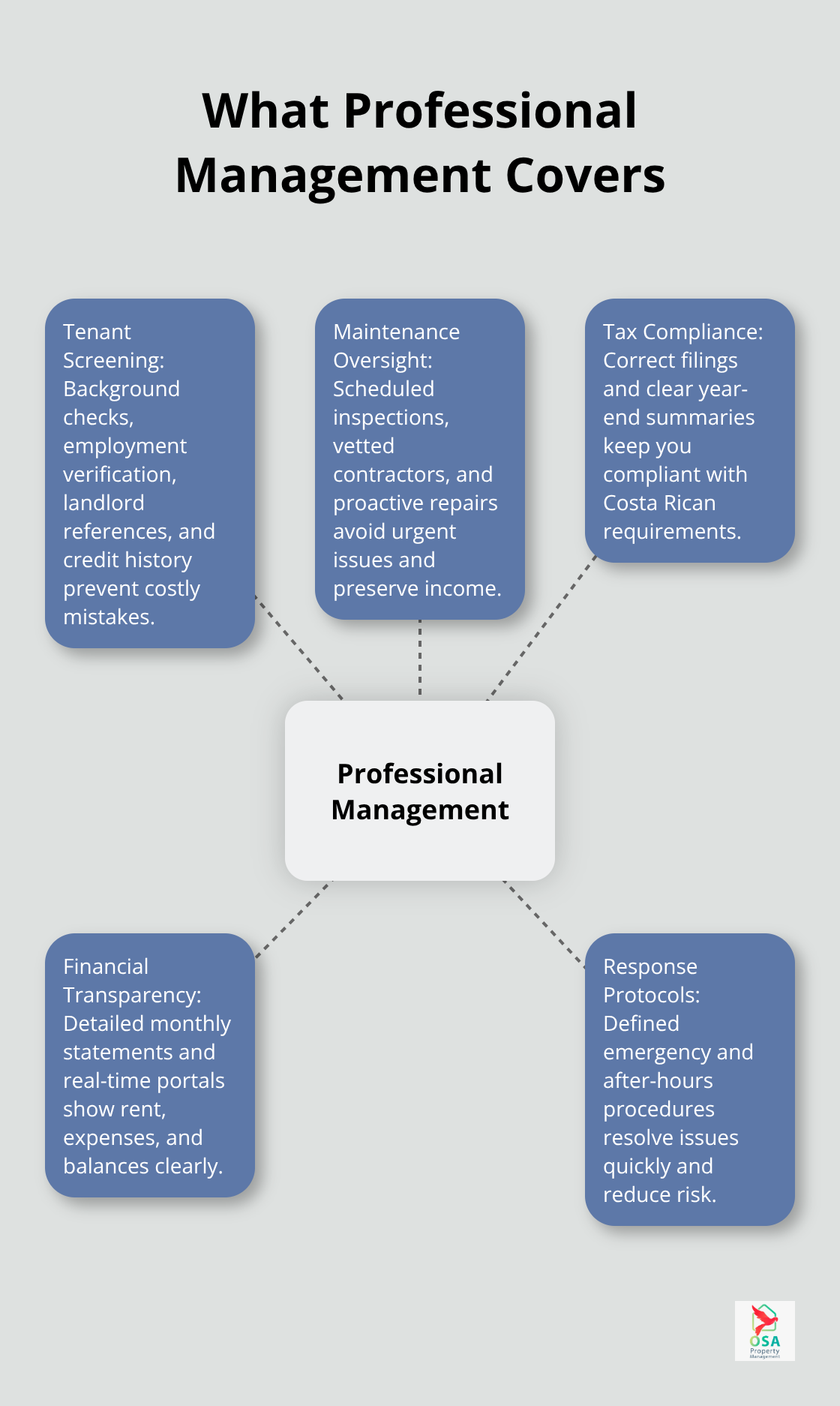
A manager resisting this level of financial transparency either lacks proper systems or deliberately obscures their true fees. Professional management handles accounting, tax compliance, and bill payment as core services because property owners need accurate financial information to make investment decisions. Demand that your manager explains exactly how they calculate what you owe each month and provides documentation proving expenses are legitimate business costs rather than inflated markups.
Final Thoughts
The best Costa Rica property managers operate with complete financial transparency, respond to emergencies within hours rather than days, and understand their specific region deeply enough to optimize your income year-round. They adjust strategies between high season and low season instead of applying generic approaches that fail to account for local market dynamics. This combination of transparency, responsiveness, and regional expertise separates managers who truly protect your investment from those who simply collect fees.
Local expertise matters more than you might think. A manager who knows Uvita’s tourism patterns, Manuel Antonio’s competitive landscape, or Jaco’s expat preferences will price your property correctly, market it effectively, and attract quality tenants or guests. They understand Costa Rican rental law, tax requirements, and local contractor relationships that mainland managers cannot replicate, and this regional knowledge translates directly to higher occupancy rates and better financial performance.
Making your final decision requires asking hard questions and demanding concrete answers. Request client references from properties similar to yours, contact those clients directly, and ask about year-over-year income growth and consistent communication. We at Osa Property Management understand that your property represents a significant investment, and with over 20 years of experience across Tarcoles, Jaco, Dominical, Manuel Antonio, Ojochal, Uvita, and Golfito, our team of over 40 full-time employees handles marketing, tenant screening, maintenance coordination, accounting, and tax compliance to deliver the professional partnership your investment deserves.