

Property taxes in Costa Rica work differently than in many other countries, and understanding them is essential before you buy.
At Osa Property Management, we've helped countless property owners navigate the local tax system. The rates, exemptions, and deductions available can significantly impact your annual costs, which is why we're breaking down exactly how much you'll pay and where you can save.
Costa Rica's Property Tax Rates and How They Work
Costa Rica's property tax system consists of two layers: a municipal tax of 0.25% on all properties, plus a solidarity tax that ranges from 0.25% to 0.55% for homes valued above approximately 240,000 USD. The municipal tax applies uniformly across the country regardless of location, making it predictable and relatively low compared to many countries. For a 300,000 USD home, you pay around 750 USD annually in municipal tax alone. The solidarity tax, officially called the Impuesto Solidario para el Fortalecimiento de Programas de Vivienda, activates when your property's construction value exceeds 145 million colones and funds affordable housing programs nationwide. This two-tier structure means a 500,000 USD property in the lowest solidarity bracket pays approximately 2,500 USD per year in total property taxes.
How Municipalities Determine Your Property Value
Property values in Costa Rica are determined by the municipality using the declared value from your deed, which typically equals your purchase price for new acquisitions. The Ministerio de Hacienda publishes the Manual de Valores Base Unitario por Tipología Constructiva, which establishes standard price-per-square-foot rates for different construction types, and municipalities apply these to calculate tax valuations. Existing properties must undergo reassessment every five years; if you skip this step, penalties apply and the municipality may assign a value without your input. Land-only properties are exempt from the solidarity tax entirely, but once you add construction, the combined land-plus-building value becomes taxable. After purchasing a property, notify your municipality to update tax records, as many don't send reminders and mismatches can create compliance headaches.
Solidarity Tax Brackets for 2025
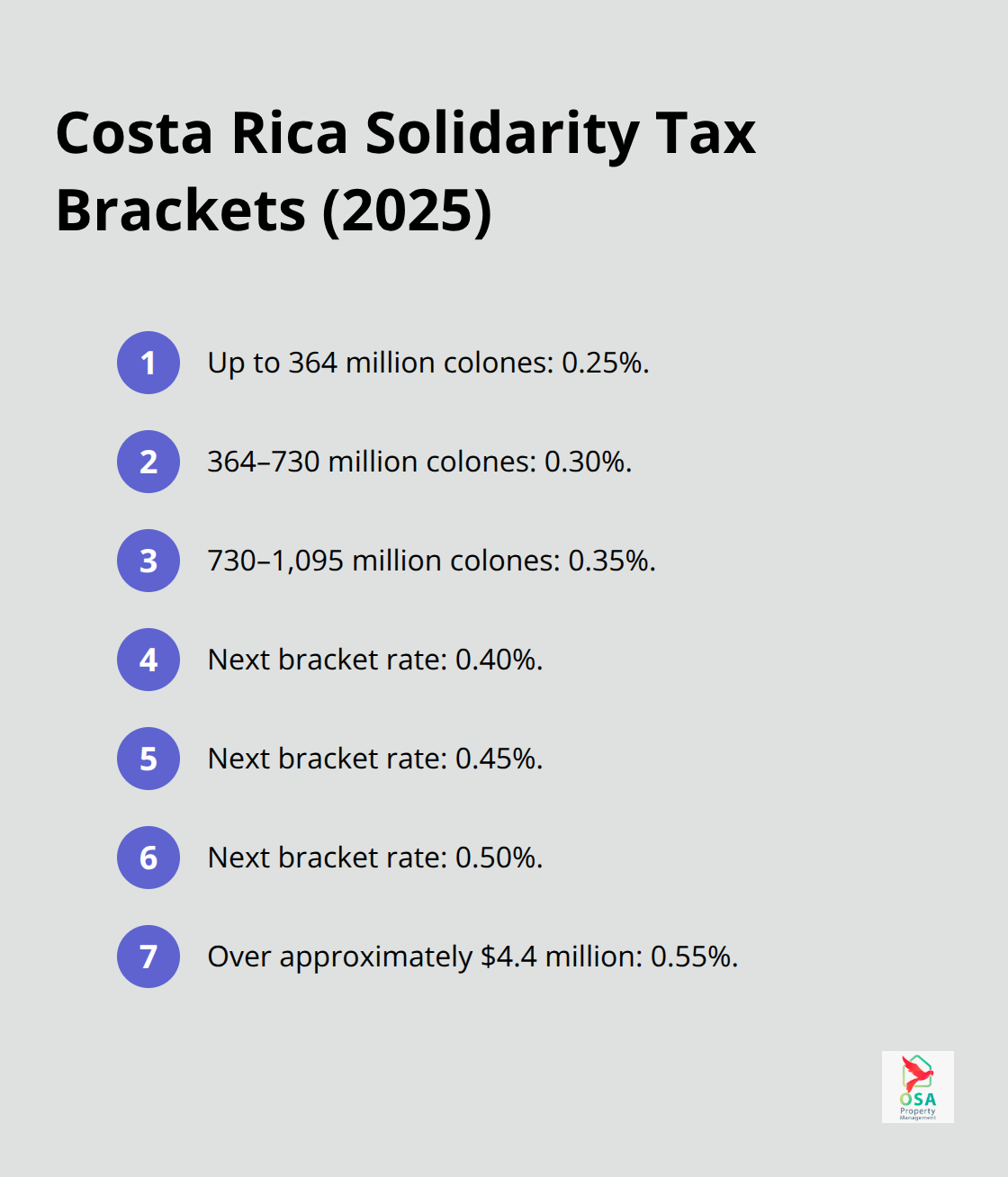
The valuation brackets for 2025 establish progressive rates based on total property value. Properties up to 364 million colones face a 0.25% solidarity rate, while those between 364 and 730 million colones pay 0.30%. Higher-value properties (730 million to 1,095 million colones) pay 0.35%, and the rate continues to climb through 0.40%, 0.45%, and 0.50% brackets.
Payment Deadlines and Municipal Schedules
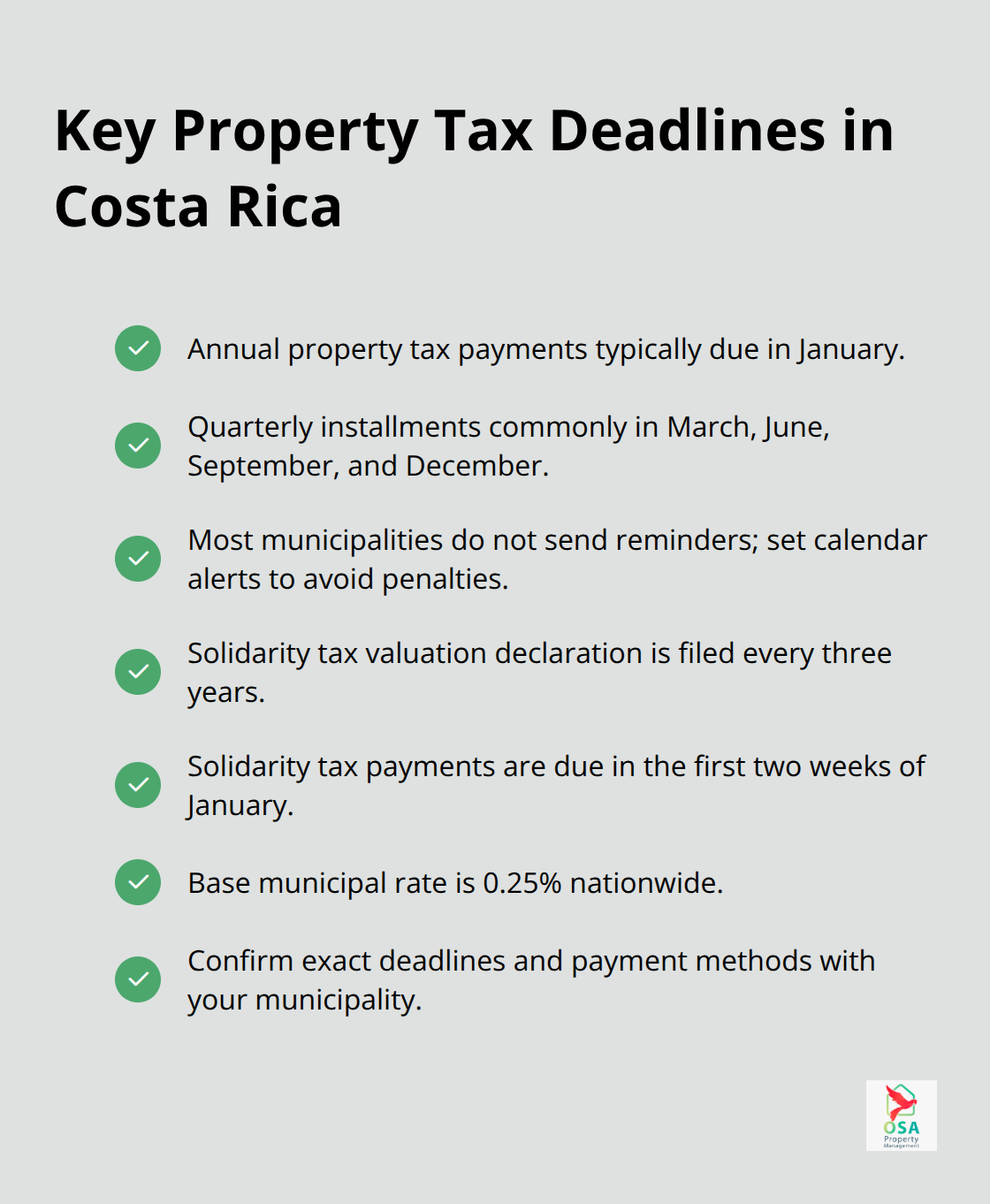
Payment deadlines vary by municipality but typically fall in January for annual payments, or in quarterly installments during March, June, September, and December. Most municipalities don't send payment reminders, so set your own calendar alert to avoid late fees and interest charges. Filing the solidarity tax valuation declaration occurs every three years using the official form, with payments due in the first two weeks of January.
What Changes Your Property Tax Bill in Costa Rica
How Your Municipality Affects Your Total Costs
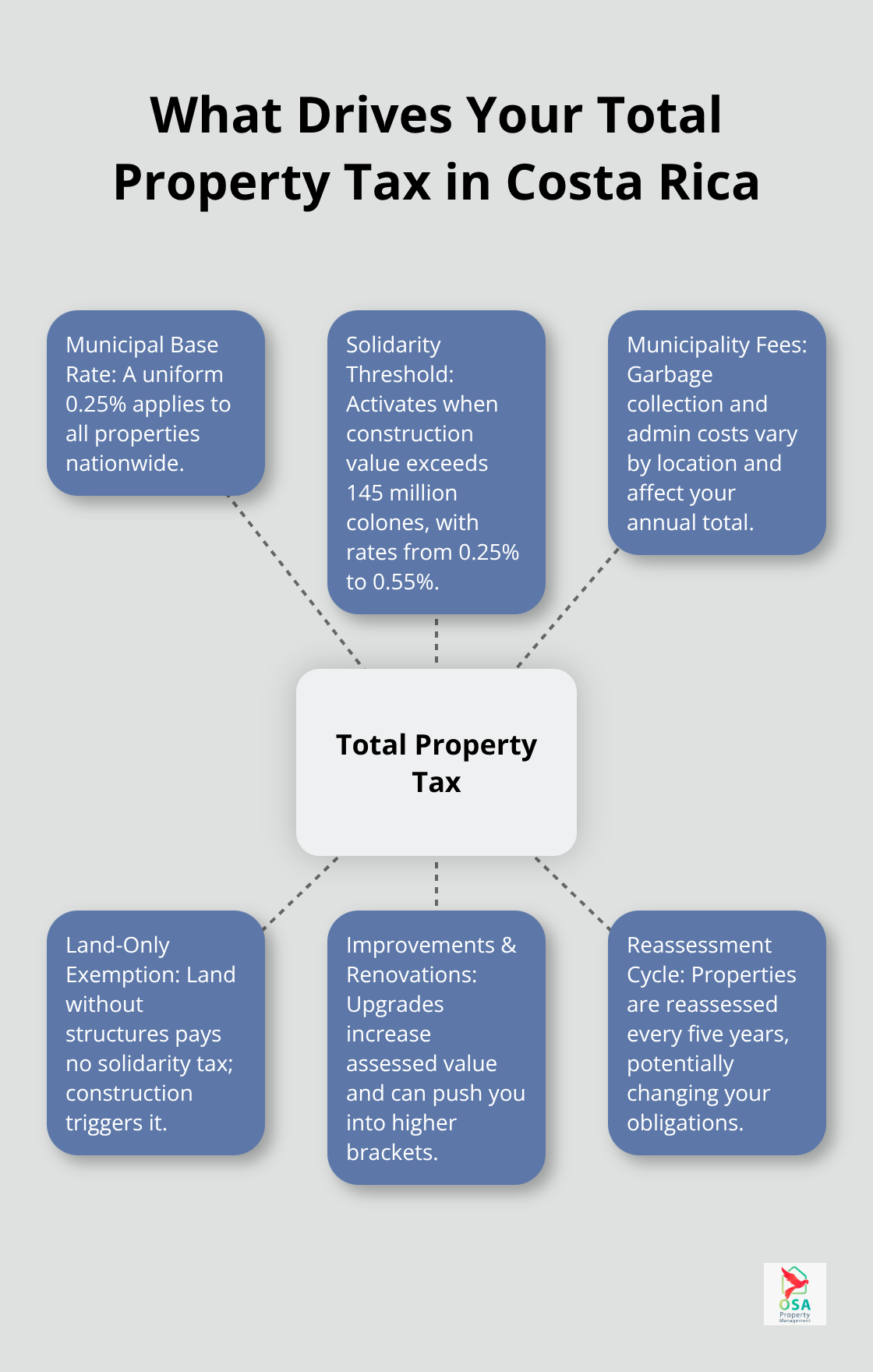
Municipal location matters far more than most property owners realize. While the base 0.25% municipal tax applies uniformly across Costa Rica, garbage collection fees, administrative processing costs, and payment schedules vary significantly by municipality. Some municipalities charge quarterly garbage fees of 10,000 to 20,000 colones per quarter, while others bundle these into annual assessments. A property in Jaco has different collection procedures and fee structures than one in Manuel Antonio, even though both pay the same base tax rate. Contact your specific municipality directly to confirm exact garbage fees and payment methods, as many don't publicize these details online. The Dirección General de Tributación handles national tax compliance, but your local municipality controls the mechanics of collection, which affects your total annual property costs.
Construction Value Determines Your Solidarity Tax Obligation
Property size and construction value directly determine whether you pay the solidarity tax at all. Land-only properties escape the solidarity tax completely, but adding even modest construction triggers it once your total property value exceeds 145 million colones. A 200,000 USD property with only land pays just 500 USD annually in municipal tax, while the same 200,000 USD split between land and construction enters the solidarity tax system.
How Improvements Push You Into Higher Tax Brackets
Renovations and improvements increase your property's assessed construction value, moving you into higher tax brackets at reassessment time. A 500,000 USD property that receives a 100,000 USD pool and rancho addition may jump from the 0.25% solidarity bracket to the 0.30% bracket, increasing annual solidarity tax from 1,250 USD to 1,500 USD or more depending on exact valuations. Property values undergo reassessment every five years, which can significantly impact your tax obligations. Planning major renovations requires factoring in not just construction costs but also the permanent increase to your annual property tax obligations that follows.
Who Qualifies for Property Tax Breaks in Costa Rica
Agricultural Land Exemptions
Agricultural land exemptions in Costa Rica may qualify for reduced tax rates or full exemptions in some cases, though strict criteria apply. If you own bare land used exclusively for farming, cattle ranching, or forestry under qualifying conditions, you may benefit from preferential treatment. The moment you add a home, pool, rancho, or any other structure to agricultural land, that exemption disappears and the combined land-plus-construction value becomes taxable. This creates a hard line: pure agricultural operations may stay tax-free, but mixed-use properties lose the exemption entirely.
If you plan to convert agricultural land to residential use, factor in the immediate jump to 0.25% municipal tax plus potential solidarity tax obligations once construction exceeds 145 million colones. Many property owners fail to realize this transition happens automatically, so clarify your land's classification with the municipality before you build anything.
Primary Residence and Usage Status
Primary residence benefits do not exist in Costa Rica's property tax system, which surprises most foreign buyers accustomed to other countries' rules. Whether you occupy a home year-round, rent it out full-time, or leave it vacant, you pay identical property taxes on the same declared value. Costa Rica taxes property ownership, not usage patterns. Your tax obligations remain the same regardless of how you use the land.
Environmental Conservation Properties
Environmental conservation properties receive no special tax treatment in Costa Rica. The government does not offer reduced rates for properties with protected ecosystems, endangered species habitat, or conservation easements. If protecting the environment matters to you financially, that motivation must come from personal values or potential long-term land appreciation rather than tax savings.
Confirming Your Property Classification
Contact your municipality to confirm your property's exact classification, as this determines your baseline obligations regardless of how you use the land. The Dirección General de Tributación handles national tax compliance, but your local municipality controls property classification and assessment procedures. Clarifying your status upfront prevents surprises at reassessment time and helps you plan your annual budget accurately.
Final Thoughts
Costa Rica's property tax system breaks down into two straightforward components: a 0.25% municipal tax that applies to all properties, and a solidarity tax ranging from 0.25% to 0.55% for homes valued above approximately 240,000 USD. How much are property taxes in Costa Rica ultimately depends on your property's declared value and whether it triggers the solidarity tax bracket. A 300,000 USD home pays around 750 USD annually in municipal tax alone, while a 500,000 USD property in the lowest solidarity bracket pays roughly 2,500 USD per year total.
Property improvements, municipal location variations, and garbage collection fees all affect your final bill, but these costs remain manageable compared to many countries. The real challenge isn't the tax rates themselves-it's staying compliant with filing deadlines and understanding how your specific municipality handles assessments and payments. Missing the January deadline or failing to update your property valuation triggers penalties and interest that compound quickly.
We at Osa Property Management recommend working with a local tax professional who understands Costa Rican property law and your municipality's specific procedures. Our team has spent over 19 years managing properties across Tarcoles, Jaco, Dominical, Manuel Antonio, Ojochal, and Uvita, and we've seen firsthand how proper tax planning protects owners from costly mistakes. Contact Osa Property Management to discuss how we can handle your tax compliance, accounting, and property management so you focus on enjoying your investment rather than navigating bureaucracy.