

Costa Rica's tropical climate accelerates property wear faster than most owners expect. Humidity, heavy rains, and salt air create maintenance challenges that directly impact your budget.
At Osa Property Management, we've seen property owners underestimate costs by 30–40% because they miss hidden expenses like foundation damage and electrical system corrosion. Getting accurate maintenance cost estimates upfront prevents financial surprises and protects your investment.
Why Tropical Climates Destroy Properties Faster Than You Think
The Perfect Storm of Sun, Salt, and Humidity
Costa Rica's combination of intense sun, prolonged humidity, and salt air creates a perfect storm for property deterioration. Metal roofs near the coast start showing rust within months if not properly sealed, while inland properties face relentless mold growth that spreads across wall interiors in weeks. The rainy season lasts up to eight months, forcing water into every gap and crack in your structure. Coastal properties like those in Ojochal or Tamarindo experience the worst damage-salt deposits accumulate on exterior surfaces and accelerate corrosion of anything metal. A property that might last 20 years in Arizona deteriorates in 10 years here.
How Coastal vs. Inland Properties Face Different Threats
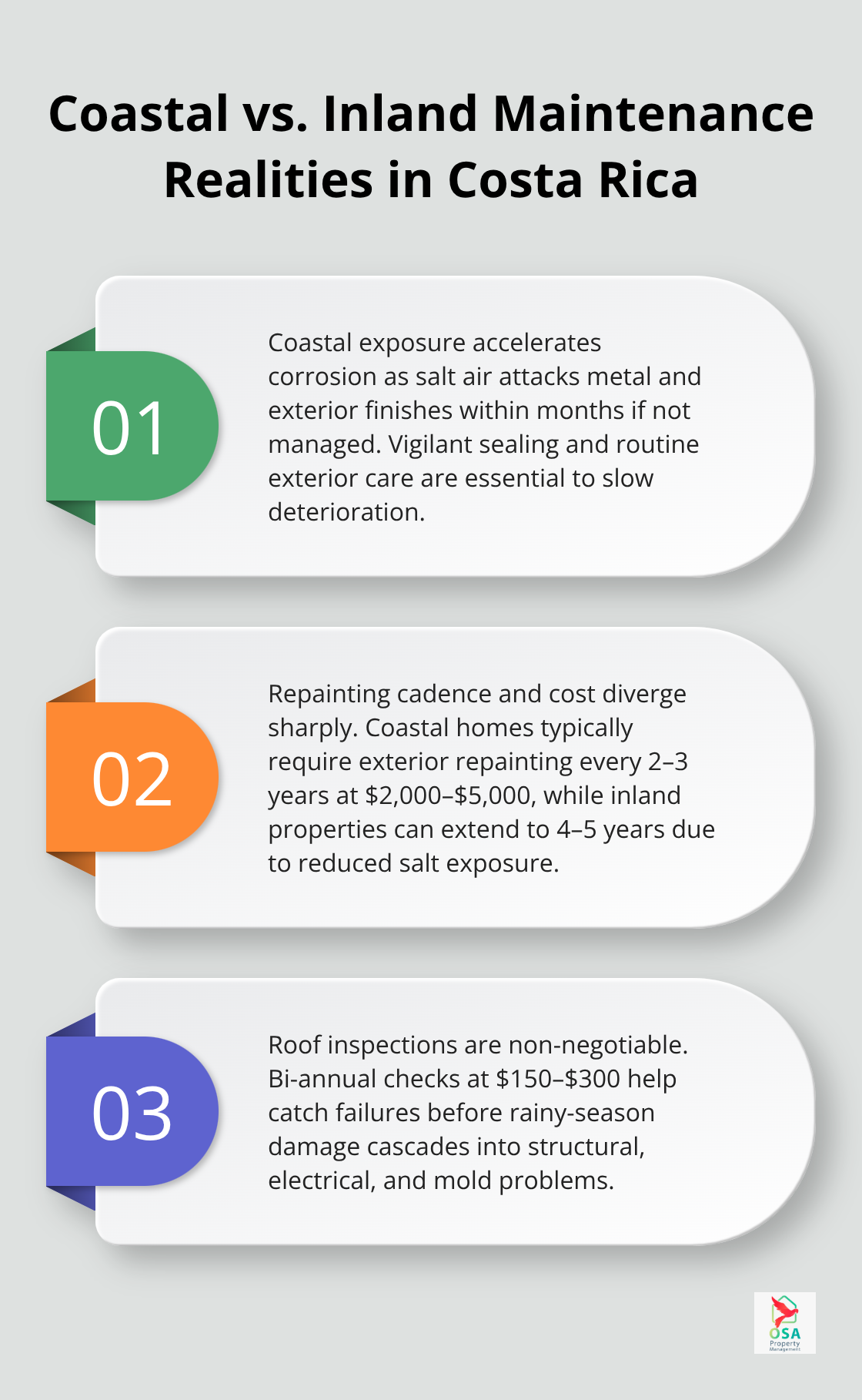
This isn't exaggeration; it explains why annual maintenance costs run 1.5% to 3% of property value, translating to $10,000–$25,000 yearly for a mid-sized home. Inland properties in regions like Manuel Antonio still face heavy humidity and rainfall, but they typically avoid the salt corrosion that coastal owners battle constantly. The key difference: coastal homes need exterior repainting every 2–3 years at $2,000–$5,000, while inland properties stretch that to 4–5 years. Your roof demands bi-annual inspections at $150–$300 each, especially before and after the rainy season, because roof failures here aren't minor leaks-they cascade into foundation damage, electrical system problems, and mold colonization that costs thousands to remediate.
Hidden Expenses That Catch Owners Off Guard
Most owners miss the hidden expenses until they're already deep in repairs. Electrical systems in rural areas experience voltage fluctuations that silently degrade appliances and wiring, requiring annual checks at $100–$300. Plumbing suffers from high mineral content in Costa Rican water, leading to unexpected repairs at $50–$200 per incident. Humidity-driven mold remediation costs between $1,373 and $3,325 on average, but severe cases can skyrocket into the tens of thousands. Pest control isn't optional-termites and ants are endemic to warm climates, and quarterly inspections at $50–$100 monthly become non-negotiable.
The Real Cost of Ownership Beyond Maintenance
Property taxes are manageable at 0.25% of declared value, but HOA fees ($500 annually), road association fees ($300–$500), and water costs ($15 monthly) accumulate alongside electricity bills that often hit $50–$400 monthly depending on usage. Most owners fail to budget for emergency repairs, yet a single major incident like hurricane damage or severe water intrusion can wipe out $5,000–$20,000 or more. We at Osa Property Management recommend maintaining an emergency reserve equal to 3–6 months of maintenance costs-roughly $2,500–$5,000 for a $300,000 property.
Building Your Defense Against Financial Surprises
The owners who avoid financial catastrophe calculate their actual baseline costs first, then add 25–40% for surprises. Understanding these regional and climate-specific challenges positions you to create a realistic budget that actually protects your investment. With this foundation in place, you're ready to move into the specific maintenance categories that demand your attention and resources.
Building Your Maintenance Budget
Break Down Costs by System, Not Guesswork
Creating a realistic maintenance budget requires organizing expenses into specific categories rather than estimating a single annual figure. Owners who track costs by system-roof and drainage, electrical, plumbing, pest control, humidity management, landscaping, and interior finishes-catch hidden expenses before they spiral into emergencies. A mid-sized Costa Rica property typically costs $1,200–$2,050 monthly in maintenance, with utilities at $150–$300, property management $200–$600, cleaning $100–$250, pool maintenance $150–$400, garden work $150–$400, and preventive repairs $100–$300. Coastal properties in Tamarindo or Ojochal consistently run 20–30% higher than inland equivalents because salt air accelerates corrosion and demands more frequent exterior repainting. Start with your property's baseline using these ranges, then adjust upward for coastal location, property age, pool presence, and guest house complexity.
Account for Your Specific Property Profile
Many owners apply the 1.5% to 3% annual maintenance formula without adjusting for their situation. A newer coastal property with a pool requires dramatically different spending than an older inland home without one. The formula works as a starting point-multiply your property value by 1.5% to 3%-but it only tells half the story. Your actual costs depend on whether you live near salt air, how many systems require active maintenance, and whether you've invested in preventive upgrades like solar panels or UV-filtered windows. Properties with pools add $150–$400 monthly; guest houses double your staffing and utility needs; coastal locations add 20–30% to exterior maintenance alone.
Include Fixed Costs and Predictable Expenses
Your annual budget must account for fixed costs that don't fluctuate: property taxes at 0.25% of declared value, HOA fees around $500 yearly, road association fees at $300–$500, and electricity bills typically ranging $50–$400 monthly depending on usage and season. These expenses form your baseline-the amount you'll pay regardless of whether your roof leaks or your plumbing holds. Water costs run roughly $15 monthly; internet and satellite services add $50–$150 monthly. Once you total these predictable expenses, you have a foundation for calculating your emergency reserve.
Build a Reserve Fund That Actually Protects You
Beyond monthly maintenance, establish a separate emergency reserve for unexpected costs. This reserve protects against roof failures, major water intrusion, or hurricane damage that easily exceed $10,000. Owners without reserves face brutal decisions when a $5,000 plumbing disaster or $8,000 mold remediation strikes. Calculate your monthly maintenance baseline, multiply by 4–6, and transfer that amount into a dedicated savings account monthly. For a property with $1,500 monthly maintenance costs, this means setting aside $6,000–$9,000 as your safety net. Proactive maintenance catches problems early-a $300 roof inspection prevents the $20,000 structural damage that develops silently during the rainy season.
Move From Budget to Action
With your baseline costs calculated and your reserve fund established, you're ready to address the specific maintenance issues that demand immediate attention. Understanding what typically fails in Costa Rica's climate helps you prioritize spending and avoid the most expensive repairs.
What Breaks First in Costa Rica and What It Costs
Roof Failures: Your Most Expensive Problem
Your roof will fail before anything else, and when it does, the damage spreads faster than you can stop it. Coastal properties show rust on metal roofs within months of installation if salt spray isn't managed aggressively. A PVDF coating is recommended to help keep the substrate metal free from oxidation. Sanding and wire brushing with anti-corrosive paint costs $500–$1,500 for a typical home, but waiting until rust penetrates deeply means replacing entire roof sections at $5,000–$15,000.
Inland properties escape salt corrosion but face different threats. Tamarindo and similar areas receive 60 inches of annual rainfall concentrated in six months, overwhelming gutters clogged with debris and forcing water through gaps in roof seals. Tile roofs perform better than metal in this environment, requiring less frequent intervention, but both types demand bi-annual inspections before and after the rainy season. Most owners ignore this until they find water stains on ceilings, but structural damage has already begun at that point.
The inspection itself costs $150–$300, while preventive sealing of vulnerable areas runs $1,000–$3,000 and prevents the $20,000 structural repairs that develop silently when water penetrates your foundation.
Plumbing Problems and Hidden Water Damage
Plumbing failures cost less upfront but create cascading problems that drain your emergency fund quickly. Costa Rica's water contains high mineral content that accumulates inside pipes, restricting flow and creating pressure that forces water through small cracks in joints and walls. A single plumbing repair averages $50–$200, but mineral buildup often requires multiple interventions yearly, totaling $500–$1,500 annually for properties with older systems.
More destructive is undetected water leakage inside walls, which feeds mold colonies that spread through insulation and drywall, eventually requiring remediation costs between $1,373 and $3,325 for moderate cases. Humidity management prevents this cascade: dehumidifiers in bathrooms and closets cost $100–$300 per unit but stop mold before it starts. Smart water sensors at $50–$100 each alert you to leaks within hours rather than weeks, preventing the tens of thousands in structural damage that develops when water sits undetected.
Pest Control: The Non-Negotiable Expense
Pest control represents your third major expense category, and it's non-negotiable in tropical climates. Termites and ants colonize wood within weeks if left untreated, and quarterly inspections at $50–$100 monthly catch infestations before they compromise structural integrity. Sealing cracks with silicone caulk and steel wool costs almost nothing but stops 70% of pest entry points, while professional treatments for active infestations run $500–$2,000 depending on severity.
The owners who survive Costa Rica's climate without financial disaster treat these three systems-roof, plumbing, and pest control-as non-optional monthly expenses rather than problems to address when they become emergencies.
Final Thoughts
Maintenance cost estimates for Costa Rica properties form the foundation of smart ownership, not optional planning you tackle later. Calculate your baseline costs by system, adjust for your coastal or inland location, and establish an emergency reserve before problems strike. Your roof, plumbing, and pest control systems demand consistent investment, and accepting that coastal properties cost 20–30% more than inland homes prevents the shock of unexpected bills.
We at Osa Property Management transform maintenance from a constant headache into a predictable expense across Tarcoles, Jaco, Dominical, Manuel Antonio, Ojochal, Uvita, and Golfito. Our team coordinates maintenance schedules, tracks costs by system, and catches problems before they escalate into expensive repairs. Properties managed professionally experience 7% higher rental income and significantly lower vacancy rates because maintenance issues don't disrupt guest experiences or create unexpected downtime.
Calculate your property's baseline maintenance costs using the 1.5% to 3% formula, adjust for your specific systems, then establish your emergency reserve. If managing maintenance remotely feels overwhelming, professional management eliminates the complexity and often pays for itself through cost efficiency and higher rental performance. The owners who thrive in Costa Rica's climate treat maintenance as an investment in their property's longevity, not an expense to minimize.