
Getting Playa Hermosa rental pricing right is the difference between a booked calendar and empty weeks. The oceanfront market moves fast, and rates that worked last season won’t cut it today.
We at Osa Property Management help owners navigate this constantly shifting landscape. This guide breaks down exactly how to price your home competitively while maximizing income.
What Are Realistic Rental Rates for Playa Hermosa Right Now
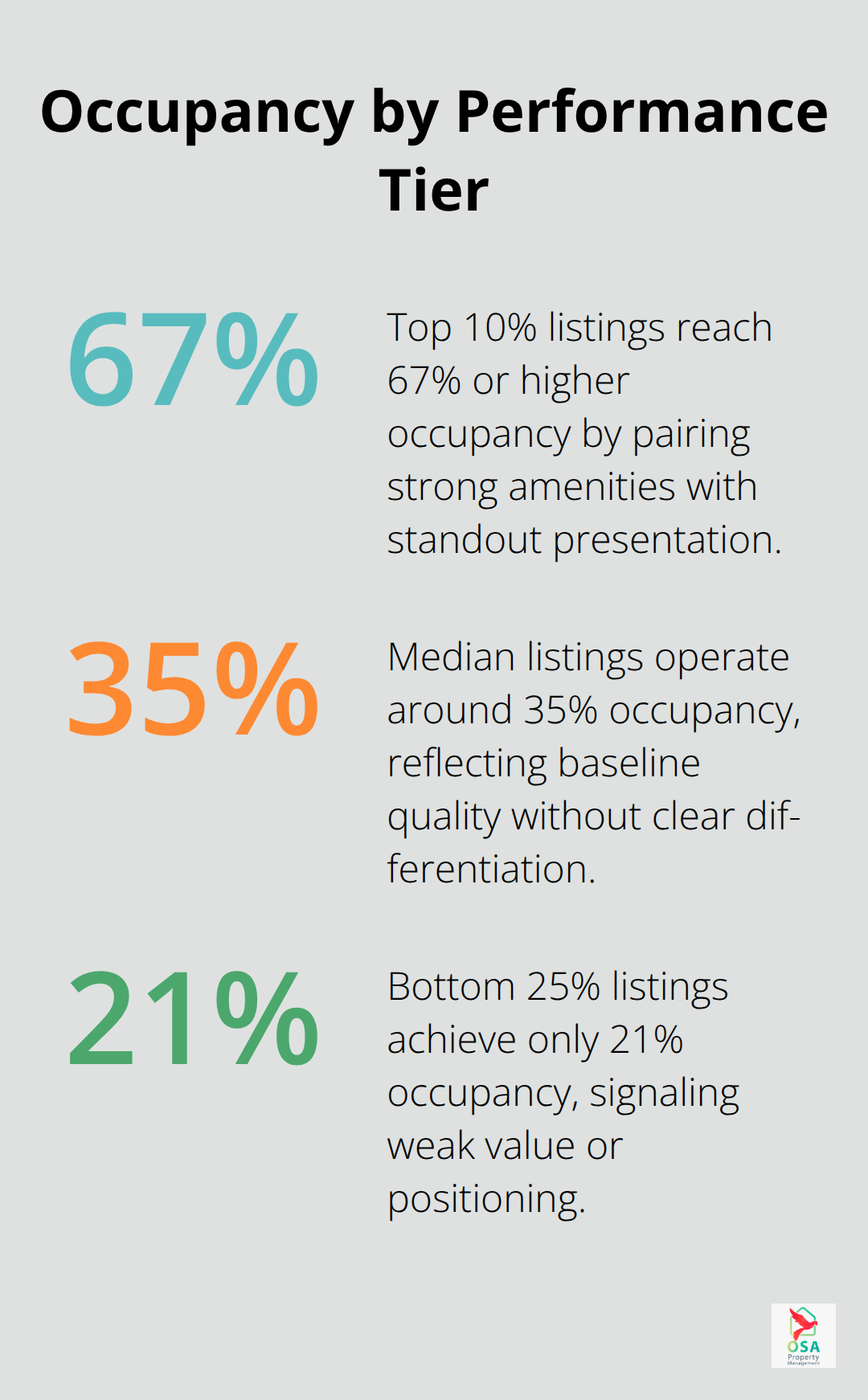
Playa Hermosa sits in a competitive micro-market with 33 active listings according to AirROI’s 2026 dataset, and the numbers tell a clear story about where pricing actually lands. The average nightly rate across the market is $274, with occupancy hovering at 41.5% and a RevPAR of $114. But these averages mask a brutal truth: most properties underperform significantly. The bottom 25% of listings achieve only 21% occupancy at $194 per night, producing just $63 in RevPAR. The median property sits at 35% occupancy with a $277 nightly rate, yielding $121 RevPAR. Only the top 10% of listings break through with 67% or higher occupancy and nightly rates exceeding $803, delivering RevPAR of $372. This spread reveals that pricing alone does not drive results-differentiation does.
Understanding Seasonality as Your Pricing Foundation
Seasonality in Playa Hermosa swings dramatically, and pricing that ignores these patterns leaves money on the table. Peak season from December through April generates monthly revenue around $7,931 per listing with 57.4% occupancy and an average nightly rate of $423. The single best month yields approximately $8,998 in revenue with 61.3% occupancy and $479 nightly rates. Shoulder season from May through August averages $4,492 monthly revenue with 37.6% occupancy and $397 nightly rates.
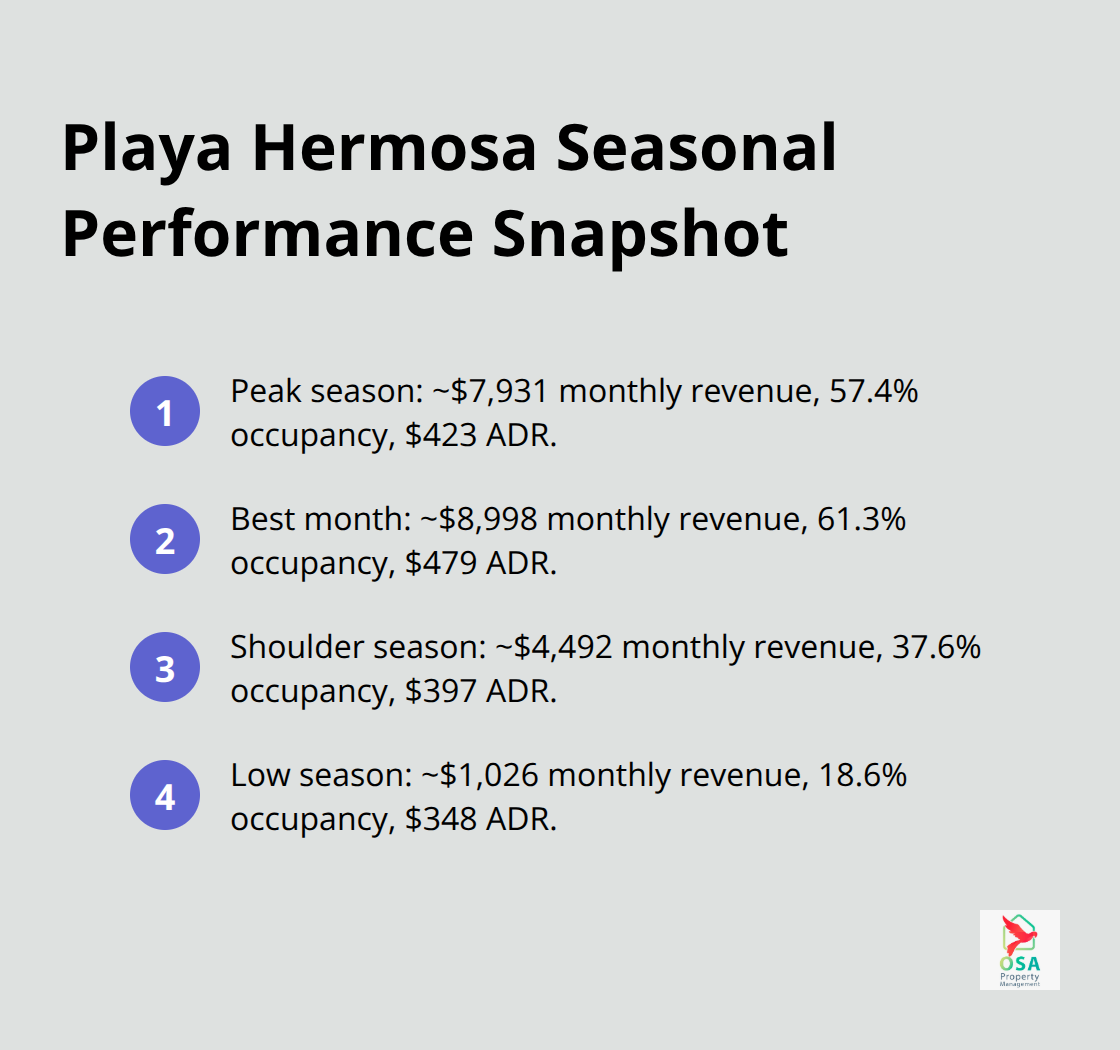
The low season from September through November collapses to just $1,026 monthly revenue with 18.6% occupancy and $348 nightly rates. Booking lead time shifts seasonally as well-spring averages 49 days advance booking, June peaks at 58 days, while September drops to just 7 days. A flat nightly rate across these windows guarantees lost revenue during peak demand and excessive vacancy during slow periods.
Competing Against Properties That Actually Win
The properties that outperform the market share specific characteristics worth copying. Top 25% listings maintain 51% or higher occupancy with nightly rates of $453 or more. The top 10% pull away with their amenities and presentation. Revenue-impact amenities in Playa Hermosa show measurable uplift: dishwashers, bathtubs, and BBQ grills differentiate your vacation rental accommodations. These are not luxuries-they are revenue drivers. Photography quality matters too, with top performers averaging 38.2 photos per listing. Guest Favorite badges appear on 42.4% of listings, while 81.8% maintain Superhost status. Nearby Tamarindo demonstrates competitive pressure, showing roughly 3 percentage points higher occupancy and approximately $31 higher average daily rates than Playa Hermosa. This proximity means guests comparing properties across the region will default to Tamarindo unless your pricing reflects the specific value your oceanfront location and amenities deliver.
How Your Amenities and Photos Drive Revenue
The gap between top performers and the rest comes down to what guests actually see and experience. Properties with strong photo libraries (38+ images) attract more qualified bookings because potential guests understand exactly what they receive. The revenue-impact amenities listed above-dishwashers, bathtubs, and BBQ grills-command premium pricing because they solve real guest needs. A property with a BBQ grill and outdoor dining setup justifies higher nightly rates than a similar oceanfront home without these features.
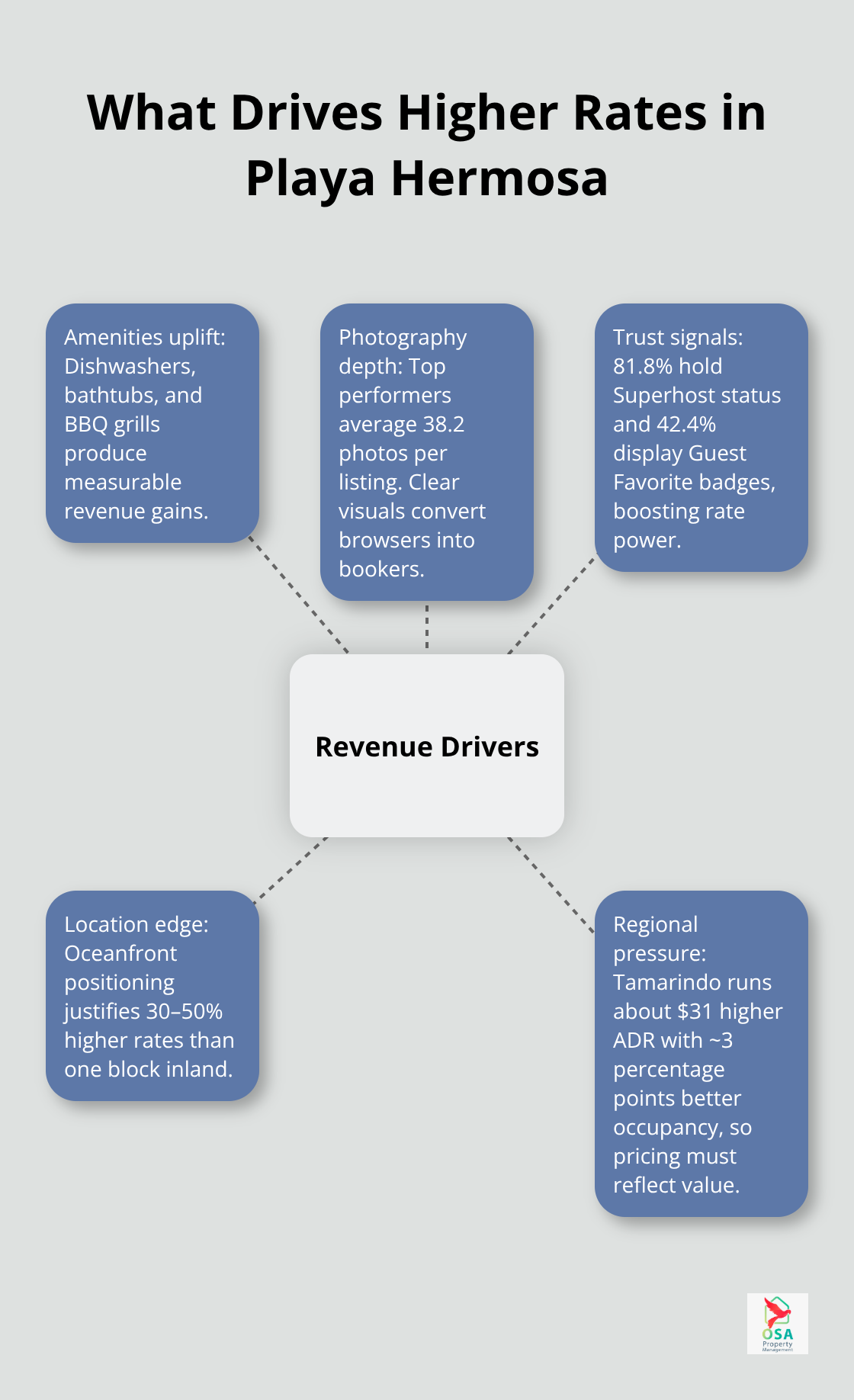
Superhost status (81.8% of Playa Hermosa listings hold it) signals reliability and quality, which guests trust. The Guest Favorite badge (42.4% of listings) indicates consistent positive reviews that translate directly into higher occupancy and rate power. Your property’s amenities and presentation determine whether you compete on price or on value.
Setting Your Rate Strategy Against Regional Competition
Tamarindo’s pricing advantage over Playa Hermosa ($31 higher ADR, 3 percentage points better occupancy) shows that nearby markets command premium rates for specific reasons-typically more developed infrastructure, higher guest volume, or stronger brand recognition. Your oceanfront location in Playa Hermosa is a genuine asset, but it only justifies premium pricing if your property matches or exceeds the quality standards of top performers in your micro-market. Properties in the top 10% achieve this through superior amenities, professional photography, and consistent guest satisfaction. The median property at $277 per night and 35% occupancy represents the baseline-properties that meet market standards but lack differentiation. To move above this baseline, you must either add revenue-impact amenities, improve your photo presentation, or both. Your next step involves analyzing which specific amenities and improvements will deliver the highest return on investment for your property type and location.
What Actually Drives Your Rental Price in Playa Hermosa
Bedroom Count and Guest Capacity Set Your Rate Foundation
Your property’s nightly rate reflects what guests will pay for the specific combination of size, amenities, location, and reputation your listing presents. AirROI’s 2026 data shows that properties with 3 or more bedrooms command substantially higher rates than smaller units, with 60.6% of Playa Hermosa listings offering 3+ bedrooms. Guest capacity matters equally: properties accommodating 6 or more guests represent 72.7% of the market and justify premium pricing because families and groups pay more per night than couples. Bedroom count alone won’t move your rate upward, however. The amenities inside those bedrooms determine whether a guest books at $200 per night or $500 per night.
Revenue-Impact Amenities Create Measurable Price Uplift
Revenue-impact amenities like BBQ grills, outdoor dining tables, and outdoor furniture generate measurable price uplift according to AirROI’s analysis. A property with a functional kitchen, washer, and Wi-Fi hits the baseline expectation. A property with those basics plus a BBQ grill, dining table, and outdoor furniture positioned on an oceanfront lot commands rates 2–3 times higher. Your first pricing action should identify which revenue-impact amenities your property lacks compared to top performers in your micro-market, then calculate whether adding a grill, expanding outdoor space, or upgrading furniture will increase annual revenue enough to justify the investment.
Location Within Playa Hermosa Creates Measurable Rate Differences
Oceanfront positioning near Coco Beach or direct beachfront access justifies nightly rates 30–50% higher than comparable properties one block inland because guests book ocean views and beach access, not square footage. Proximity to attractions like El Miro ruins (2 miles away) or Jacó Beach (4 miles away) adds appeal and supports premium pricing for properties marketing easy access to activities. These location advantages compound when combined with strong amenities and professional presentation.
Guest Reviews and Performance History Function as Your Rate Ceiling
Properties with Superhost status (81.8% of Playa Hermosa listings hold it) and Guest Favorite badges (42.4% of listings) earn higher occupancy and rate power because guests trust consistent quality. A property with 50+ five-star reviews and a Guest Favorite badge can sustain rates $75–$150 higher per night than an identical property with 10 reviews and no badge. The relationship works in reverse too: properties with poor reviews or inconsistent guest satisfaction cannot maintain premium rates regardless of amenities or location.
Audit Your Reviews and Address Pain Points Systematically
Your second pricing action involves auditing your guest reviews and identifying specific pain points mentioned repeatedly. If guests mention dirty common areas, slow Wi-Fi, or missing basic amenities, those complaints justify rate reductions until you fix them. If guests praise your responsiveness, cleanliness, and attention to detail, you have permission to test higher rates. The properties that command premium pricing in Playa Hermosa share one critical trait: they solve real guest problems through thoughtful amenities, professional photography, and consistent service quality. Your next step involves translating these pricing drivers into a concrete rate strategy that positions your property against direct competitors.
How to Price Your Property Across Seasons and Against Competitors
Seasonal Rate Adjustments Drive Real Revenue Gains
Playa Hermosa’s seasonal swings demand aggressive pricing adjustments, not incremental tweaks. Peak season from December through April justifies nightly rates around $423 according to AirROI’s 2026 data, yet many owners leave money on the table by holding flat rates year-round. The single strongest month generates $8,998 in revenue per listing with $479 nightly rates and 61.3% occupancy. Low season from September through November collapses to $1,026 monthly revenue with $348 nightly rates and 18.6% occupancy. Your pricing strategy must reflect this reality: a property charging $350 per night in September will sit empty while one charging $200 per night fills most weeks. The difference isn’t property quality-it’s rate strategy.
Tamarindo demonstrates this principle by commanding approximately $31 higher average daily rates than Playa Hermosa while maintaining 3 percentage points better occupancy. That pricing power comes from owners who adjust rates weekly based on demand rather than setting prices quarterly. Seasonal rate adjustments based on booking lead times shape your entire strategy-spring bookings arrive further in advance while last-minute travelers dominate low season, requiring different rate structures for each period.
Test Rate Reductions to Fill Your Calendar
Properties in the top 10% of Playa Hermosa’s market achieve 67% or higher occupancy precisely because they balance rate and occupancy to maximize total revenue rather than simply achieving high occupancy at low rates. Your first action involves mapping your property’s historical booking patterns month by month, then testing rate reductions of 15–25% during your slowest months to drive occupancy above 40%. Properties sitting at 35% occupancy cannot afford to maintain peak-season pricing.
A property with strong fundamentals (oceanfront location, 3+ bedrooms, Superhost status) will recover lost nightly revenue through increased bookings when you lower rates strategically. The math works: filling 50% of September nights at $200 per night generates more revenue than filling 15% of nights at $350 per night.
Position Premium Amenities Against Direct Competitors
Premium amenities only justify higher rates when positioned correctly against direct competitors. A property with a BBQ grill, dining table, and outdoor furniture generates measurable revenue uplift, but only if your nightly rate reflects that advantage over similar oceanfront homes lacking those features. Top 25% listings maintain 51% or higher occupancy with nightly rates of $453 or more, while median properties at $277 per night achieve 35% occupancy. That $176 rate difference represents value-based pricing working correctly.
If your property has 3+ bedrooms, accommodates 6+ guests, includes revenue-impact amenities, maintains Superhost status, and holds a Guest Favorite badge, your rates should sit in the $400–$500 range during peak season, not $275. Conversely, if your property lacks outdoor amenities, has inconsistent reviews, or sits one block from the beach instead of oceanfront, pricing at $400 guarantees extended vacancies.
Audit Reviews and Match Rates to Reality
The properties commanding premium rates in Playa Hermosa share identical characteristics: 38+ professional photos, amenities that solve real guest needs, and consistent five-star reviews. Audit your guest feedback specifically for mentions of cleanliness, responsiveness, and amenity quality. If reviews consistently praise your oceanfront access and outdoor space, your rates can support a $50–$75 premium over comparable properties. If reviews mention missing amenities or slow responses, reduce rates until you address those gaps.
Your second action involves identifying which specific amenities your property lacks compared to top performers in your immediate neighborhood, calculating the investment required, then determining whether adding a grill or upgrading outdoor furniture will generate enough additional revenue to justify the cost within 18–24 months. A $3,000 investment in outdoor furniture and a quality BBQ grill pays for itself within one season if it allows you to raise rates by $50 per night and increase occupancy by 10 percentage points.
Final Thoughts
Playa Hermosa rental pricing works when you treat rates as dynamic tools rather than static numbers. Properties in the top 10% achieve 67% occupancy and $803+ nightly rates by combining oceanfront location, revenue-impact amenities, professional presentation, and consistent guest satisfaction. The median property at $277 per night and 35% occupancy represents owners who set rates once and ignore market shifts-a strategy that fails in competitive micro-markets.
Your pricing strategy rests on three concrete actions. First, audit your property against direct competitors and identify which revenue-impact amenities you lack, then calculate whether adding outdoor furniture or a quality BBQ grill will increase annual revenue enough to justify the investment. Second, implement seasonal rate adjustments that reflect actual demand patterns-peak season from December through April justifies $423+ nightly rates, while low season from September through November demands aggressive reductions to $200–$250 to fill your calendar. Third, audit your guest reviews monthly and address pain points immediately, since properties with Superhost status and Guest Favorite badges command $75–$150 rate premiums over identical properties with inconsistent reviews.
Rate adjustments should happen weekly during peak season and monthly during slower periods, not quarterly. Tamarindo commands $31 higher average daily rates than Playa Hermosa precisely because owners there adjust pricing based on booking lead times and demand signals rather than holding flat rates year-round. We at Osa Property Management handle this complexity for our clients across Costa Rica, managing dynamic pricing and revenue optimization so owners focus on their investment returns.