

Getting your rental pricing strategy right is the difference between a vacant property and consistent bookings. At Osa Property Management, we’ve seen owners leave thousands on the table by either pricing too high or failing to adjust for seasonal demand.
This guide walks you through proven methods to balance occupancy and profitability, from analyzing local competition to implementing dynamic pricing that responds to real market conditions.
Know Your Local Market Before Setting Prices
Pull Data on Comparable Properties
Understanding what similar properties rent for in your area is non-negotiable. Start every pricing decision by collecting data on comparable rentals within a one-mile radius, focusing on properties with similar bedroom counts, amenities, and condition. This isn’t guesswork-it’s the foundation of any pricing decision that sticks. When you price without this data, you’re essentially throwing darts. Properties priced 15-20% above local comps typically sit vacant longer than fairly priced alternatives. That vacancy directly eats into your annual income.
Account for Seasonal Demand Shifts
Seasonal demand shifts matter just as much as base rates. In most markets, peak seasons command 30-50% rate premiums over off-season periods, but the timing varies dramatically by location. Coastal properties see summer spikes, mountain destinations peak in winter, and business hubs stay relatively flat year-round. You need to identify when your specific property attracts demand and when it doesn’t. Pull your booking history if you have it, or research local tourism calendars and event schedules. Major conferences, holidays, and school breaks all drive rental demand, and your rates should reflect that reality. Adjusting your rates based on demand, seasonality, and local events can maximize occupancy and revenue throughout the year.
Monitor Competitor Rates Consistently
Most owners check competitor rates once and call it done. That’s a mistake. The rental market moves constantly-competitors adjust weekly or even daily based on demand. Check comparable listings at minimum every two weeks, more frequently during peak seasons. Market data platforms provide occupancy rates, average daily rates, and revenue trends for specific neighborhoods, giving you context beyond just what one competitor charges. Your goal isn’t to match every competitor but to understand the pricing band where properties like yours operate. If most three-bedroom oceanfront homes in your area rent for $180-220 per night, pricing at $150 signals desperation, while $280 signals overconfidence. The sweet spot sits where demand, supply, and your property’s actual condition intersect.
Highlight What Makes Your Property Different
Your unique value proposition-whether that’s a renovated kitchen, ocean views, proximity to restaurants, or premium linens-justifies premium pricing only if it genuinely differs from what competitors offer. Generic amenities that everyone has don’t warrant higher rates. Distinctive features that guests actively search for do. Professional photography and detailed descriptions command higher rates than similar properties with poor presentation. That quality presentation signals a well-maintained property and attracts guests willing to pay more.
Once you understand your market position and what competitors charge, the next step involves setting your base rate strategically and then adjusting it for demand fluctuations throughout the year.
Building Your Base Rate and Adjusting for Demand
Calculate Your True Break-Even Point
Your base rate must reflect three concrete factors: your property’s actual condition and amenities, your location’s earning potential, and what you need to cover costs plus desired profit. Start by calculating your annual expenses-mortgage or lease, insurance, maintenance reserves, cleaning between guests, utilities, and property management fees if applicable. Divide that total by your expected annual occupancy rate. If your costs run $15,000 yearly and you expect 70% occupancy across 365 days, you need roughly $59 per night just to break even. From there, add your target profit margin. Most owners try for 30-50% profit above costs, which means your base rate should land between $77-$89 per night in this example.
Align Your Rate with Local Market Data
Cross-reference your calculated rate against your local comp analysis from the previous section. If three-bedroom homes in your area command $150-$180 nightly, your calculated $77-$89 sits well below market, signaling either underpricing or that your property needs upgrades to justify higher rates. The goal is alignment: your base rate should sit comfortably within your local pricing band while covering costs and generating real profit. Research suggests adjusting your base rate to maintain competitiveness while protecting your margins.
Leverage Dynamic Adjustments Throughout the Year
Once your base rate is set, the real leverage comes from dynamic adjustments tied to actual demand patterns. Peak season rates should run 30-50% higher than your base rate, not as arbitrary markups but as responses to genuine demand increases. If your base rate is $150 and summer demand is strong, pricing at $195-$225 during those months captures the higher willingness to pay without triggering excessive vacancy.
Off-season rates can drop 20-30% below base to maintain occupancy when demand softens-pricing at $105-$120 during slow months keeps units filled rather than sitting dark. Dynamic price adjustments based on local events can significantly boost your annual income compared to static rates. The timing matters enormously: a ski property peaks December-March, a beach destination peaks June-August, and a city business rental stays relatively flat.
Use Your Booking History to Identify Patterns
Your own booking history provides the clearest signal. Pull your last two years of reservations and identify which months had fastest bookings, shortest cancellations, and highest rates guests accepted. That pattern repeats year after year. Use booking platforms’ built-in dynamic pricing features if available-Airbnb, Vrbo, and Booking.com all offer automated tools that adjust rates based on demand signals without requiring manual daily updates. Third-party tools like PriceLabs and Wheelhouse integrate across multiple platforms and apply algorithmic adjustments based on local competition, upcoming events, and historical patterns, often delivering 5-15% ADR lifts compared with static pricing.
Implement Tools That Match Your Workflow
The right pricing tool depends on your portfolio size and technical comfort. Single-property owners often find platform-native tools sufficient for their needs. Multi-property operators benefit from third-party solutions that consolidate data across channels and apply consistent logic across all listings. Whichever tool you select, the principle remains the same: rates that respond to actual market conditions outperform rates that stay static. With your base rate established and dynamic adjustments in place, the next step involves protecting that revenue by implementing strategies that fill your calendar during slower periods while maintaining premium rates when demand peaks.
Filling Your Calendar Without Sacrificing Margins
Price Strategically Across Seasons
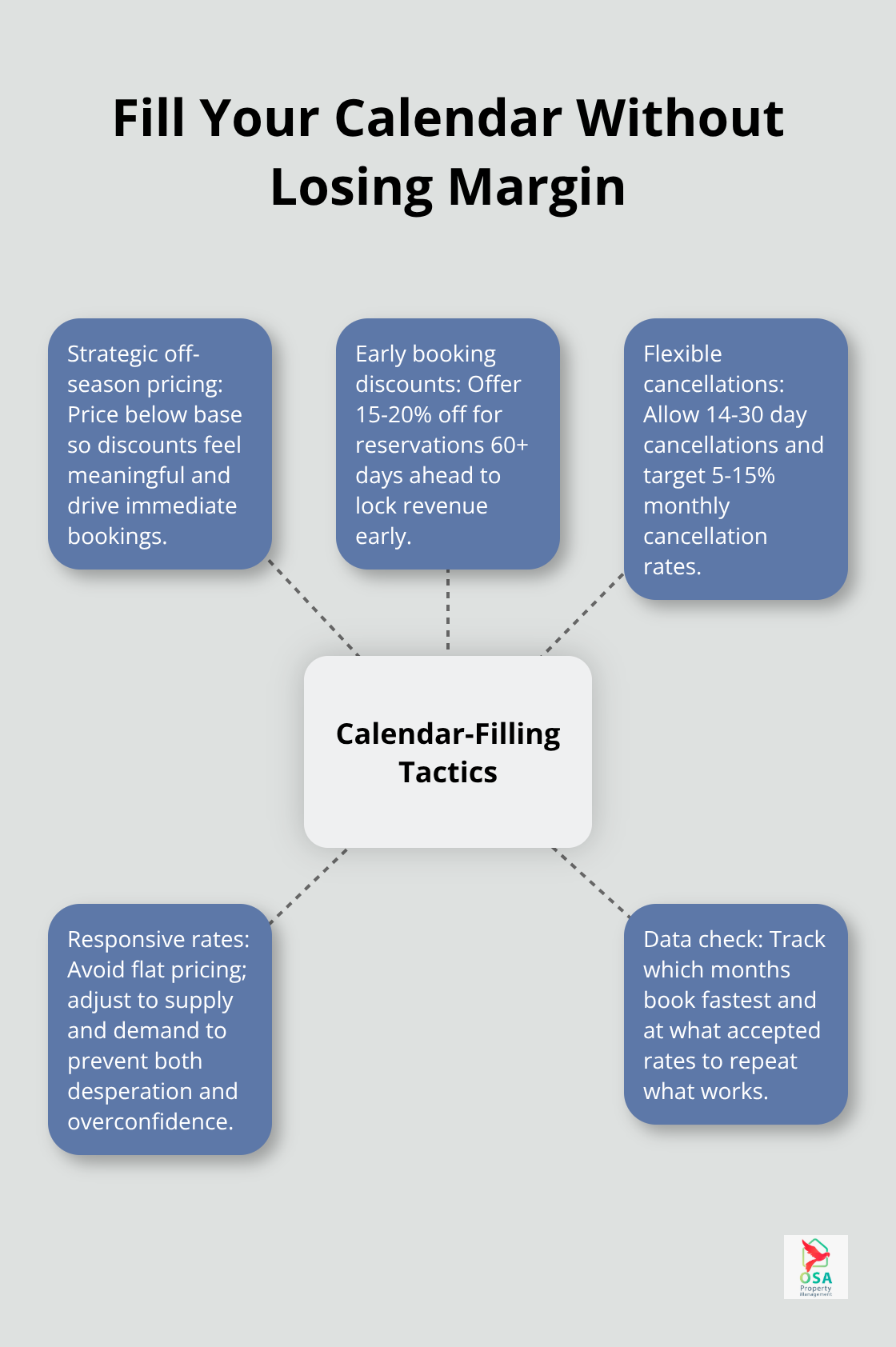
The tension between occupancy and profitability disappears when you stop treating them as opposites. Lower rates during slow periods and premium rates during peaks aren’t contradictions-they’re mathematical responses to supply and demand. Most owners make the mistake of holding rates flat year-round or dropping them indiscriminately whenever bookings slow. Neither approach works. During your property’s off-season, strategic off-season pricing reduces rates below base, because guests perceive meaningful discounts as genuine deals rather than noise. If your base rate is $150 nightly, pricing at $105-120 during slow months signals active availability and attracts budget-conscious travelers who book immediately. That $105 night generates more annual revenue than a $145 night that sits unsold.
The math is straightforward: 60 nights at $105 equals $6,300, while 20 nights at $145 equals $2,900. Strategic off-season pricing keeps your property occupied and your cash flowing rather than watching empty nights accumulate.
Lock in Revenue With Early Booking Discounts
Early booking discounts shift demand forward and reduce your marketing burden during peak season. Offer 15-20% discounts for bookings made 60+ days in advance to lock in revenue while the property still has months of visibility ahead. A guest who books three months early at a discounted rate costs far less to acquire than aggressive marketing for a property with only days until arrival. This approach also smooths your booking calendar-instead of feast-or-famine patterns where you scramble during peak season, you build a more predictable stream of confirmed reservations. The upfront discount trades short-term rate reduction for long-term occupancy stability and reduced acquisition costs.
Balance Cancellation Policies With Occupancy Goals
Flexible cancellation policies operate differently than discounts but serve the same occupancy goal. Flexible cancellation policies that allow guests to cancel 14-30 days before arrival convert hesitant prospects into bookings. The risk is real-some guests will cancel-but the occupancy gains from attracting more bookings typically outweigh cancellation losses. Track your actual cancellation rates monthly; if they exceed 15%, your policy is too lenient and needs tightening. If they fall below 5%, you’re likely being too strict and losing bookings you could have captured. Your goal isn’t zero cancellations; it’s the occupancy rate that maximizes total revenue across the entire year.
Final Thoughts
Your rental pricing strategy determines your income trajectory for years ahead. The three core principles we’ve covered-understanding your local market, setting dynamic rates that respond to demand, and filling your calendar without sacrificing margins-work together to maximize both occupancy and returns. Owners who adjust rates seasonally, monitor competitors regularly, and use data-driven tools report occupancy improvements of 2-3% and ADR lifts of 5-15% compared with static pricing, which translates to thousands in additional annual revenue.
Start your implementation by pulling comparable property data for your area and calculating your true break-even point. Set a base rate that covers costs plus your target profit margin, then layer in seasonal adjustments of 30-50% above base during peak periods and 20-30% below during slow months. Single-property owners often find their booking platform’s native tools sufficient, while multi-property operators benefit from dynamic pricing tools like PriceLabs or Wheelhouse that apply algorithmic adjustments across all listings.
If you manage properties in Costa Rica or need guidance tailoring these principles to your specific market, Osa Property Management brings extensive experience and data-driven expertise to maximize your returns. Their team handles pricing optimization alongside full property management, marketing, and guest relations across the southern Pacific zone.