
Costa Rica’s tropical climate is relentless on properties. Without a solid plan, small issues become expensive repairs that drain your budget and damage your investment.
We at Osa Property Management have seen firsthand how routine maintenance in Costa Rica makes the difference between thriving properties and struggling ones. A preventive schedule stops problems before they start.
Why Preventive Maintenance Saves Money in Costa Rica
The True Cost of Neglect
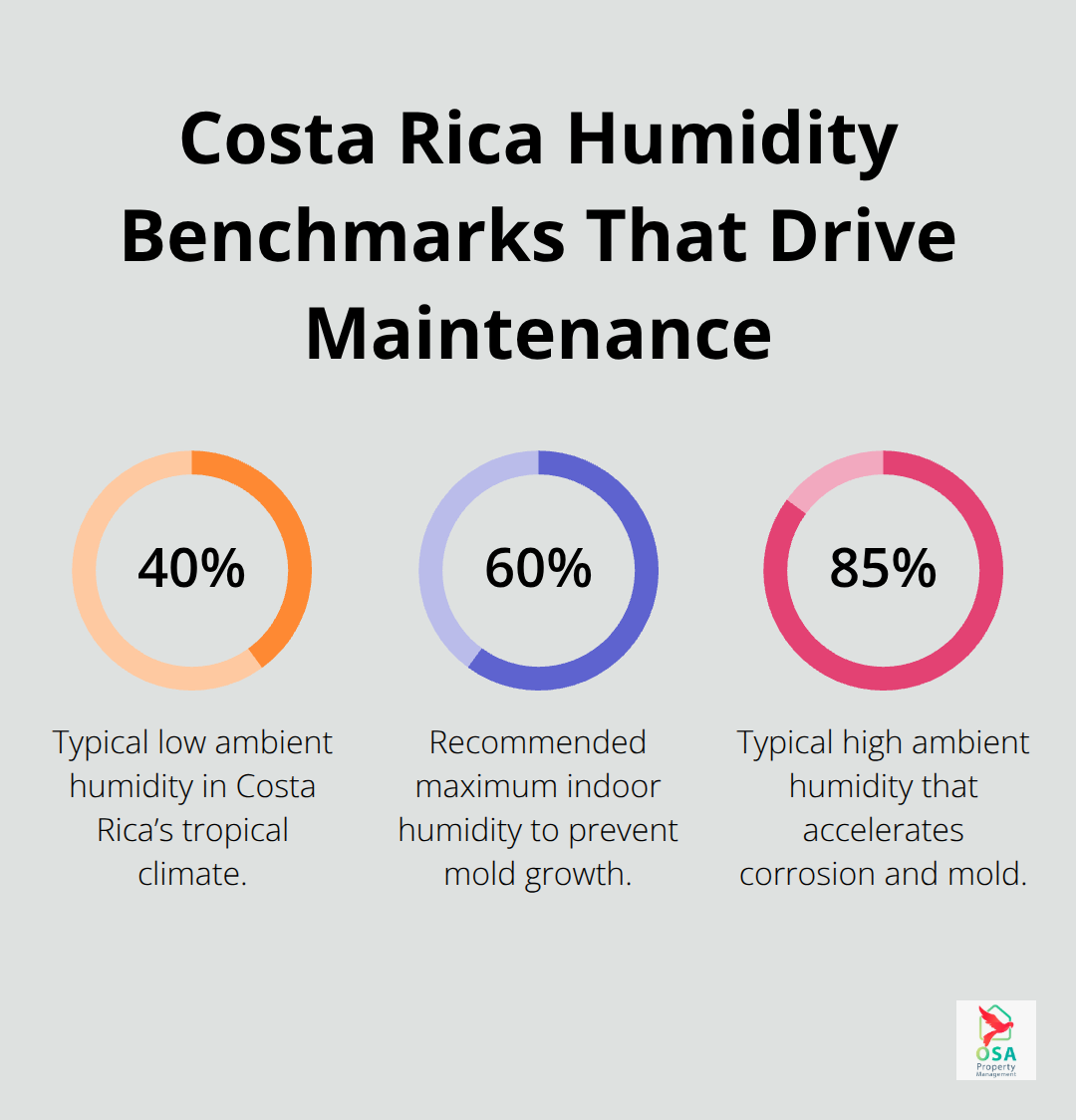
Costa Rica’s humidity ranges from 40% to 85%, and coastal properties face salt air that corrodes metal fixtures in months rather than years. The rainy season from May through November tests every drainage system, gutter, and foundation seal on your property. Without preventive maintenance, a small roof leak becomes structural rot that costs thousands to repair. A gutter cleaning costs $150, but water damage from a clogged gutter costs $3,000 to $8,000.
Monthly pest control inspections run $100 to $150, while termite damage costs millions annually across Costa Rica, destroying wooden beams and floor joists beyond recovery.
Catching Problems Early Protects Your Investment
Coastal homes in Jaco or Manuel Antonio need quarterly checks for salt corrosion on hardware and exterior surfaces. Catching rust early with a rust converter and protective coating prevents complete hardware replacement. Your property investment in Costa Rica appreciates only if you maintain it consistently. Mold and mildew thrive in high humidity and directly reduce rental income by deterring guests and lowering property valuations. A dehumidifier running 50 pints per day in damp areas costs roughly $300 to $500 upfront and $10 monthly in electricity, yet prevents mold damage that would require repainting walls and replacing affected materials at 10 times the cost.
Roof Care and Seasonal Priorities
Roof inspections before and after the rainy season-performed twice yearly-take a few hours and cost $200 to $300 but extend roof lifespan by 5 to 10 years. Exterior painting with UV-resistant paint every 2 to 3 years protects wood and metal from sun damage that accelerates decay. Properties with documented preventive maintenance histories command higher resale prices and attract quality long-term renters because they demonstrate structural integrity and reliability. The seasonal maintenance focus matters: dry season work (December through April) prioritizes exterior painting, roof sealing, and major repairs, while rainy season work focuses on drainage, gutter maintenance, and mold prevention.
Building Your Maintenance Strategy
Properties that follow a preventive schedule spend significantly less on emergency repairs than those managed reactively. The difference lies in timing and consistency rather than complexity. A structured approach to maintenance-one that accounts for Costa Rica’s specific climate challenges-transforms how your property performs and how much it costs to operate. With the right plan in place, you move from reacting to problems to preventing them entirely, which sets the stage for understanding exactly what tasks matter most throughout the year.
Building Your Maintenance Schedule
Structure Tasks Around Costa Rica’s Climate Patterns
Knowing what to maintain is one thing; executing it consistently is another. The difference between owners who stay ahead of problems and those who face costly emergencies comes down to a preventive maintenance schedule tied directly to Costa Rica’s climate patterns. A practical maintenance plan breaks tasks into monthly, seasonal, and annual cycles that align with when problems actually occur in your property. Monthly inspections catch water leaks before they damage walls, check air conditioning filters before mold builds up in ducts, and verify drainage systems are clear before the next heavy rain.
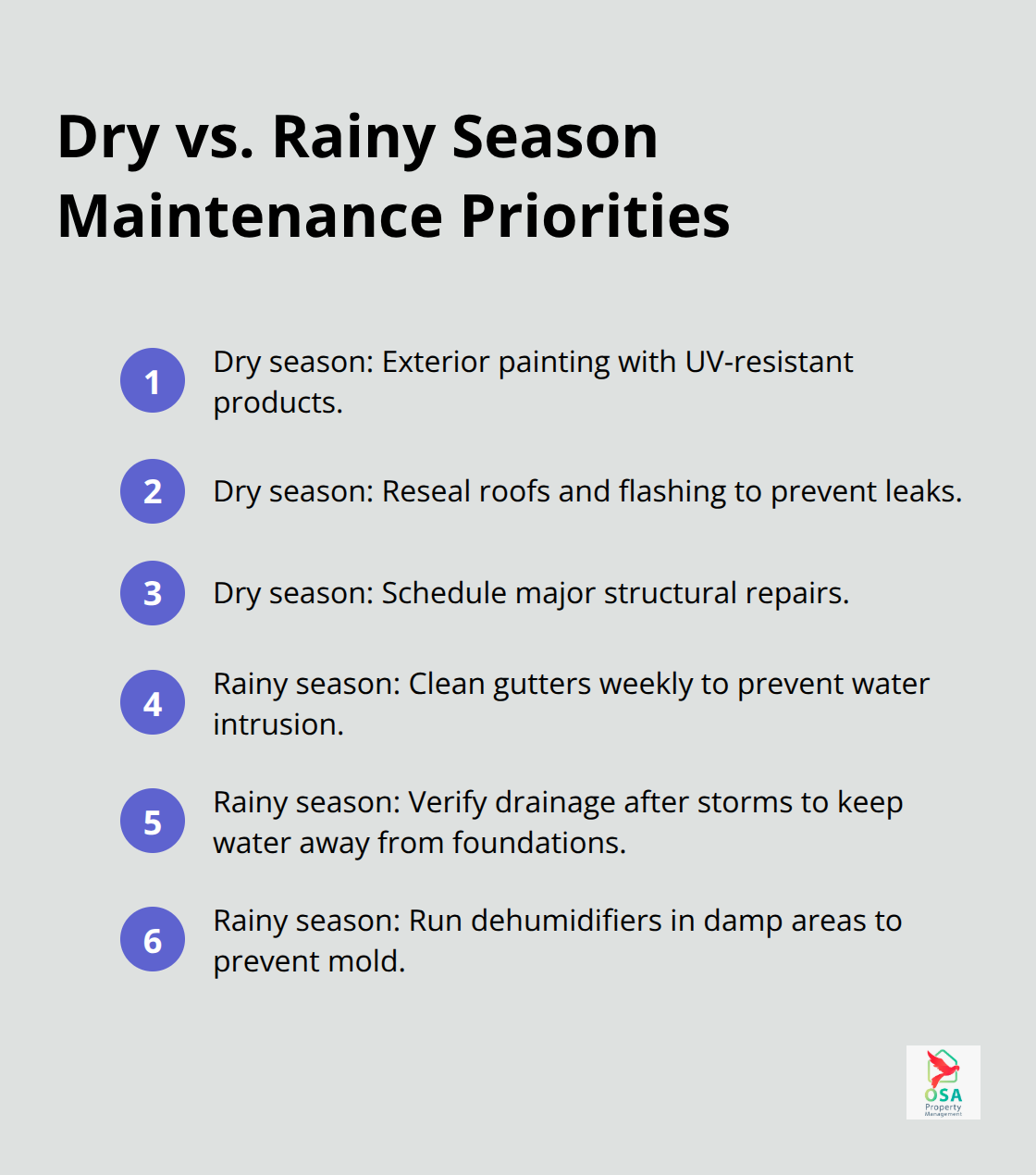
Seasonal shifts demand different priorities: the dry season from December through April is ideal for exterior painting with UV-resistant products, roof sealing, and major structural repairs, while the rainy season from May through November requires weekly gutter cleaning to prevent water intrusion, mold prevention through dehumidifiers in damp areas, and drainage verification after storms.
Establish Quarterly and Annual Inspection Cycles
Quarterly structural checks assess roof integrity, examine exterior paint and sealants for UV damage, inspect major appliances, and verify that seals around pipes and utilities remain intact to block pest entry. Bi-annual inspections at the start and end of rainy season include tree trimming to prevent storm damage, solar panel cleaning if installed, and assessment of outdoor furniture for rust or deterioration. Annual inspections address full structural integrity, complete exterior repainting or resealing with UV-resistant products, and upgrades to energy efficiency and guest comfort. The key is writing these preventive tasks into a calendar now so they happen on schedule, not when problems force your hand.
Select Contractors Who Understand Local Conditions
Hiring the right local contractors determines whether your schedule actually gets executed. Costa Rica’s construction and maintenance sectors vary widely in quality and reliability, making local expertise essential. A contractor familiar with salt corrosion in Jaco knows exactly how to treat rust on metal roofs and which hardware resists corrosion longest. One experienced in Dominical’s mountainous terrain understands drainage challenges and proper roof pitch for intense rainfall. Rather than calling random contractors when problems appear, establish relationships with 2 to 3 vetted specialists before you need them: one for general carpentry and structural work, one for plumbing and drainage, and one for electrical and climate control systems.
Vet Contractors Before You Need Them
Request references from other property owners, verify licensing and insurance, and start with small jobs to assess their reliability and quality. Contractors who arrive on time, communicate clearly, and document their work tend to maintain that standard across all projects. A property manager with established contractor networks saves owners on labor costs through better rates and avoids the delays that plague owners managing from abroad who must coordinate work via email and phone calls. This foundation of trusted relationships transforms how quickly you respond to maintenance needs and how efficiently your property operates throughout the year.
What Actually Ruins Costa Rican Properties
Humidity and Mold: The Silent Destroyers
Humidity and mold destroy Costa Rican properties far more than most owners realize. At 40% to 85% humidity year-round, mold colonizes inside air conditioning ducts, under floorboards, and within wooden structural beams where damage becomes irreversible before you spot it. A dehumidifier pulling 50 pints per day costs $300 to $500 upfront and runs roughly $10 monthly in electricity, yet prevents mold remediation that costs $2,000 to $5,000 per room once it spreads. Indoor humidity levels should be kept below 60 percent to prevent mold growth, and whole-house ventilation reduces indoor humidity effectively, which makes ceiling fans in every bedroom and bathroom exhaust fans essential infrastructure rather than optional upgrades. Mold-resistant paints with anti-microbial coatings cost slightly more than standard paint but eliminate the mold problem at the source rather than treating it repeatedly. During renovations, use mold-resistant materials throughout and clean surfaces with vinegar-water solutions to inhibit growth before it takes hold.
Salt Air and Coastal Corrosion
Coastal properties in Jaco face an additional threat that inland owners avoid: salt air corrodes metal fixtures, wood sealants, and exterior hardware in months rather than years. Rust appears rapidly on metal roofs, railings, and fasteners, and treating it immediately with a rust converter and protective coating prevents complete hardware replacement that costs thousands. UV-resistant paints on exterior surfaces every 2 to 3 years and annual wood sealant reapplication on decks and railings are non-negotiable in coastal zones. Roof care directly determines property lifespan because water intrusion from failed seals or rusted metal causes cascading damage throughout the structure. Inspecting roofs before and after the rainy season, clearing gutters weekly during May through November, and applying waterproof sealant every 2 to 3 years keeps water out entirely rather than managing water damage after it occurs.
Termite Damage and Pest Control
Pest control in Costa Rica requires a different approach than mainland United States property management because termites, ants, and tropical insects cause structural damage that insurance often excludes. Termite damage costs millions annually across Costa Rica, destroying wooden beams and floor joists beyond recovery if left unchecked. Quarterly licensed pest inspections cost $100 to $150 but catch infestations when they remain treatable rather than catastrophic. Sealing entry points with silicone caulk around pipes, utilities, and foundation cracks eliminates pest highways into your home.
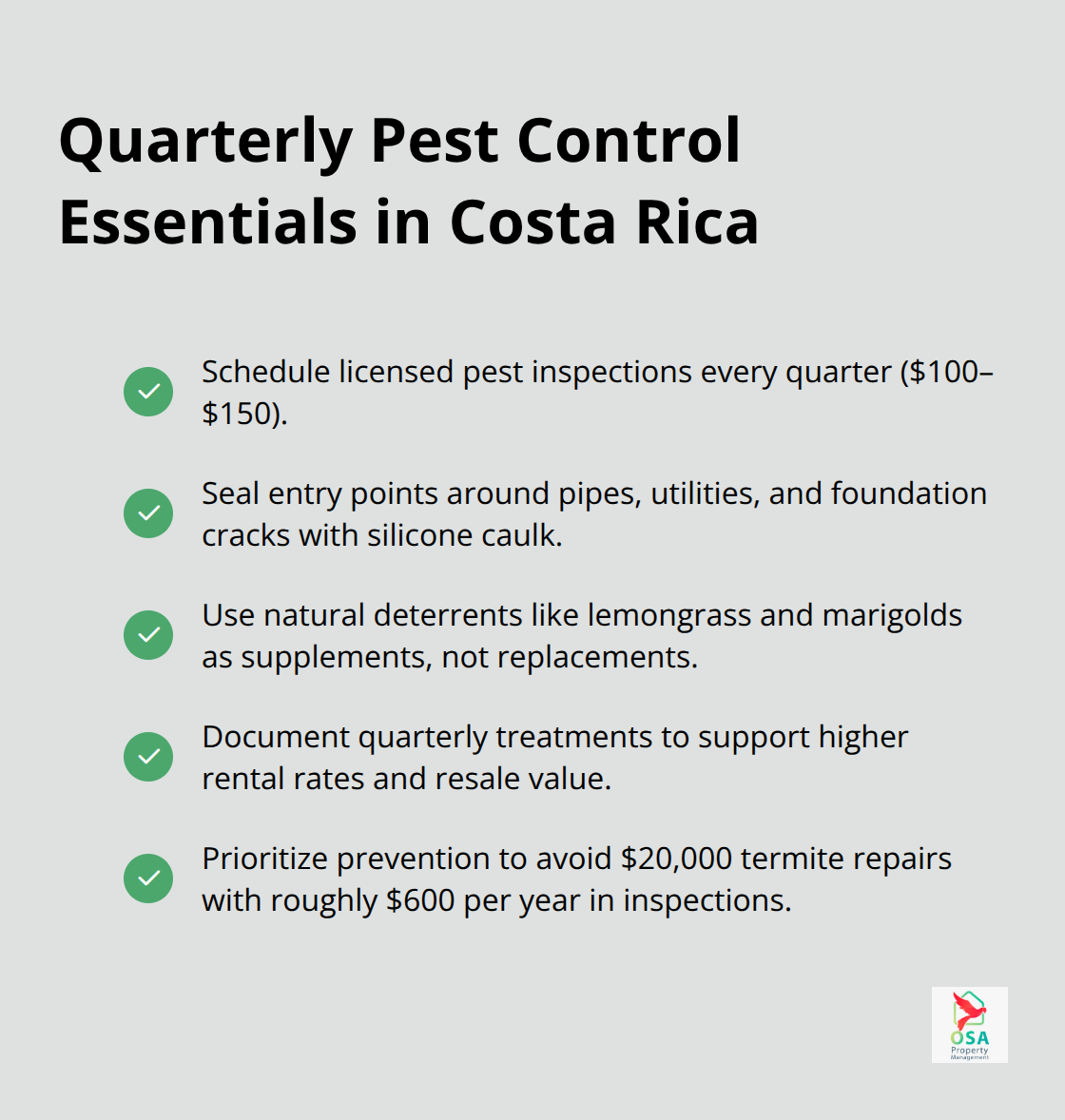
Natural deterrents like lemongrass or marigolds planted around the property perimeter and indoor essential oils reduce pest pressure without chemicals, though they supplement rather than replace professional inspections. Properties with documented quarterly pest control histories command higher rental rates and resale prices because guests and buyers recognize that structural integrity remains protected. The difference between owners who face $20,000 termite repairs and those who spend $600 annually on prevention comes down to consistency, not cost.
Final Thoughts
Owners who follow a preventive schedule spend significantly less on emergency repairs, attract higher-quality renters, and command better resale prices than those who react to problems after they occur. The math proves itself: a $150 gutter cleaning prevents $3,000 to $8,000 in water damage, and $600 annually in pest control prevents $20,000 termite repairs. Routine maintenance in Costa Rica transforms how your property performs financially and operationally.
Professional property management makes this consistency possible, especially for owners living abroad who cannot oversee work personally. We at Osa Property Management coordinate with trusted local contractors, schedule inspections on your calendar, and respond immediately when problems emerge-our team understands how salt air corrodes coastal properties in Jaco, how mountain zones demand robust drainage, and when to prioritize exterior painting during the dry season versus mold prevention during the rainy months. With 19 years of experience across Tarcoles, Jaco, Dominical, Manuel Antonio, Ojochal, and Uvita, we handle marketing, renter relationships, bill payments, accounting, tax compliance, and maintenance oversight so you don’t coordinate across time zones and language barriers.
A solid maintenance plan written into your calendar now prevents the costly emergencies that drain profits later. Contact Osa Property Management to discuss how professional oversight transforms your property’s performance and your peace of mind.