
Chontales property oversight requires balancing multiple regulations, tax requirements, and quality standards simultaneously. Property owners in this region face complex compliance demands that directly impact their bottom line and tenant relationships.
At Osa Property Management, we’ve seen firsthand how overlooked compliance issues create costly problems down the road. This guide walks you through the regulations, common pitfalls, and practical strategies that keep Chontales properties running smoothly.
What Regulations Actually Govern Chontales Properties
Chontales property owners operate within a layered regulatory system that combines national Costa Rican law with municipal requirements specific to the Chontales Department. The National Registry, SETENA (environmental authority), INVU (building authority), and the College of Engineers and Architects all exercise jurisdiction over different aspects of property ownership and operation. Understanding which agency controls what prevents costly delays and fines.
Property Tax Requirements and Filing Obligations
Property tax in Costa Rica runs at 0.25% of the registered property value annually, according to the Ministerio de Hacienda. Luxury properties valued above approximately $214,000 face a solidarity tax that can push rates to around 0.55%. The Declaración Jurada de Bienes Inmuebles, a sworn declaration filed every five years, trips up many owners who submit inaccurate property valuations. Underpayment triggers penalties, while overpayment wastes money unnecessarily. Professional assistance when filing protects against these mistakes and saves time during tax season.
Building Permits and Construction Compliance
Permiso de Construcción applies to all new buildings or significant renovations in Chontales. The permit process typically takes 3 to 6 months because multiple authorities must review architectural plans, environmental impact, and zoning alignment. Most owners underestimate this timeline and face construction delays as a result. Keep the original permit after completion as proof of legal construction; without it, authorities can issue fines or demolition orders.
Zoning classifications in Chontales vary by municipality and define what uses are permitted on each property. Verify your property’s current classification before purchasing or changing use. Environmental restrictions tighten near protected zones or water sources, requiring additional permits within 50 meters of rivers or streams.
Boundary Verification and Survey Requirements
Boundary issues affect nearly 30% of real estate transactions in Costa Rica according to the National Registry. Banks refuse to lend on properties with discrepancies between survey maps and Registry records, creating immediate financing risk. Professional surveys cost $1,200 to $3,000 but prevent disputes that typically cost $15,000 or more in legal fees alone. A qualified survey reveals encroachments, easement violations, and boundary overlaps that lenders treat as deal-breakers.
Tax Filings and Documentation Systems
Rental income taxation rates apply a flat 15% rate on 85% of your gross rental receipts, which works out to an effective tax of roughly 12.75% for most property owners. Maintain digital and physical receipts for all expenses; utility bills serve as occupancy proof and help track maintenance issues like leaks. Organized financial documentation accelerates tax preparation and audit readiness. Many foreign owners form Costa Rican corporations to simplify tax reporting and potential tax planning.
The Certificación Literal from the National Registry proves ownership and shows the property’s history of liens and mortgages; obtain a fresh copy before major transactions to avoid hidden claims. Update this document regularly and store certified copies securely alongside your Escritura (property deed) and Plano Catastrado (cadastral map). These three documents form the foundation of legal property ownership in Chontales. A disciplined organization system saves time and reduces stress when dealing with authorities, lenders, or potential buyers.
With regulations spanning tax filings, building permits, boundary verification, and documentation requirements, property owners in Chontales face substantial compliance demands. The next section addresses the compliance failures that most commonly derail property operations and how to sidestep them.
What Compliance Mistakes Cost Chontales Property Owners
Building code violations and safety hazards
Building code violations rank among the costliest oversights in Chontales property management. Authorities conduct inspections on rental properties, and structures lacking valid permits face fines starting at roughly $500 and escalating to demolition orders in serious cases. The College of Engineers and Architects enforces safety standards that cover electrical grounding, structural integrity, and fire exits. A licensed electrician must verify your system meets Costa Rican codes, which differ from North American standards in ways that create hazards if ignored.
One property owner in the region discovered exposed wiring and overloaded circuits during a routine inspection, costing $3,200 to remediate before rentals could resume. Many owners skip inspections until problems force intervention, which doubles or triples repair expenses. Schedule electrical and structural assessments every two years, document all findings, and address safety gaps before they trigger regulatory action.
Tenant documentation and lease Failures
Tenant documentation failures create a separate category of expensive problems. Rental agreements must clearly specify payment terms, maintenance responsibilities, and house rules; vague or missing leases invite payment disputes and property damage claims that drag through small claims court for months. The Ministerio de Trabajo enforces tenant rights, and improper eviction procedures can result in lawsuits costing $2,000 to $8,000 in legal fees alone.
Utility bills and occupancy records matter equally-they prove active rental status and support tax compliance. Many owners neglect to maintain inspection records, which authorities demand during audits and which strengthen your position if disputes arise. Create a simple inspection checklist covering roof condition, plumbing leaks, foundation cracks, window seals, and exterior drainage; photograph findings monthly and store records digitally and physically.
The Cost of Neglected Property Records
This approach costs roughly $300 to $500 annually for professional inspections but prevents the $15,000+ litigation costs that follow from boundary encroachments or structural damage claims that escalate unchecked. Organized documentation systems protect your rental income and reduce stress when dealing with authorities or tenant disputes. The difference between a well-managed property and a problem property often comes down to whether owners maintain clear records and respond to issues promptly rather than waiting for crises to force action.
Building Quality Into Chontales Properties
Systematic Inspections Reduce Emergency Costs
Property owners who implement monthly inspection routines and maintain detailed repair logs reduce emergency costs by 40 to 50 percent compared to reactive management. Start with a standardized inspection checklist covering roof condition, plumbing leaks, foundation cracks, window seals, and exterior drainage; photograph findings each month and store records digitally and physically. This approach costs roughly $300 to $500 annually for professional assessments but prevents the $15,000+ litigation costs that follow from structural damage claims or boundary encroachments that escalate unchecked.
Tropical Climate Demands Specific Maintenance
Costa Rica’s tropical climate creates maintenance demands that differ significantly from North American properties. Exterior roof and drainage require inspection every three months because missing tiles and clogged gutters cause foundation damage within months in high-rainfall areas. Electrical systems need verification by licensed electricians every two years to confirm grounding, proper circuit loads, and compliance with Costa Rican safety codes, which differ substantially from North American standards.
Plumbing systems suffer from hard water deposits that corrode pipes and fixtures; annual inspections catch corrosion early and identify leaks before they damage structural components. Humidity control matters more than traditional HVAC in Chontales; prioritize proper air circulation, use ceiling fans, and deploy dehumidifiers to reduce mold risk that damages interiors and health. Window and door seals deteriorate faster in tropical humidity, so quarterly checks for water infiltration prevent interior damage and maintain energy efficiency.
Tenant Screening Determines Rental Success
Tenant screening determines whether your property generates reliable income or creates costly disputes. Require three years of rental history, employment verification, and bank statements showing monthly deposits; contact previous landlords directly rather than accepting written references that owners provide. Rental agreements must specify payment terms, maintenance responsibilities, house rules, and consequences for violations; vague leases invite disputes that drag through small claims court for months and cost $2,000 to $8,000 in legal fees.
Maintain utility bills and occupancy records as proof of active rental status and to support tax compliance; the Ministerio de Trabajo enforces tenant rights, and improper eviction procedures trigger lawsuits that devastate your rental income.
Preventative Maintenance Eliminates Budget Surprises
Preventative maintenance planning eliminates the emergency repairs that consume 60 to 70 percent of annual maintenance budgets when owners ignore routine upkeep. Schedule annual HVAC filter changes, quarterly gutter cleaning, semi-annual plumbing inspections, and monthly visual checks for roof damage or water stains. Document all maintenance work with dates, costs, and contractor names; this record proves you maintained the property to legal standards and strengthens your position in tenant disputes or insurance claims.
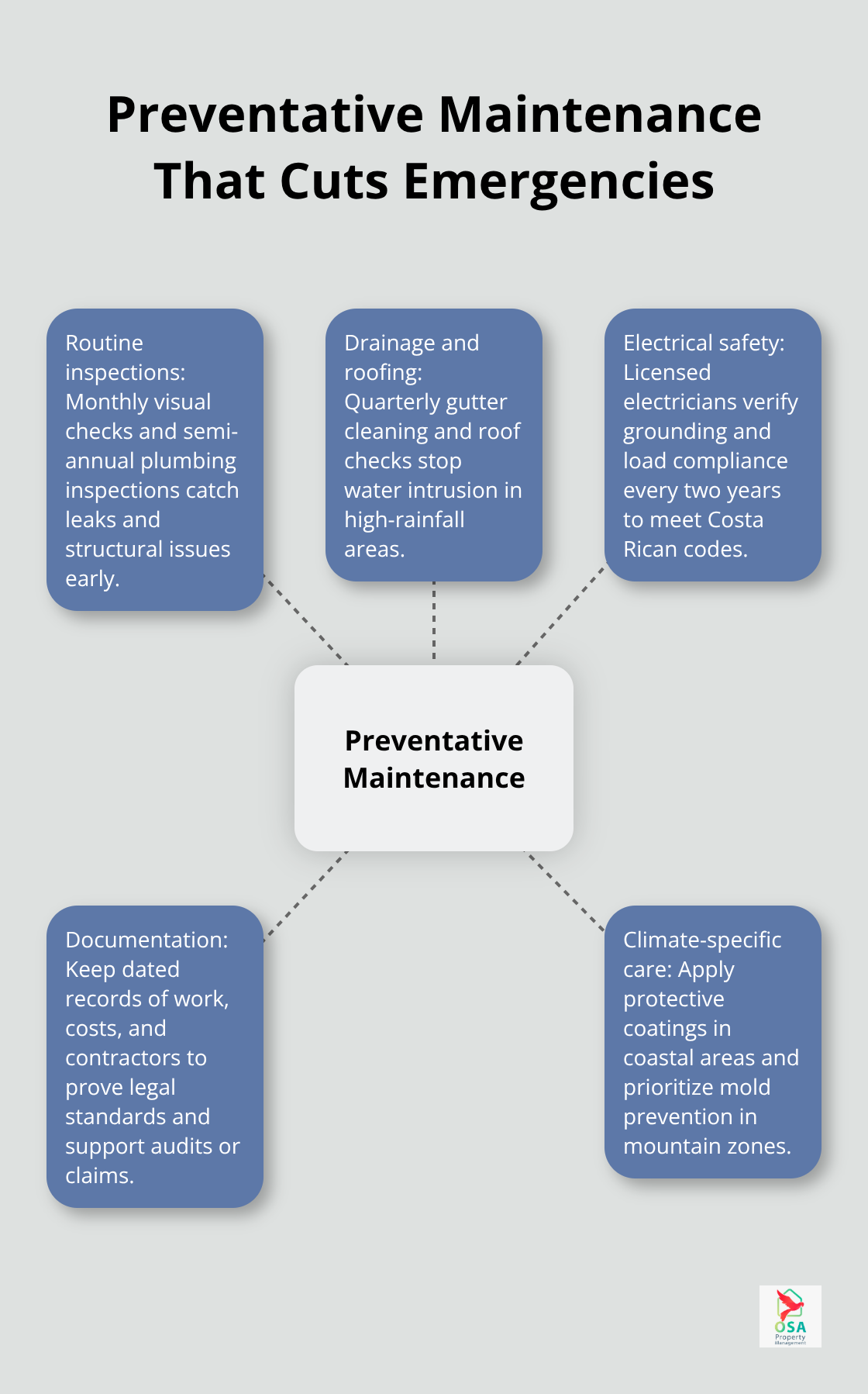
Coastal properties in areas like Uvita and Ojochal face salt air corrosion that accelerates metal deterioration, requiring biannual exterior inspections and protective coatings. Mountain properties in Chontales contend with higher humidity and require more aggressive mold prevention. Professional property management services handle these regional variations and coordinate inspections, tenant screening, and maintenance scheduling without consuming your time.
Final Thoughts
Chontales property oversight demands attention to regulations, compliance deadlines, and maintenance standards that directly affect your rental income and legal standing. Owners who stay on top of tax filings, building permits, boundary verification, and tenant documentation avoid the costly disputes and fines that plague reactive management. Regular inspections catch structural damage early, proper tenant screening prevents payment disputes, and accurate tax documentation keeps authorities satisfied.
We at Osa Property Management understand the specific demands of managing properties in Chontales and surrounding regions. Our team handles tax compliance, tenant relationships, maintenance coordination, and regulatory filings so you don’t have to navigate Costa Rica’s complex legal landscape alone. With full-time staff across Tarcoles, Jaco, Dominical, Manuel Antonio, Ojochal, Uvita, and Golfito, we deliver the local expertise your property needs.
Professional property management support eliminates the guesswork and frees you to focus on what matters. Whether you need full-service management, turn-key vacation rental operations, or development consulting, experienced oversight delivers peace of mind and stronger financial performance.