

Costa Rica property owners face strict tax deadlines that can result in hefty penalties and legal complications. Missing these dates puts your investment at serious risk.
We at Osa Property Management have seen too many owners struggle with Costa Rica’s complex tax system. This guide breaks down every important date you need to know for 2025.
How Much Will You Actually Pay in Costa Rica Property Taxes?
Costa Rica’s property tax system operates on a deceptively simple foundation that catches many owners off guard. The standard property tax rate sits at just 0.25% of your property’s registered value annually, one of the lowest rates globally. However, this registered value often differs significantly from your purchase price or current market value, which creates confusion for new owners.
Property owners must submit a property value declaration every five years, with the next major deadline on January 1, 2026. When you miss this declaration, municipalities assess your property at potentially inflated values, which dramatically increases your tax burden.
The Luxury Tax Reality Check
Properties valued over 126 million colones (approximately $247,073) face the luxury home tax with progressive rates from 0.25% to 0.55%. This tax operates independently from standard property taxes and carries its own deadline of January 15, 2026. The threshold calculation includes property improvements like pools and sports fields, so many owners discover they qualify unexpectedly.
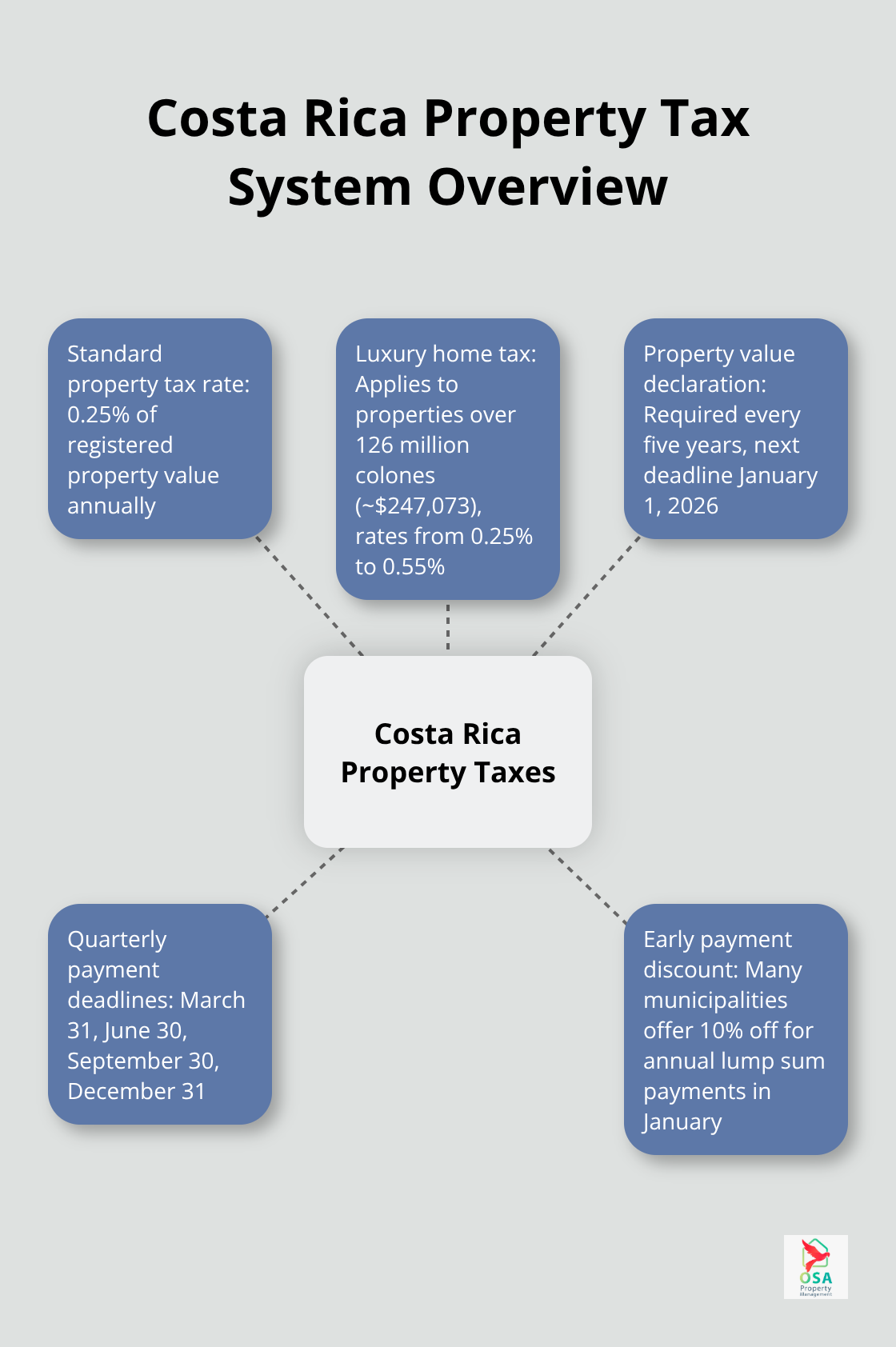
Foreign property owners typically establish corporations for ownership, which adds annual corporation fees of roughly $120 for inactive companies and $300 for active ones. Rental income from your Costa Rica property triggers a 15% tax on 85% of rental income, with quarterly advance payments due on the last day of March, June, September, and December.
Municipal Payment Systems Vary Dramatically
Each municipality manages its own tax collection system, which creates wildly different payment experiences across Costa Rica. Some municipalities like Osa offer advanced online systems that accept credit cards, while others require in-person visits or bank transfers through Banco de Costa Rica accounts.
The four quarterly payment deadlines remain consistent nationwide: March 31, June 30, September 30, and December 31. Late payments trigger 1.5% monthly interest charges plus penalties that reach up to 50% of the original tax amount. Many municipalities offer early payment discounts of around 10% for annual lump sum payments made in January, which provides significant savings for organized property owners.
These payment complexities become even more challenging when you consider the specific deadlines that await you throughout 2025.
What Are the Critical 2025 Tax Dates
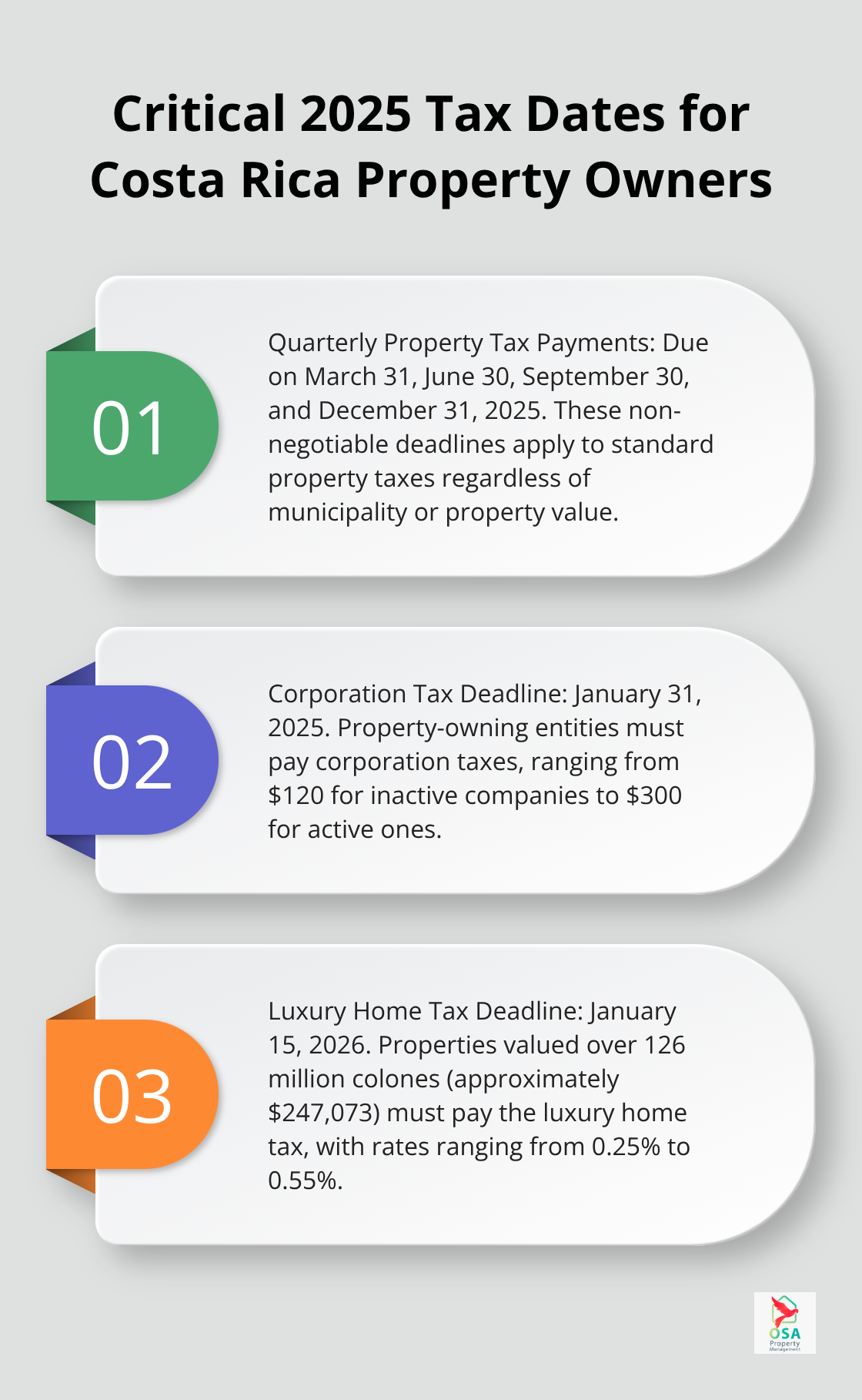
Costa Rica property owners must navigate four quarterly payment deadlines that remain non-negotiable throughout 2025: March 31, June 30, September 30, and December 31. These dates apply to standard property taxes regardless of your municipality or property value. Each missed quarterly payment triggers immediate penalties of 1.5% per month on outstanding amounts, which compound rapidly and can reach up to 50% of your original tax debt within a year.
Annual Declaration Requirements Hit January 1, 2026
Property owners face a mandatory property value declaration deadline on January 1, 2026, which occurs every five years. This declaration determines your tax burden for the next five-year cycle, which makes it absolutely essential for your financial plans. Municipalities assess properties at inflated values when owners miss this deadline, often resulting in tax increases of 200% or more.
Luxury Tax and Corporation Deadlines
The luxury home tax operates on a separate timeline with its payment due January 15, 2026, which affects luxury properties. The tax rates range from 0.25% to 0.55% of the property’s value. Corporation taxes for property-owning entities must be paid by January 31, 2025, with fees that range from $120 for inactive companies to $300 for active ones.
Rental Income Tax Schedule
Rental income taxes require quarterly advance payments on the final working days of March, June, September, and December, based on 15% of 85% of rental income. Property owners should slightly overestimate these quarterly payments to avoid underpayment penalties that accumulate throughout the year.
Early Payment Discounts End in January
Most municipalities offer 10% discounts for property owners who pay their entire annual tax bill in January, but these discounts disappear after the first month. Property owners who utilize this early payment strategy save hundreds of dollars annually while they avoid the stress of quarterly deadlines.
These strict deadlines create serious financial consequences when property owners fail to meet them, which leads to penalties that can devastate your investment returns.
What Happens When You Miss Tax Deadlines
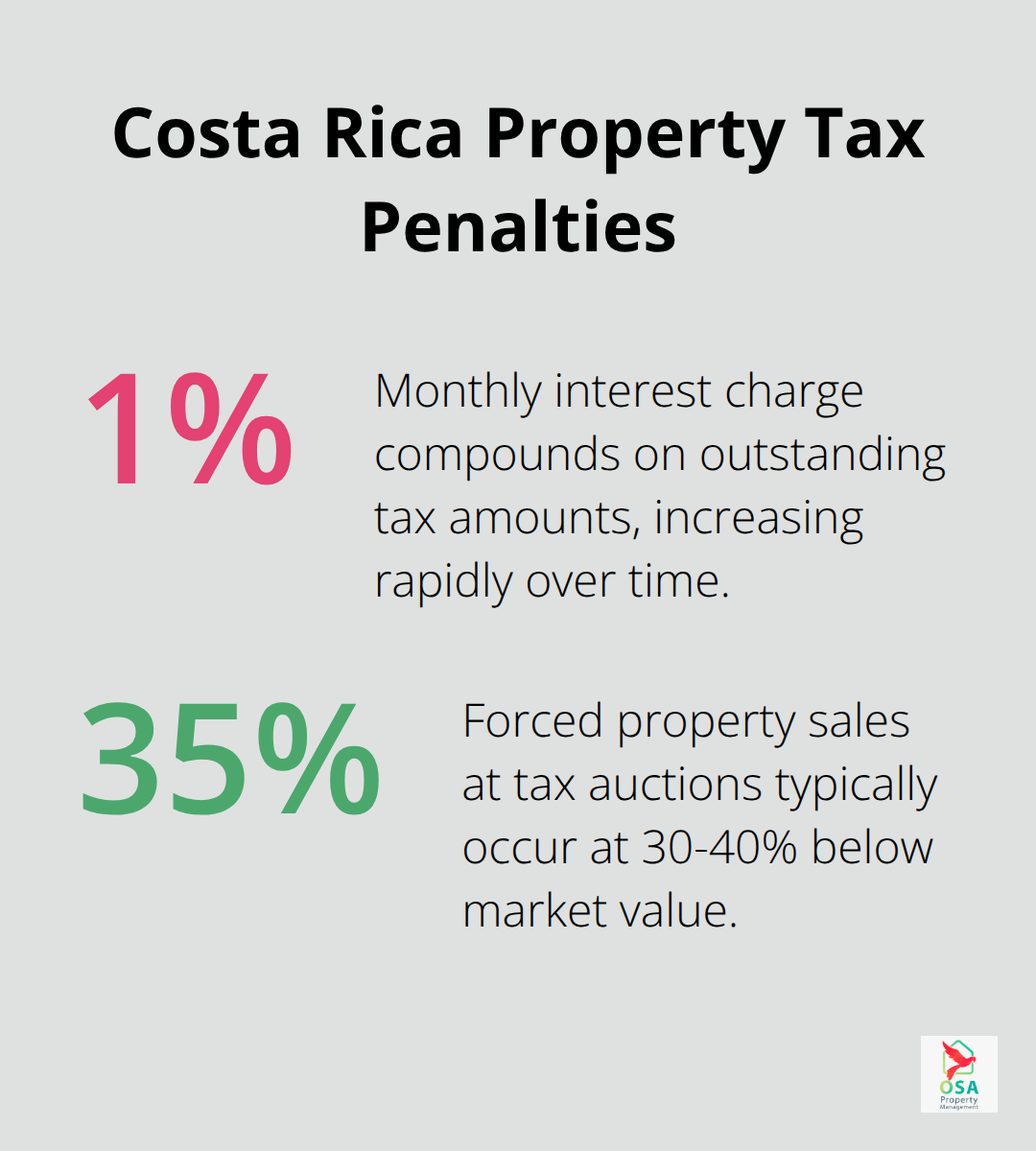
Property tax penalties in Costa Rica escalate rapidly and can destroy your investment returns within months. The 1.5% monthly interest charge compounds on outstanding amounts, which means a $1,000 tax bill becomes $1,600 after just one year of non-payment. Penalties reach up to 50% of the original tax amount, which transforms manageable payments into financial disasters that force property sales.
Legal Action Starts Faster Than Expected
Municipalities initiate collection proceedings within 90 days of missed deadlines, which leads to property liens that prevent any transfers or refinancing. The Costa Rican legal system allows forced property sales to recover unpaid taxes, and these auctions typically occur at prices 30-40% below market value. Foreign property owners face additional complications because collection notices arrive at local addresses they rarely monitor, which accelerates legal proceedings without their knowledge.
Property Transactions Stop Immediately
Unpaid property taxes create immediate barriers to property sales or transfers because buyers cannot obtain clear title with outstanding tax debts. Real estate transactions require current tax certificates from municipalities, and these documents become unavailable when payments fall behind. Properties with tax liens sit on the market indefinitely while penalties accumulate, which forces owners into desperate situations where they accept below-market offers just to escape mounting debts.
Financial Impact Compounds Monthly
Each month of delayed payment adds 1.5% to your total debt (approximately 18% annually), which creates a snowball effect that quickly overwhelms property owners. A modest $500 quarterly tax payment becomes $750 after just one year of non-payment, and the penalties continue to compound until full payment occurs. Property owners who miss multiple quarters often face total tax bills that exceed their annual rental income, which eliminates any profit from their Costa Rica investment.
Recovery Options Become Limited
Once penalties exceed 25% of the original tax amount, municipalities rarely accept partial payments or payment plans. Property owners must pay the full amount including all accumulated interest and penalties before they can regain good standing. This all-or-nothing approach forces many owners to liquidate other assets or take emergency loans at unfavorable terms to protect their Costa Rica property investment.
Final Thoughts
Costa Rica property tax deadlines demand absolute precision from property owners throughout 2025. The quarterly payment dates of March 31, June 30, September 30, and December 31 remain fixed, while the luxury home tax deadline of January 15, 2026, and the property value declaration due January 1, 2026, create additional compliance requirements that cannot be ignored. These tax deadlines transform manageable payments into financial disasters when owners miss them.
Property owners who fall behind face immediate 1.5% monthly penalties that compound rapidly. Property liens, forced sales, and blocked transactions become inevitable consequences when owners fail to meet their obligations. The Costa Rican legal system shows no mercy to property owners who ignore these critical dates (regardless of their residency status).
We at Osa Property Management handle tax compliance, bill payment, and record maintenance for properties throughout Costa Rica’s Pacific coast. Our team protects owners from costly penalties and legal complications that destroy investment returns. Property owners who need professional assistance can contact Osa Property Management to secure their investments and maintain compliance with Costa Rica’s strict tax requirements.