Owning rental property in Costa Rica comes with tax obligations that many landlords overlook or misunderstand. The Costa Rica rental tax system has specific rules about what income you must report, which expenses you can deduct, and when you need to file. At Osa Property Management, we've seen firsthand how costly mistakes can be when landlords don't handle their taxes correctly. This guide walks you through the essentials so you can stay compliant and keep more of your rental income.
How Your Rental Income Gets Taxed in Costa Rica
Short-Term vs. Long-Term Rental Classifications
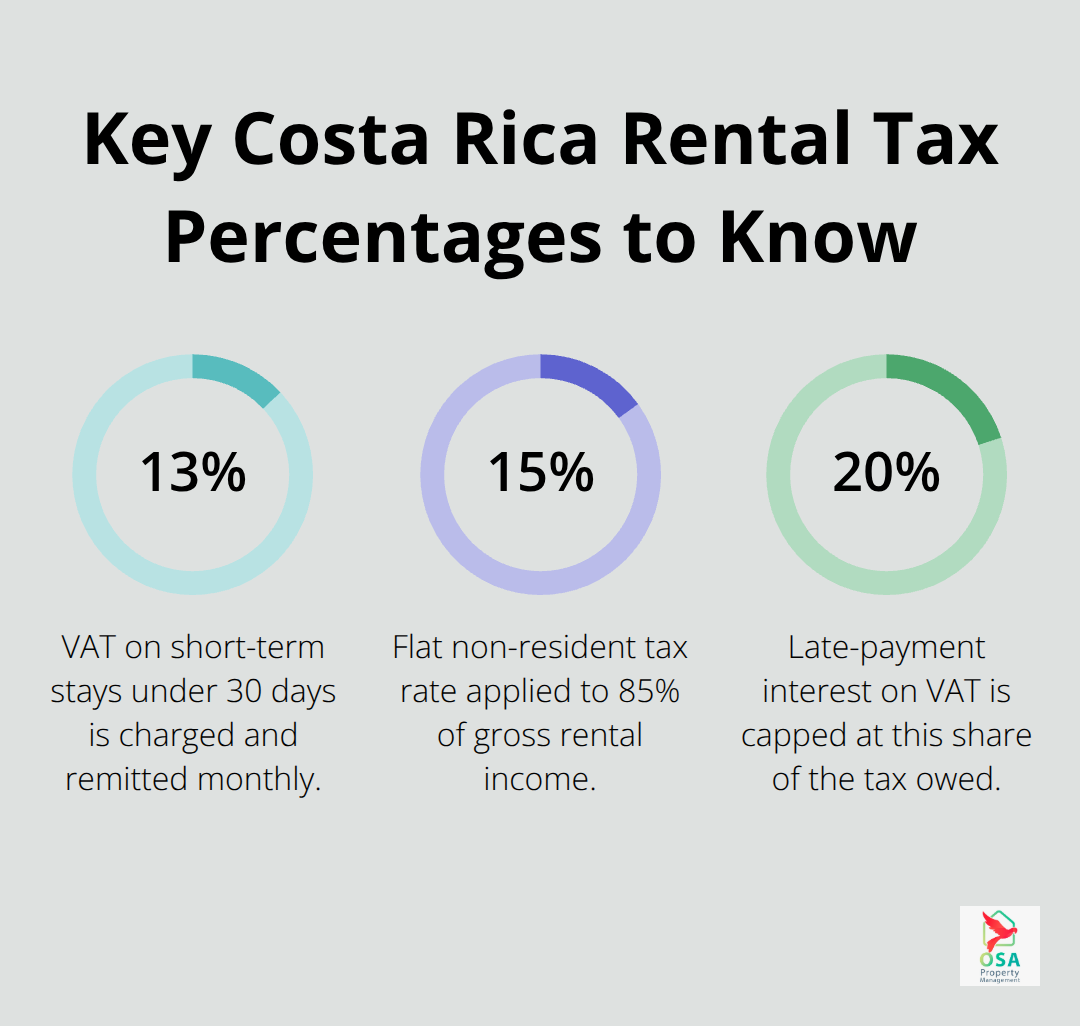
Your rental income classification determines everything about your tax liability. Short-term rentals where guests stay under 30 days trigger
13% VAT collected from each guest and remitted monthly to the Dirección General de Tributación. This VAT stays separate from income tax and does not count toward your taxable rental income, yet many landlords mistakenly treat it as profit, creating cash-flow problems when the monthly payment arrives.
Long-term rentals over 30 days avoid VAT entirely, though rental income still gets taxed through the progressive income tax system if you're a resident or a flat 12.75% withholding if you're non-resident. The threshold between these two categories sits around CRC 650,000 monthly (roughly USD 1,085), meaning a long-term rental at $1,500 per month could save approximately $1,950 annually compared to short-term operations generating identical revenue.
Tax Rates for Residents vs. Non-Residents
Residents pay
progressive income tax rates climbing from 10% to 25% on net rental income after deductions, while non-residents face a flat 15% tax on 85% of gross rental income with no deductions allowed. This distinction matters enormously: a resident with $50,000 annual rental income and $15,000 in deductible expenses pays tax on $35,000, whereas a non-resident pays 15% on $42,500 with zero ability to reduce the taxable amount. Non-residents must appoint a local representative called a NIT to handle all tax filings on their behalf, adding complexity that many overlook until penalties appear.
Critical Filing Deadlines and Penalties
Costa Rica's tax year runs October 1 through September 30, requiring quarterly installment payments due February 20, May 20, August 20, and November 20, with a final annual return due December 15. Short-term rental operators must also
file monthly VAT declarations by the 15th of each following month, even during months with zero rental activity. Missing a single VAT deadline triggers penalties starting at 1% monthly interest capped at 20% of the tax owed, compounding quickly. For a $10,000 monthly short-term rental generating $1,300 in VAT liability, missing payments can grow to $1,560 after the first month and $1,873 after the second.
Audit Risk in Tourism Hotspots
The Dirección General de Tributación cross-references platform reports from Airbnb and VRBO against your filings, making discrepancies impossible to hide. Tourism hotspots like Manuel Antonio, Uvita, and Dominical face higher audit frequency due to their volume of short-term rentals, making precision non-negotiable in these areas. Cloud-based accounting software like QuickBooks Online or Xero costs $15 to $30 monthly and automatically tracks deadlines while preventing the duplicate entries and missed filings that trigger audit flags.
Managing Compliance Without the Headache
Professional managers charge $300–$1,000 annually for tax advisory and compliance support. This investment often pays for itself through accurate deduction capture and timely filings that prevent penalties. Understanding your tax classification and filing schedule forms the foundation for compliance, but the real complexity emerges when you calculate which expenses you can actually deduct from your rental income.
Deductions and Expenses That Reduce Your Rental Tax Bill
Understanding What You Can Deduct
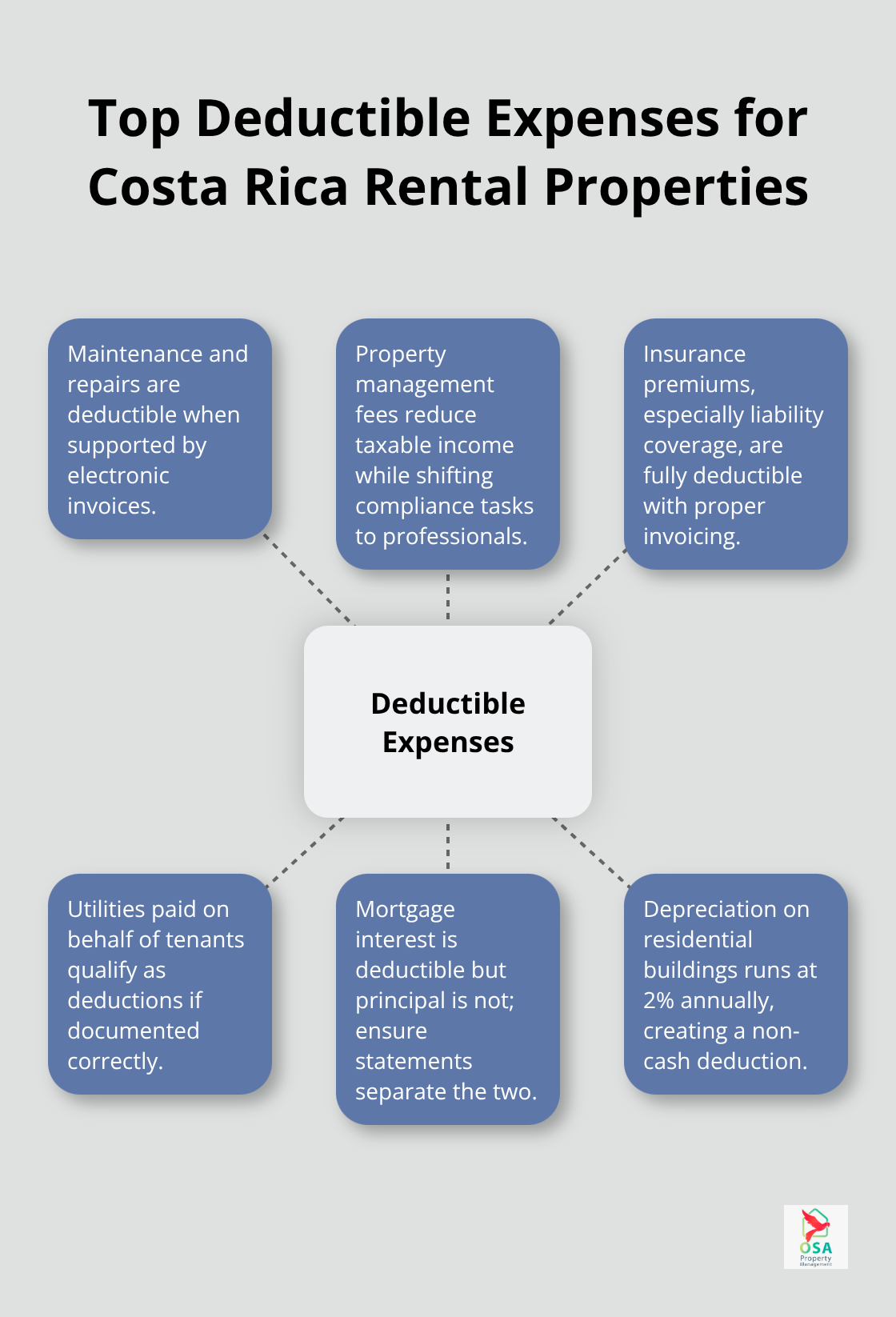
Deductions are where most landlords leave money on the table. Residents in Costa Rica can deduct maintenance, repairs, property management fees, insurance, utilities paid on behalf of tenants, mortgage interest (not principal), property taxes, advertising costs, depreciation, and since 2025, energy-efficient upgrades like solar panels and water-saving systems. Non-residents receive none of these-they pay 15% on 85% of gross income with zero deductions allowed.
This gap creates a massive difference: a resident with $50,000 annual rental income can potentially cut taxable income to $30,000 through proper deductions, while a non-resident pays on $42,500 regardless of actual expenses. The Dirección General de Tributación requires electronic invoices (factura electrónica) for every deductible expense, so a $5,000 roof repair without proper documentation disappears from your tax file.
Maintenance Costs in Tropical Climates
In tropical regions like Manuel Antonio, Uvita, and Jaco,
maintenance and repairs typically consume 1.5 to 3 percent of your property's value yearly, averaging $10,000–$25,000 annually. These are not optional costs-they are survival expenses that absolutely must be documented. Cloud-based accounting software like QuickBooks Online or Xero costs $15 to $30 monthly and boosts deductible capture by 15 to 20 percent compared to manual tracking, often recovering $2,000 to $5,000 in missed deductions annually. Mortgage interest is deductible but principal payments are not, so separating these on your loan statements proves essential. Depreciation on residential buildings runs 2 percent annually over 50 years, meaning a $300,000 property structure generates $6,000 in annual depreciation deductions without any cash outlay.
Property Management and Professional Services
Property management fees solve two problems simultaneously: they reduce your taxable income and they shift compliance responsibility to professionals who understand Costa Rica's complex rules. Professional managers charge 20 to 30 percent of gross rental income, which sounds steep until you realize they handle monthly VAT filings, quarterly tax installments, electronic invoicing, expense documentation, and vendor coordination. Utility expenses paid on behalf of tenants, platform commissions (Airbnb typically takes 3 percent), advertising costs, insurance premiums, and HOA fees all qualify as deductions when properly invoiced. Insurance is particularly important-liability coverage for rental properties is non-negotiable in Costa Rica, and the annual premium is 100 percent deductible.
Documentation and Record-Keeping
Separate bank accounts for each rental property eliminate co-mingling issues that trigger audit flags. Maintain four years of signed leases, invoices, receipts, and bank statements to give you the documentation Hacienda expects during an audit. Missing a single receipt or invoice for a claimed deduction can invalidate the entire expense category, which is why digital documentation matters far more than it seems. Electronic invoices form the backbone of your defense against audit challenges, so treat every transaction as a potential audit record.
Moving Forward With Tax Strategy
Once you understand which expenses reduce your tax liability, the next step involves calculating your actual tax obligation based on your residency status and rental classification. This calculation determines how much you owe quarterly and annually, and it shapes your cash-flow planning for the year ahead.
Common Mistakes Landlords Make with Rental Taxes
Treating VAT as Income Instead of a Liability
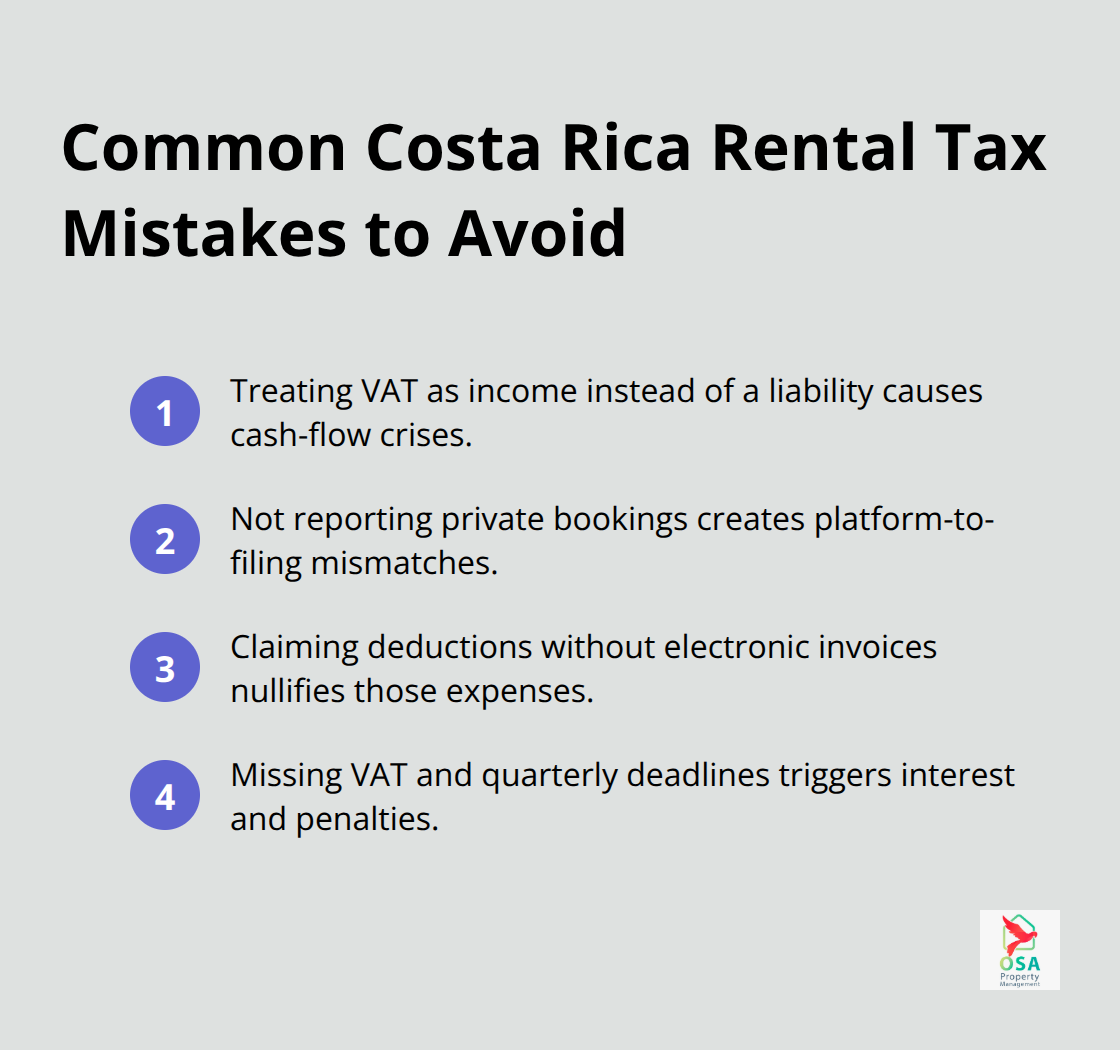
Landlords operating short-term rentals in Costa Rica commonly treat VAT as income rather than a liability, costing thousands annually. When a guest pays $1,130 for a $1,000 nightly rate, many landlords deposit the full amount into their business account and report $1,130 as rental income, then panic when the $130 VAT payment arrives on the 15th of the following month. The Dirección General de Tributación expects that $130 to be remitted, not kept as profit. Over a year with 200 nights booked at $1,000 per night, this mistake creates a $26,000 cash-flow crisis. The solution is immediate: open a dedicated VAT holding account and transfer 13% of every booking into it before touching the remaining 87%. This single step eliminates the monthly scramble to find money for VAT remittance. Non-residents face even harsher consequences because the flat 15% withholding on 85% of gross income already assumes zero deductions, so misclassifying VAT as income inflates the tax base further.
Failing to Report All Rental Income
Many landlords fail to report private bookings made outside platforms like Airbnb and VRBO. The
Dirección General de Tributación cross-references platform reports against your tax filings, and when discrepancies appear, auditors assume intentional underreporting. A property that generates $30,000 annually on Airbnb but $50,000 total because of private bookings that go unreported creates an immediate audit trigger in tourism hotspots like Manuel Antonio and Uvita.
This gap signals intentional evasion to tax authorities, who then scrutinize every other aspect of your filing.
Claiming Deductions Without Electronic Invoices
The second major error involves claiming deductions without the required electronic invoices. Costa Rica's
factura electrónica system means every single deductible expense must have a digital invoice issued through Hacienda's system. A $5,000 roof repair paid in cash to a local contractor without a formal invoice is worthless as a deduction, even if you have a receipt. The contractor must issue an electronic invoice, and you must receive a copy in Hacienda's system. Many landlords lose $2,000 to $5,000 annually in valid deductions simply because they lack proper documentation.
Professional property managers handle this administrative burden by ensuring every vendor issues compliant invoices and maintains organized digital records, which eliminates the documentation gap entirely.
Missing Deadlines and Accumulating Penalties
The third mistake is missing quarterly installment payments and monthly VAT filing deadlines. Costa Rica's tax year runs October 1 through September 30, with quarterly payments due February 20, May 20, August 20, and November 20. Missing even one deadline triggers penalties starting at 1% monthly interest, capped at 20% of the amount owed. For someone owing $1,300 monthly in VAT, a two-month delay compounds to $1,873 in liability. Non-residents must file Form D-125 every month regardless of activity level, and missing a single filing creates penalty exposure. Cloud accounting software like QuickBooks Online costs $20 monthly and sends automatic reminders before every deadline, preventing the costly oversights that plague landlords managing multiple properties or operating from overseas.
Final Thoughts
Costa Rica rental tax compliance rests on three fundamentals: classify your rental correctly as short-term or long-term, claim every deductible expense with proper electronic invoices, and hit your filing deadlines without exception. Residents who master these elements typically reduce their tax liability by 20 to 30 percent compared to landlords who treat taxes as an afterthought. Non-residents face steeper challenges because the flat 15% withholding on 85% of gross income leaves no room for deduction recovery, making accurate income reporting and expense documentation even more critical. The mistakes outlined earlier cost landlords thousands annually-treating VAT as income instead of a liability, failing to report private bookings, claiming deductions without electronic invoices, and missing deadlines are entirely preventable errors that compound into audit exposure and penalties. A single missed VAT filing deadline triggers 1% monthly interest capped at 20%, turning a $1,300 liability into $1,873 within two months. These risks happen regularly in tourism hotspots like Manuel Antonio, Uvita, and Jaco where the Dirección General de Tributación audits aggressively. We at Osa Property Management handle monthly VAT filings, quarterly tax installments, electronic invoicing, expense documentation, and vendor coordination across Tarcoles, Jaco, Dominical, Manuel Antonio, Ojochal, Uvita, and Golfito. Professional support transforms Costa Rica rental tax compliance from a source of stress into a manageable system, and our team manages these administrative burdens so you focus on your property investment rather than tax deadlines. Contact
Osa Property Management to eliminate the complexity entirely while maximizing your rental income through accurate tax planning and compliance.