Costa Rica's IVA system affects every landlord who rents property in the country. Getting the rules wrong can lead to penalties, missed deductions, and unnecessary tax bills. At Osa Property Management, we've helped countless property owners navigate Costa Rica IVA compliance. This guide walks you through registration requirements, filing deadlines, deductible expenses, and the credits available to you. At Osa Property Management we have
in-house accountants that handle ALL of a vacation rental owner's tax requirements.
Contact us and let us handle your property management and tax needs.
How IVA Works and Who Pays It
Costa Rica's
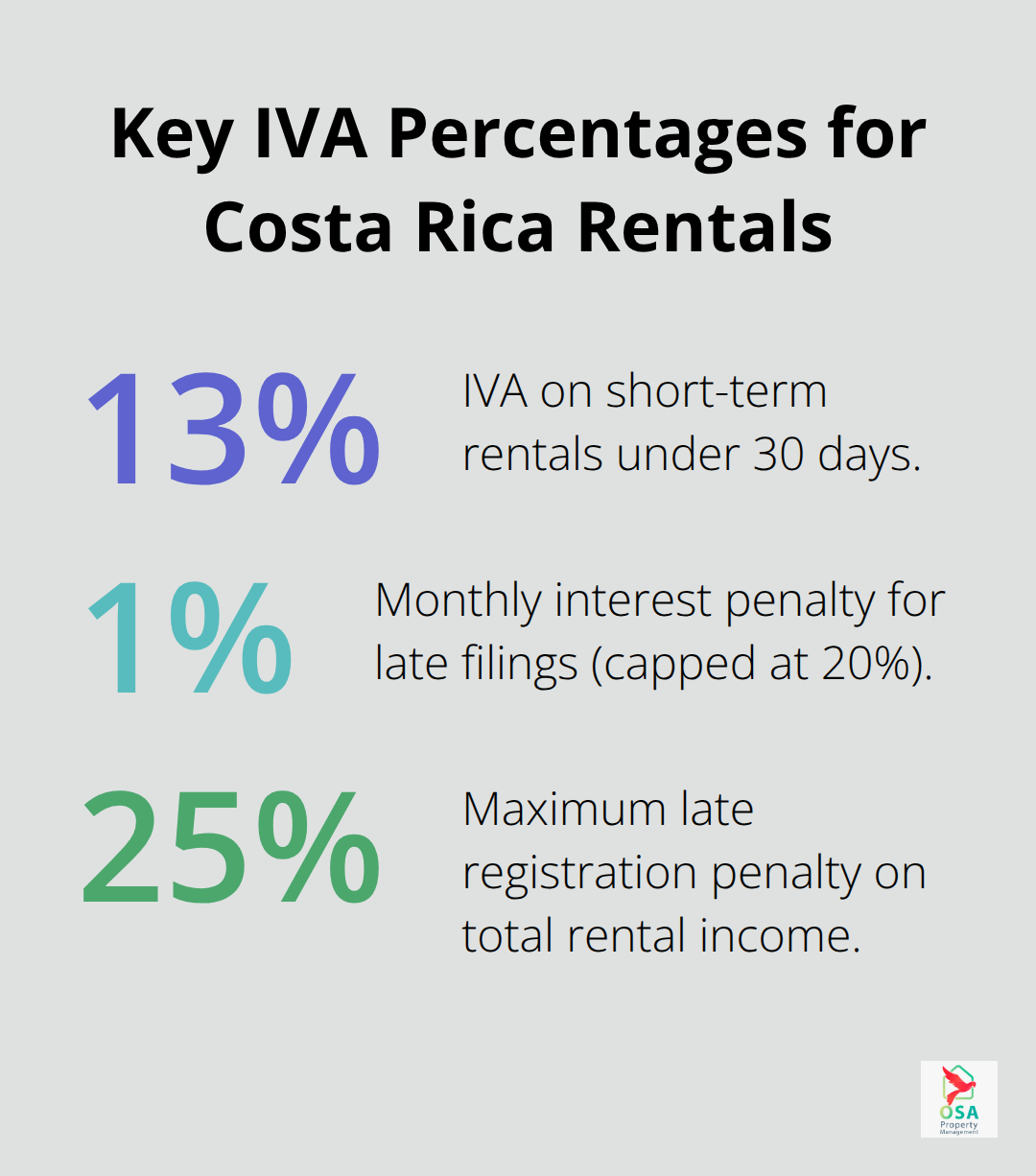
13% IVA tax on short-term rentals under 30 days means you collect this tax from guests and remit it monthly to Hacienda, the country's tax authority. The math is straightforward: a $1,000 base rental becomes $1,130 after IVA, with you collecting the $130 difference from the guest and passing it to the government. Long-term rentals over 30 consecutive days are exempt, which creates a significant pricing advantage if your property can sustain longer bookings. Most property owners in tourist zones like Manuel Antonio and Uvita operate short-term rentals, so the 13% tax applies to the vast majority of rental income.
Additional services you offer-private chefs, area tours, concierge services-also incur the 13% tax, compounding your tax obligations. According to Hacienda, the fiscal month runs from the 1st to the 31st, and you must remit all
IVA collected between the 1st and 15th of the following month. Missing this deadline triggers automatic penalties of 1% interest per month, capped at 20%, plus potential compliance reviews that cross-reference your reported income against platform data from Airbnb or Vrbo.
When Registration Becomes Mandatory
Registration with Hacienda is mandatory once you collect rental income. You must obtain a NITE identification number before depositing any funds into your account. Late registration carries penalties up to 25% of total rental income, making early compliance non-negotiable. After registration, every transaction requires a factura electrónica, or digital invoice, issued immediately upon booking confirmation.
Understanding Income Thresholds
If your annual rental income exceeds roughly 1,000,000 colones, you must register as an IVA taxpayer and file monthly returns. Below that threshold, registration is optional but strongly inadvisable because unregistered operators lose the ability to deduct business expenses or recover the 13% IVA paid on property-related purchases like maintenance, cleaning supplies, or contractor labor. A 2,000,000 colones renovation with properly documented invoices yields approximately 260,000 colones in recoverable IVA-money you forfeit if unregistered.
Invoice Requirements and Contractor Documentation
Once you register, your invoices must display your NITE number, and contractors must include their own NITE on receipts for expenses to qualify for deduction. Hiring a local contador público autorizado, or certified accountant, typically costs 150,000 to 300,000 colones annually and pays for itself by capturing deductions and preventing filing errors that trigger audits. The Ministry of Finance provides an official tax calendar listing all deadlines; saving or printing this calendar prevents missed payments during peak season when administrative tasks pile up.
Record-Keeping Standards Hacienda Enforces
Hacienda demands four years of records to support your tax filings, including lease terms, invoices marked with your NITE, utility bills tied to the rental, and platform statements from Airbnb or Vrbo. Your records must align with platform data because Hacienda cross-references reported income against what platforms report about your properties. Maintain a dedicated rental business bank account to keep personal and rental finances separate, creating an auditable trail that reduces dispute potential during reviews. Pay all contractors via bank transfer or credit card rather than cash to verify expenses and ensure they qualify for recovery; cash payments leave no documentation trail and Hacienda disallows them entirely. With these registration and documentation systems in place, you're ready to understand which expenses actually reduce your tax burden and how to claim the deductions available to you.
Filing Your Monthly IVA Returns On Time
The 15th Deadline Is Non-Negotiable
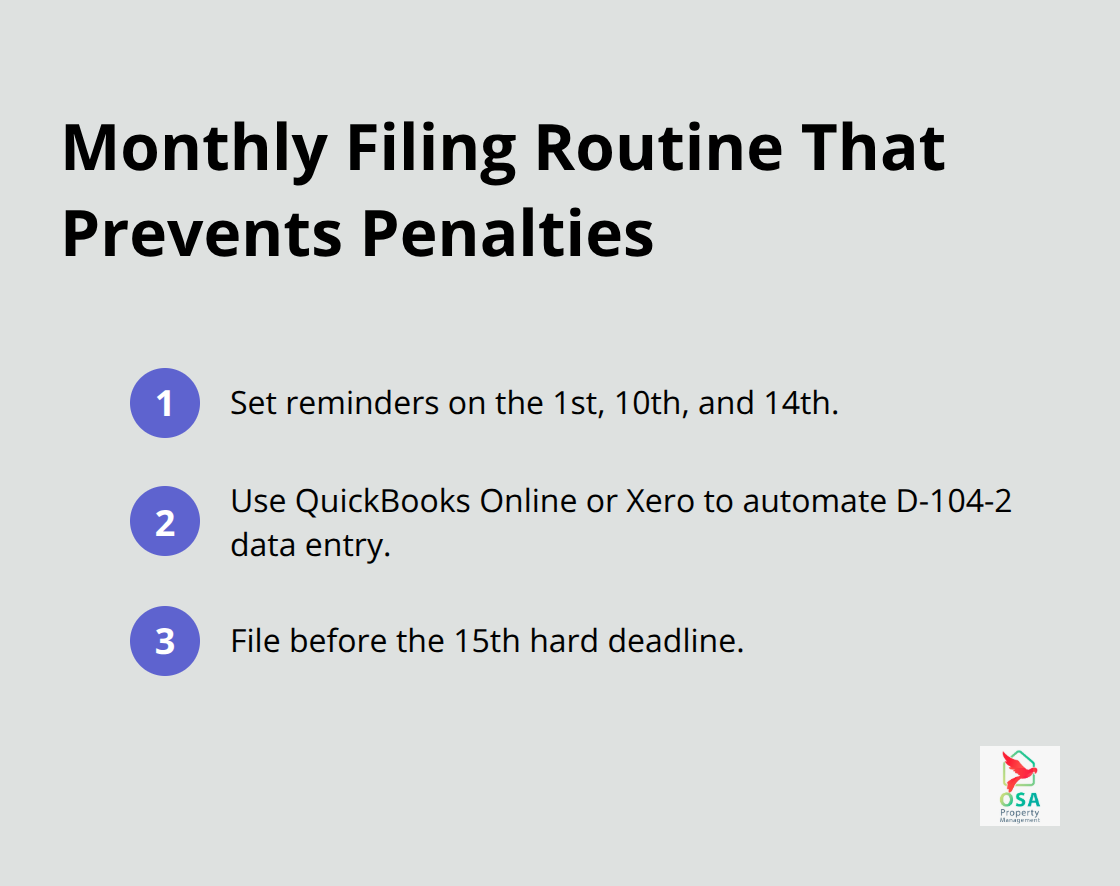
The 15th of every month is your hard deadline. Hacienda grants no extensions, and missing this date triggers automatic penalties of 1% monthly interest capped at 20%, plus potential compliance reviews that flag your account. You file on the D-104 form through Hacienda's virtual portal, which auto-calculates your IVA liability once you enter your monthly income and expenses. The fiscal month runs from the 1st to the 31st, so a rental collected in January must be declared and remitted by February 15th. If the 15th falls on a weekend or holiday, the deadline shifts to the next business day, but Hacienda's system is unforgiving-late submissions by even one day incur penalties. Most landlords fail here because they treat filing as optional or assume platforms like Airbnb or Vrbo handle taxes on their behalf. They do not. You are personally responsible for collecting, declaring, and remitting every colón.
Automate Your Filing Process
Set three calendar reminders on the 1st, 10th, and 14th of each month to prep your records, review your income against platform statements, and file before the deadline. Cloud-based accounting tools like QuickBooks Online or Xero automate the D-104-2 data entry, integrate directly with your bank, and reduce manual errors that trigger audits. These tools cost $15 to $30 monthly and pay for themselves by preventing a single missed deduction or miscalculation.
Even months with zero rental income require a
zero-return filing to maintain compliance. Skipping this step is illegal and signals non-compliance to tax authorities, increasing audit risk exponentially.
Align Your Records With Platform Data
Your documentation must align perfectly with your filed returns because Hacienda cross-references your reported income against what Airbnb, Vrbo, and other platforms report directly to the tax authority as of 2026. Keep four years of records including lease agreements, factura electrónica for every reservation, utility invoices tied to the rental, contractor receipts marked with their NITE registration number, and bank statements showing all payments. A dedicated rental business account eliminates confusion and creates an auditable trail that defends you during reviews. Pay contractors exclusively by bank transfer or credit card-cash payments leave no documentation and Hacienda disallows them entirely for deduction purposes.
Avoid These Critical Compliance Mistakes
The most common compliance mistake is mixing personal and rental expenses in a single account, which forces auditors to scrutinize your entire financial history. Another critical error is failing to obtain contractor NITE numbers before paying them; without this documentation, their invoices cannot qualify for input tax recovery. A 2,000,000 colones renovation yields roughly 260,000 colones in recoverable IVA only if every invoice displays your NITE and the contractor's NITE. Hiring a certified contador público autorizado costs 150,000 to 300,000 colones annually and prevents these costly oversights. The third major mistake is assuming long-term rentals eliminate all tax obligations. Rentals exceeding 30 consecutive days are IVA-exempt, but you must maintain separate meticulous records proving the rental term, or auditors will reclassify the income as short-term and assess back taxes plus penalties.
Understanding Deductions and Input Tax Recovery
Late payments incur compounding interest and can result in liens against your property or frozen bank accounts. Once you master the filing mechanics and avoid these pitfalls, you unlock the real opportunity: identifying which expenses reduce your tax burden and how to claim the deductions available to you. The next section walks you through deductible expenses, input tax credits, and strategies to maximize your tax efficiency without crossing into non-compliance.
What Expenses Actually Reduce Your IVA Tax Bill
Documentation Determines Your Tax Recovery
The difference between a property owner who captures 260,000 colones in recoverable IVA and one who misses it entirely comes down to documentation and strategy. Deductible expenses for rental operations include
maintenance and repairs, contractor labor, cleaning supplies, property insurance tied to the rental, utilities allocated to guest use, professional accounting fees, and digital tools for invoicing and compliance. The critical detail most landlords miss is that every invoice must display both your NITE registration number and the contractor's NITE number, or Hacienda disallows the deduction entirely. A 2,000,000 colones renovation with invoices missing contractor NITE numbers yields zero IVA recovery instead of the potential 260,000 colones. When you hire a contractor, request their NITE upfront and verify it appears on their invoice before payment. Pay exclusively by bank transfer or credit card and photograph each invoice to show the NITE clearly displayed. Cloud-based accounting tools like Wave or Zoho Books cost $15 to $30 monthly and automatically flag incomplete invoices during expense entry, preventing this costly mistake before you file.
How Input Tax Recovery Works
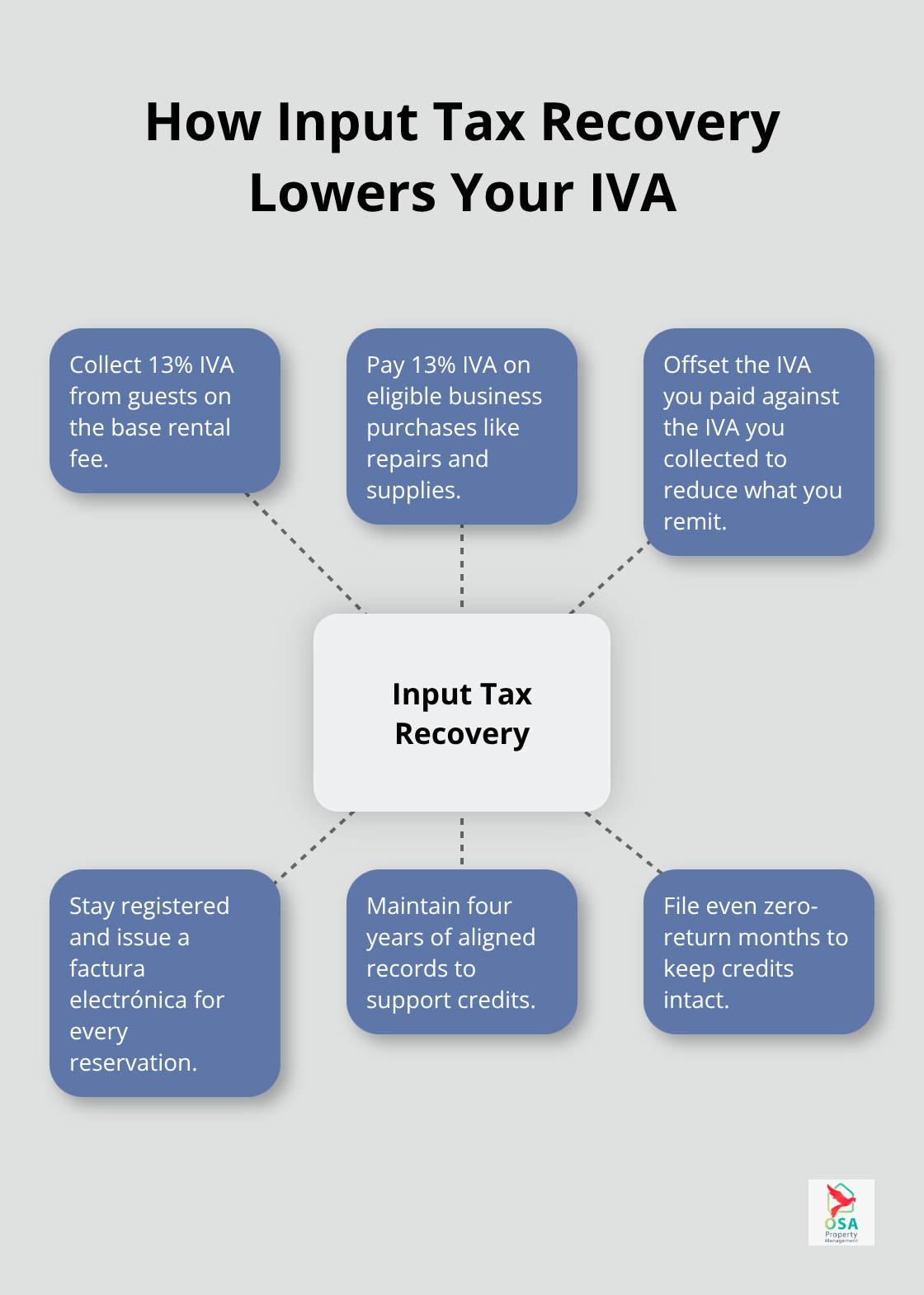
Input tax recovery operates on a simple principle: you collect 13% IVA from guests on the base rental fee, but you also paid 13% IVA on business purchases like repairs or supplies. Hacienda allows you to offset the IVA you paid on eligible expenses against the IVA you collected from guests, reducing your monthly remittance. A property with $10,000 in monthly rental income collects $1,300 in IVA from guests. If you spent $4,000 on contractor labor and maintenance that month, you paid $520 in IVA on those purchases. Your net IVA due to Hacienda drops from $1,300 to $780 because of the $520 offset.
This is why unregistered operators suffer so severely: they collect IVA from guests but cannot recover the IVA paid on business expenses, paying the 13% tax twice. Unregistered status eliminates your ability to deduct any business expenses or recover input taxes, a financial penalty that compounds annually.
Organization Systems That Maximize Deductions
Maximizing tax efficiency requires treating expense documentation as your primary business process, not an afterthought. Before the 15th of each month, reconcile your platform statements from Airbnb or Vrbo against your bank deposits and contractor invoices. If Hacienda's cross-reference system flags a discrepancy between what you reported and what the platform reported, you face a compliance review that can take months to resolve. A dedicated rental business account eliminates confusion and creates an auditable trail. Many property owners in tourist zones like Manuel Antonio and Uvita operate multiple properties, so maintain separate folders with monthly summaries of bookings, IVA collected, and eligible expenses for each property. This organization pays dividends during audits because you can instantly produce the documentation Hacienda requests.
Professional Support Captures Hidden Deductions
A certified contador público autorizado costs 150,000 to 300,000 colones annually but captures deductions a typical bookkeeper misses and handles the monthly filing mechanics. This investment frees you to focus on guest experience and property maintenance instead of tax administration. The accountant's expertise often identifies overlooked expenses-utility allocations, insurance premiums, software subscriptions-that reduce your final tax bill by far more than their annual fee.
Final Thoughts
Costa Rica IVA compliance demands immediate action because the financial penalties for delay far outweigh the cost of proper setup. Register with Hacienda now and obtain your NITE identification number before you deposit any rental income, then set up a dedicated rental business bank account and configure your payment system to automatically collect 13% IVA from guests. Issue a factura electrónica for every reservation, maintain four years of records with invoices marked with both your NITE and each contractor's NITE, and automate your filing with cloud-based accounting tools that cost $15 to $30 monthly. Set three calendar reminders on the 1st, 10th, and 14th of each month to reconcile your platform data against your bank deposits and file your D-104 return before the 15th deadline, even if you collected zero rental income that month. Missing this deadline triggers automatic penalties of 1% monthly interest capped at 20%, and failing to register before collecting income carries penalties up to 25% of your total rental revenue. A certified contador público autorizado costs 150,000 to 300,000 colones annually and captures deductions that pay for their fee many times over. We at Osa Property Management handle Costa Rica IVA compliance, digital invoicing, monthly declarations, and tax coordination for property owners across the southern Pacific zone.
Contact us to discuss how professional support can simplify your tax obligations and maximize your deductions.