

Owning rental property in Costa Rica comes with tax obligations that many landlords overlook. Costa Rica rental taxes can be complex, with multiple deductions available and strict filing deadlines that catch property owners off guard.
At Osa Property Management, we've seen firsthand how costly mistakes can be. This guide walks you through the tax system, deductions you can claim, and the pitfalls to avoid.
How Rental Income Tax Works in Costa Rica
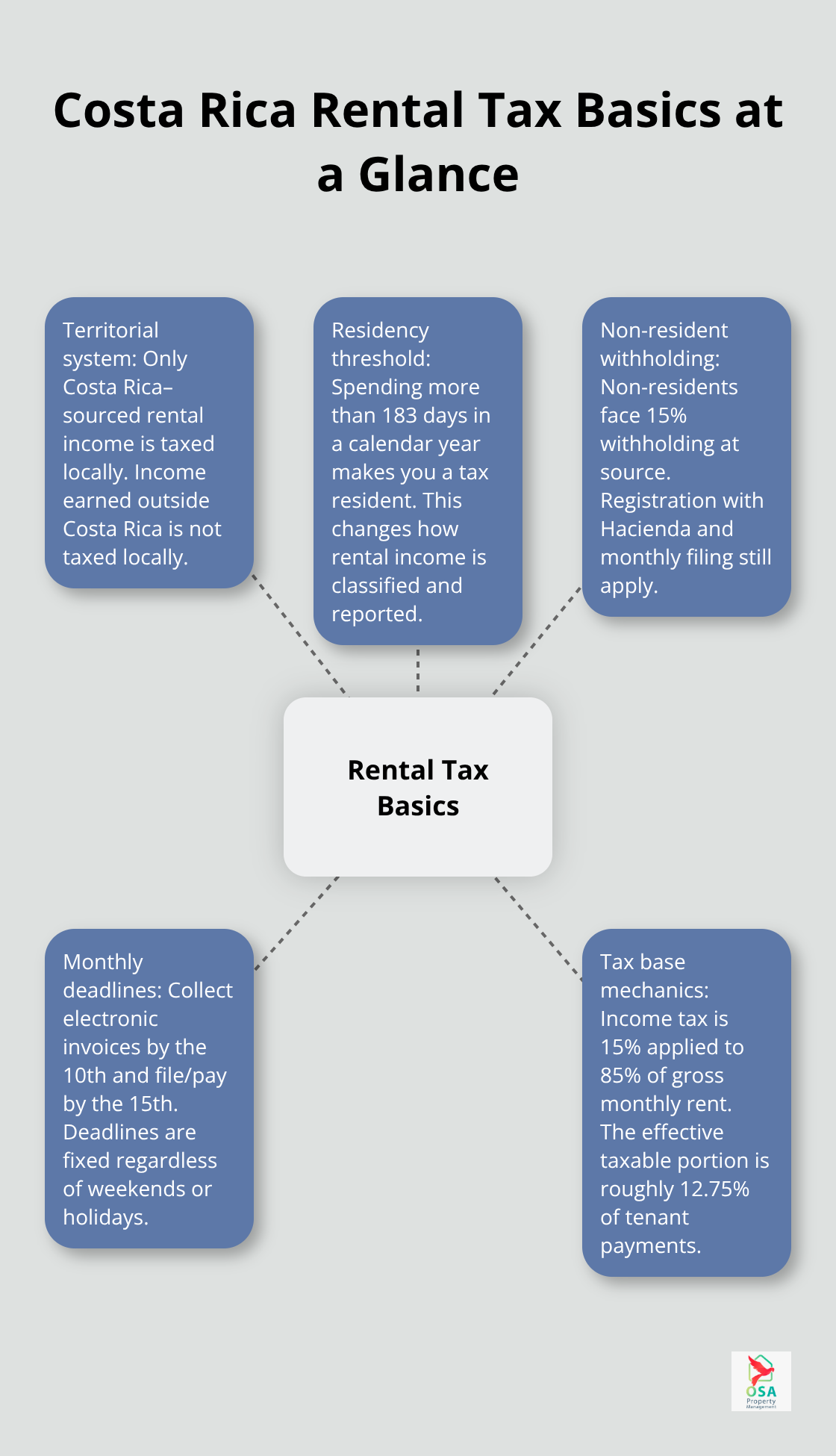
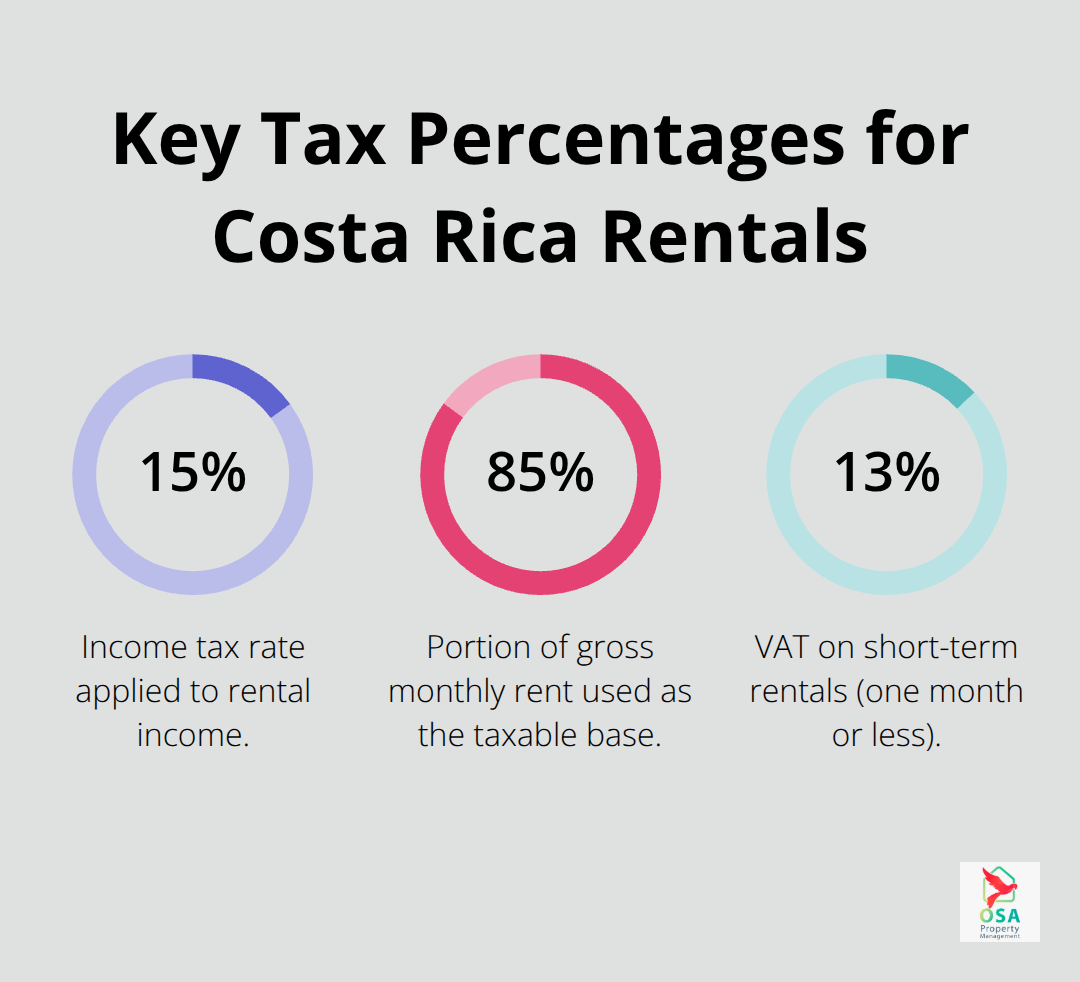
Costa Rica taxes rental income at 15% on 85% of your gross monthly rent, which effectively means you pay tax on roughly 12.75% of what tenants pay you. This rate applies whether you're a resident or non-resident, though non-residents face withholding at the tenant's end. Costa Rica uses a territorial tax system, meaning only income earned within Costa Rica gets taxed locally. If you spend more than 183 days in Costa Rica during a single calendar year, you become a tax resident, which affects how your rental income is classified and reported. Non-residents don't face this residency threshold and can own and rent property without triggering local income tax obligations beyond the 15% withholding, though you must still register with Hacienda and file monthly.
Timing and Documentation Requirements
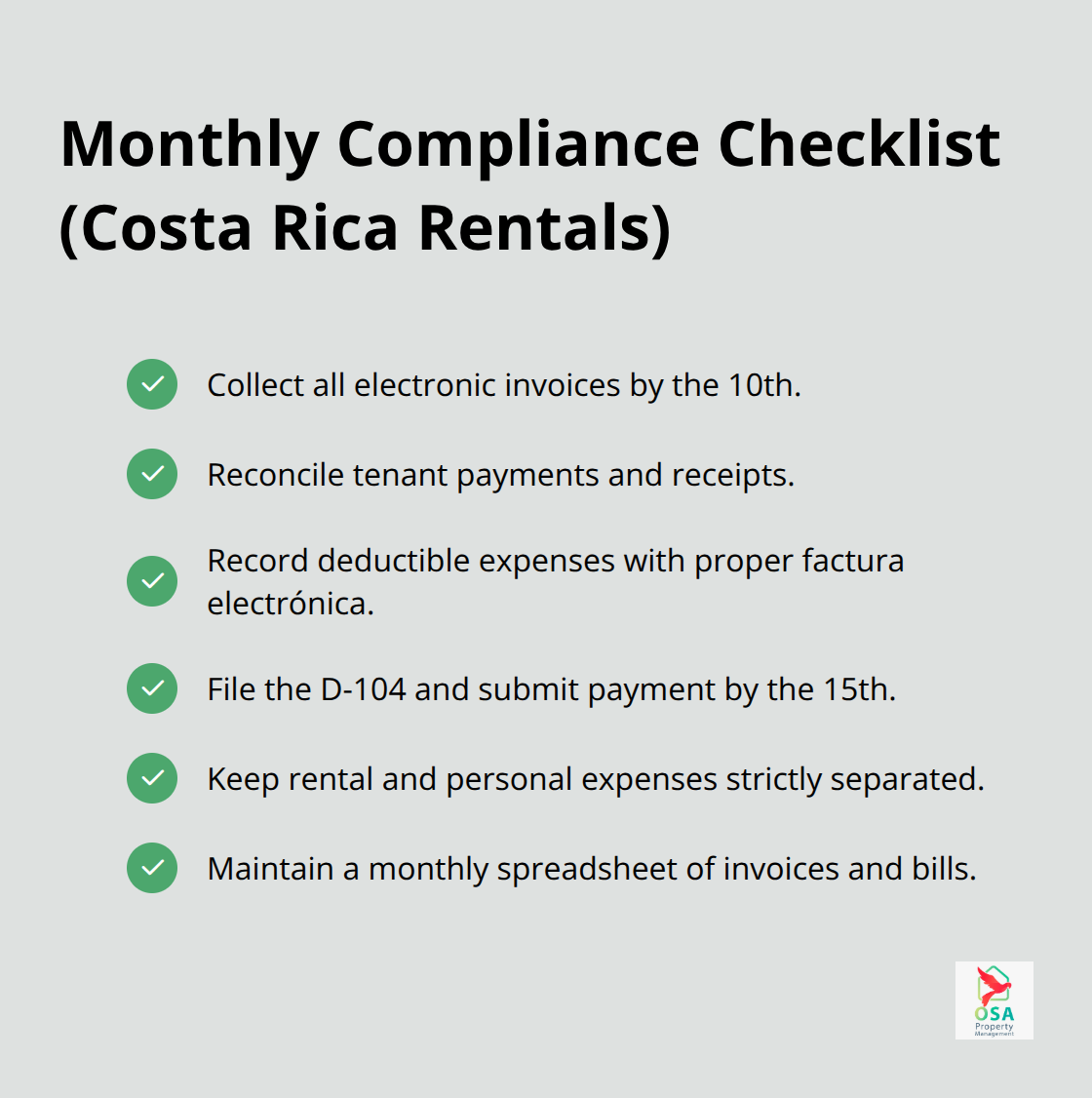
Most landlords miss deductions because they wait until year-end to gather receipts, but you cannot recover expenses after the fact if documentation wasn't captured by the 10th of each month when electronic invoicing deadlines apply. Your property manager or accountant must collect electronic invoices, tenant payments, and receipts by the 10th to meet the 15th filing deadline. This compressed timeline means you cannot delay record gathering to December-you must implement a monthly checklist starting in January. Landlords who document expenses as they occur (contractor invoices, property taxes, utilities) reduce their taxable income significantly compared to those claiming only the standard deduction.
What Income Actually Gets Taxed
Rental income includes monthly rent, advance payments, security deposits held as rent credits, and any non-cash compensation from tenants. Hacienda cross-checks your reported income against electronic records from platforms like Airbnb and VRBO, so hiding cash payments creates serious audit risk. Short-term rentals (one month or less) are subject to 13% VAT in addition to the income tax, while long-term rentals avoid VAT if the monthly rent stays below approximately 975,000 colones (roughly $1,627 USD), which is 1.5 times the current average base salary. This VAT threshold matters because a property renting for $1,500 monthly crosses into VAT territory and suddenly your tenant owes an extra 13% on top of rent.
How Management Fees Reduce Your Tax Base
The 15% income tax calculation starts after management fees, so if you pay 8% of rent to a property manager, your taxable base drops before the 15% rate applies. This structure means a landlord who documents $800 monthly in contractor expenses, property taxes, and utilities can reduce taxable income significantly. Professional property management handles invoicing, bill payments, and ongoing tax compliance on your behalf, which simplifies your monthly filing obligations. Understanding this deduction structure positions you to make informed decisions about outsourcing versus direct employment when managing your rental property.
What Deductions Actually Reduce Your Taxable Rental Income
Repairs Versus Improvements: The Critical Distinction
Costa Rica distinguishes sharply between repairs (deductible immediately) and improvements (capitalized over time), and misclassifying either one triggers audits. A roof patch costs you nothing after deduction, while a new roof gets spread across years. Hacienda scrutinizes contractor invoices closely, so you need electronic invoices (factura electrónica) for every expense to claim it-a $500 cash payment to a handyman disappears from your deduction pile without documentation. One costly error involves treating routine maintenance as capital improvements when it should be expensed immediately, artificially inflating your taxable income for years.
Interest, Fees, and Property-Related Costs
Mortgage interest qualifies as a full deduction, but principal payments do not, meaning a $1,200 monthly mortgage with $800 interest and $400 principal only nets you $800 in deductions. Property management fees (typically 8% of rent) reduce your gross income before the 15% tax rate applies, which is why a property manager handling invoicing and compliance often pays for itself through tax savings alone. Property taxes at 0.25% of cadastral value, municipal garbage collection fees, utilities, insurance premiums, and accounting services all reduce your taxable base when properly documented with electronic receipts.
The Power of Combined Deductions
Multiple deductions compound your tax advantage significantly. A landlord with $3,000 monthly rent who pays 8% to a property manager ($240), claims $300 in property tax and utilities, and documents $200 in repairs faces a taxable base of roughly $2,260 instead of the full $3,000-that difference saves approximately $111 monthly in income tax. Hacienda expects you to submit electronic invoices by the 10th of each month, which means you cannot wait until December to dig through receipts and reconstruct expenses; a monthly spreadsheet tracking contractor invoices, utility bills, and insurance payments becomes non-negotiable.
Documentation and Common Pitfalls
Landlords who document expenses as they occur and maintain organized electronic records typically recover 2–4% additional deductions compared to those relying on memory or scattered receipts at year-end. Another costly error involves failing to separate rental property expenses from personal expenses-if your property manager uses a company vehicle for maintenance coordination, only the portion allocable to rental operations qualifies for deduction. Hacienda cross-checks your reported deductions against electronic records, so incomplete documentation creates serious audit risk and forces you to forfeit legitimate deductions.
The difference between landlords who maximize deductions and those who claim only the standard allowance often amounts to hundreds of dollars annually per property. Your next step involves organizing your expense tracking system and connecting with a local accountant who understands the repairs-versus-improvements distinction and electronic invoicing requirements.
Where Landlords Lose Money on Taxes
Hacienda cross-checks your reported rental income against electronic records from Airbnb, VRBO, and tenant bank transfers, which means hiding cash payments or underreporting income creates serious audit risk. Many landlords assume that because they manage properties informally or rent through word-of-mouth, Hacienda won't notice income gaps. This assumption costs them dearly. One common mistake involves treating security deposits as non-taxable when they actually get taxed if you hold them as rent credits rather than refundable deposits. Another involves reporting only the base monthly rent while omitting advance payments, cleaning fees, or damage charges that tenants pay directly. Hacienda's electronic invoicing system means platforms automatically report your income to the tax authority, so if your declared income on the D-104 monthly form doesn't match what Airbnb reports, you trigger an audit. The penalty for underreporting can reach 50% of the unpaid tax plus interest, making compliance far cheaper than the risk of discovery. Non-residents face 15% withholding at source, meaning the tenant or platform withholds tax before payment reaches you, which creates a built-in enforcement mechanism that residents don't experience.
Mixing Personal and Rental Expenses Destroys Your Deduction Claims
Hacienda scrutinizes contractor invoices and property expenses closely, and mixing personal expenses with rental property costs results in audits and forfeiture of legitimate deductions. A common error involves claiming vehicle expenses when a property manager uses a personal vehicle for maintenance coordination without clearly allocating only the rental-related portion to the property. If you claim 100% of vehicle costs when only 40% applies to your rental property, Hacienda disallows the entire deduction and penalizes you for misrepresentation. Another frequent mistake occurs when landlords claim home office expenses, utilities, or internet costs without proper allocation between personal and rental use. The rule is straightforward: only expenses directly tied to generating rental income qualify for deduction, and Hacienda expects electronic invoices proving the expense relates to your rental property. If a contractor invoice doesn't clearly identify the property address or the work performed, you cannot claim it. The fix involves maintaining separate accounts, requiring contractors to issue invoices addressed to your rental property specifically, and using electronic payment methods that clearly document the transaction purpose.
The 10th and 15th Deadlines Are Non-Negotiable
Hacienda's monthly filing system requires electronic invoices by the 10th of each month and tax payment by the 15th, and missing either deadline triggers penalties that compound monthly. Many landlords treat these deadlines as flexible guidelines, but Costa Rica's tax authority assesses penalties of 5% to 10% of unpaid tax for late payment, plus interest that accrues daily. If you owe $500 in monthly income tax and miss the 15th by even one day, you face a $25 penalty plus interest charges. Over a year, missed deadlines cost hundreds of dollars in penalties alone, entirely separate from the tax owed. The compressed timeline between the 10th invoicing deadline and the 15th payment deadline leaves no room for last-minute scrambling. You cannot gather receipts in December and file retroactively for months you missed, and Hacienda will not accept late-filed monthly forms for prior months.
Final Thoughts
Costa Rica rental taxes demand consistent attention to monthly deadlines and expense documentation, but the payoff justifies the effort. Landlords who track invoices by the 10th, file by the 15th, and separate rental expenses from personal costs reduce their effective tax rate significantly below the headline 15% figure. A local tax professional who understands electronic invoicing, the repairs-versus-improvements distinction, and Hacienda's cross-checking systems protects your position far better than attempting to navigate the system alone.
We at Osa Property Management handle Costa Rica rental taxes on behalf of our clients, managing electronic invoicing, bill payments, monthly filings, and ongoing compliance across our properties in Tarcoles, Jaco, Dominical, Manuel Antonio, Ojochal, Uvita, and Golfito. Our team coordinates with local accountants to maximize deductions while keeping you audit-proof, and Osa Property Management handles the complexity so you can focus on returns. This partnership costs far less than penalties, audit fees, or forfeited deductions that accumulate over years.
Organize your expense tracking system this month and implement a monthly checklist for collecting invoices and receipts. Connect with a local accountant who understands your specific situation, and decide whether professional property management makes sense for your portfolio. The sooner you establish compliant systems, the sooner you stop leaving money on the table.