

Owning rental property in Costa Rica comes with tax responsibilities that many landlords overlook. IVA for landlords is one of the most misunderstood obligations, and getting it wrong can lead to penalties and compliance issues.
We at Osa Property Management help property owners navigate these requirements every day. This guide breaks down what you need to know about IVA, your filing deadlines, and practical strategies to reduce your tax burden.
Understanding IVA and Your Rental Income
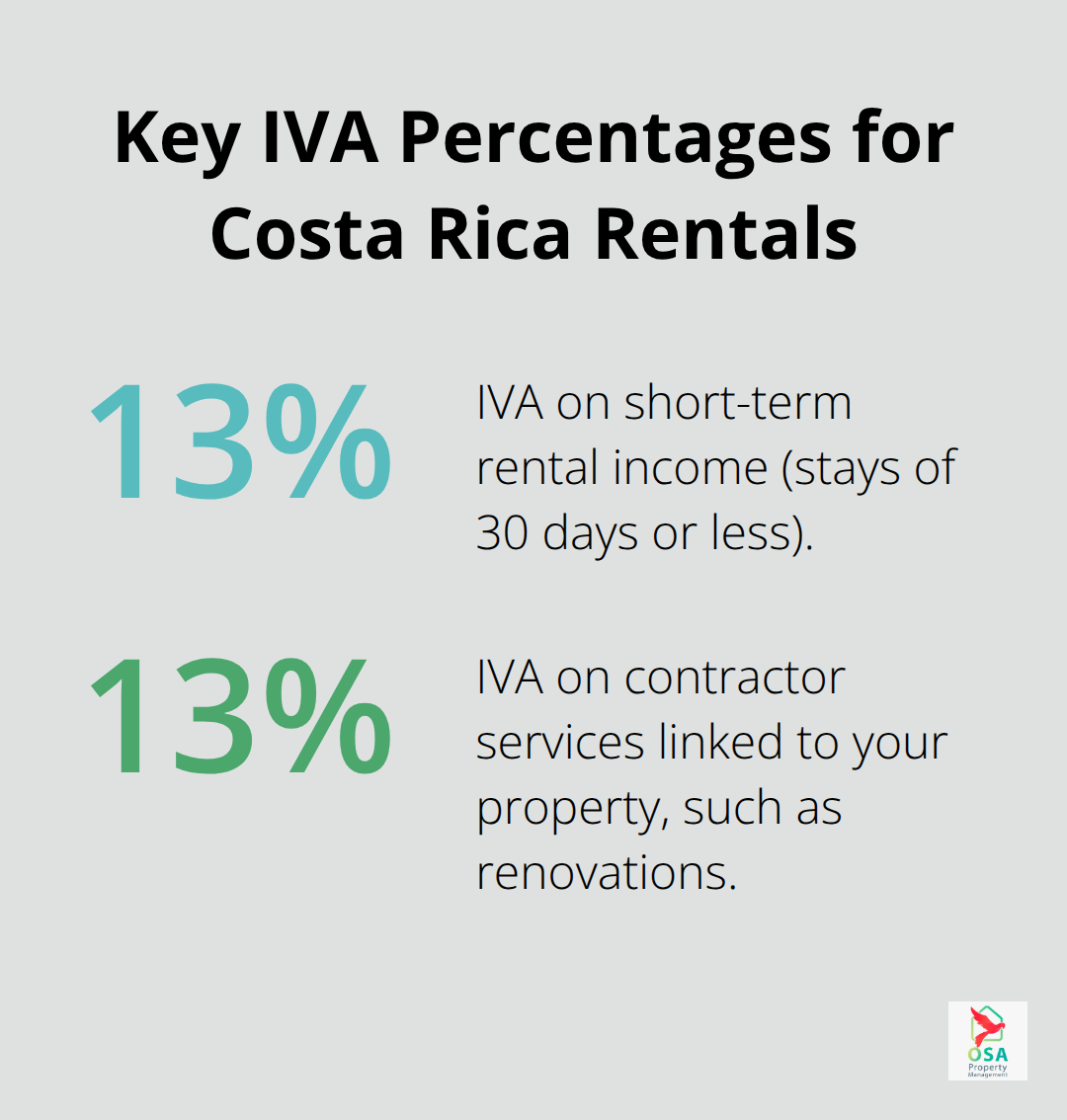
IVA in Costa Rica is a 13% value-added tax that applies to short-term rental income. This is not optional, and it is not a gray area. If you rent a property for stays of 30 days or less, you must collect 13% from your guests and remit it monthly to Hacienda, the Costa Rican tax authority. Long-term rentals-those exceeding 30 days-remain exempt from IVA, which is why some landlords shift their strategy away from vacation rentals entirely. The distinction matters because misclassifying your rental type or underreporting IVA exposure can trigger audits and substantial penalties. The tax replaced the previous GST system on July 1, 2019, and expanded significantly to include professional services tied to real estate. When you hire a contractor for a $10,000 kitchen renovation, that work now carries a 13% IVA charge on top of the base cost, adding $1,300 to your project budget. This expansion has raised overall operating costs for landlords across the country.
How to Register as an IVA Taxpayer
You must register as an IVA taxpayer with Hacienda before collecting any tax from guests. This registration is not automatic, and delaying it creates compliance risk. Once registered, you issue a factura electrónica-a digital invoice-for every reservation, documenting the base rental fee and the 13% IVA amount collected. The system works straightforwardly: renters pay the total (rental price plus 13%), and you retain the rental amount while remitting the IVA portion to Hacienda monthly. Your fiscal month runs from the 1st to the last day of the calendar month, with payment due between the 1st and 15th of the following month. Even months with zero bookings require you to file a declaration stating $0 income and $0 IVA. You log into Hacienda’s virtual portal to record your IVA income and eligible expenses, then pay online through your bank’s Impuestos section. A qualified Costa Rican attorney or accountant can handle this registration for you, which is worth the investment to avoid filing errors.
The Real Impact on Your Profit Margins
The 13% IVA effectively reduces your net rental income unless you raise prices to compensate. If a guest books a $1,000 nightly rate, they now pay $1,130 total. Many landlords absorb this cost to remain competitive, cutting their actual profit margin. Others pass the full tax to guests, which can reduce booking rates in price-sensitive markets. Properties in high-demand areas like Manuel Antonio and Uvita can sustain higher prices, but secondary locations face real pressure. Transparent, tax-inclusive pricing has become standard practice-guests expect clarity on what they owe. Additional services tied to your rental (area tours, private chefs, spa treatments, or concierge arrangements) each incur their own 13% IVA, compounding your tax obligations. You must track these separate service revenues and their corresponding IVA for accurate monthly declarations.
Managing Multiple Tax Streams from One Property
When you operate a vacation rental with ancillary services, your tax filing becomes more complex. Each service category requires separate IVA tracking and reporting to Hacienda. A guest who books a five-night stay, hires a private chef for two dinners, and books a guided tour generates three distinct IVA obligations for you. Your factura electrónica system must itemize these separately so your monthly declaration reflects the correct tax on each revenue stream. Failure to segregate these amounts can result in underreporting and audit exposure. This complexity is why many landlords work with property management firms or accountants who specialize in Costa Rican rental taxation-the administrative burden alone justifies professional support.
What You Must File and When
Hacienda tracks everything electronically, and missing a deadline costs you money. Once registered as an IVA taxpayer, you enter a monthly filing cycle that never stops: collect 13% from guests, file a declaration between the 1st and 15th of the following month, and remit payment through your bank’s Impuestos section. The fiscal month runs calendar-based (1st to last day), so a guest checking out on June 30th means that IVA gets reported in your July declaration due by July 15th. Even if you had zero bookings in June, you still file a $0 declaration-Hacienda requires this monthly submission regardless of activity level.
The Monthly Filing Cycle
Skipping a month, even accidentally, triggers penalties and audit flags that complicate your account for years. Your factura electrónica system documents every transaction automatically, and Hacienda receives this data in real time through their electronic invoicing network. This means they know your rental income before you file, making underreporting immediately visible. The portal calculation is straightforward: you enter total IVA collected and eligible business expenses, the system auto-calculates what you owe, and you pay online. The transparency cuts both ways-it protects you from math errors but leaves zero room for creative reporting.
Why Documentation Standards Matter
Hacienda requires you to maintain records for at least four years, and they audit based on patterns they spot in your electronic data. Every factura electrónica, every guest receipt, and every contractor invoice for property repairs must align with your monthly declarations. If you claim $5,000 in maintenance expenses in July but your invoices show work spread across June and August, auditors flag the discrepancy. Property management services, contractor payments, utilities tied to rental operations, and HOA fees all generate invoices that support your deductible expenses.
Your bank statements and credit card records should match these invoices exactly-the dates, amounts, and vendor names must be consistent. When you work with contractors, demand that they issue factura electrónica invoices; without electronic documentation, Hacienda may disallow the expense entirely. Keeping organized digital folders for each expense category, sorted by month and vendor, saves enormous time if an auditor requests verification.
Building an Audit-Proof Record System
One misaligned receipt across four years of filings can trigger a full audit. You need this documentation not just to prove compliance but to substantiate the deductions that reduce your monthly IVA liability. Create separate digital files for each vendor and expense type (repairs, utilities, professional services). Update these folders monthly as invoices arrive, rather than scrambling to organize records when Hacienda requests them. This approach prevents the common mistake of mixing personal and business expenses, which auditors scrutinize heavily.
Your factura electrónica system automatically timestamps every transaction, so the electronic record becomes your primary evidence. Print or export monthly summaries from Hacienda’s portal and store them alongside your supporting invoices. If you operate multiple properties or have ancillary service revenue (tours, chef services, concierge), maintain separate documentation streams for each income category. This segregation protects you if Hacienda questions one revenue stream-your other records remain clean and defensible.
Moving Forward with Confidence
Proper documentation transforms IVA compliance from a burden into a manageable process. Once your filing system is in place, the monthly routine becomes predictable: collect invoices, verify electronic documentation, file your declaration, and remit payment. The next critical step involves understanding which expenses actually reduce your IVA liability and how to structure your property operations to maximize legitimate deductions.
Maximizing Deductions to Lower Your Monthly IVA Liability
The 13% IVA you collect from guests belongs to Hacienda, not to you. What you keep depends entirely on which business expenses you can document and deduct. We at Osa Property Management see landlords leave thousands of dollars on the table annually because they fail to track legitimate expenses or misunderstand what qualifies for deduction. Property management fees, maintenance and repairs, utilities tied to rental operations, HOA fees, contractor services, and professional accounting support all generate factura electrónica invoices that reduce your monthly IVA obligation. The key is that every expense must be properly documented electronically and segregated by category so your monthly declaration reflects the correct deductible amounts.
How Deductible Expenses Reduce Your Tax Liability
If you pay a contractor $8,000 for a bathroom renovation, that $1,040 in IVA (13% of $8,000) can offset IVA you owe on guest bookings, provided the invoice is issued as factura electrónica and matches your monthly expense reporting. Landlords who operate without professional support typically claim 30–40% less in deductible expenses than they actually incurred, simply because invoices get lost or filed incorrectly. This mistake alone costs a typical short-term rental operator $3,000–$6,000 annually in unnecessary tax payments. The solution is straightforward: demand electronic invoicing from every vendor, organize expenses by month and category in digital folders, and cross-reference your bank statements with your factura electrónica records before filing each month.
Aligning Expenses with Your Fiscal Month
Your monthly IVA declaration allows you to claim eligible business expenses that reduce the tax you remit to Hacienda. Hacienda’s portal auto-calculates your liability once you enter total IVA collected and your documented expenses, so accuracy in expense reporting directly lowers what you owe. The critical detail many landlords miss is that expenses must align with your fiscal month (1st to last day of the calendar month), and the invoice date must match the month in which you claim the deduction. If you receive a plumbing invoice dated July 15th but don’t pay until August 5th, it belongs in your July declaration-the invoice date controls, not the payment date. This distinction matters because Hacienda’s electronic invoicing system timestamps everything, and auditors spot inconsistencies between your declaration and the actual invoice dates in the system.
Maximizing Your Largest Deductible Categories
Repair costs represent your largest deductible category for most rental properties; a $500 monthly maintenance budget generates $65 in monthly IVA credits if properly documented. Over a year, that single category saves you $780 in tax liability. Add property management fees (typically 15–25% of rental income), accounting services, insurance premiums, and utilities, and your total deductible expenses often reach 40–50% of your gross rental revenue. Landlords operating solo without professional support frequently underestimate these totals because they pay some vendors in cash, fail to request invoices, or store receipts in disorganized files. Switching to a system where every transaction generates a digital receipt and gets filed by category transforms your tax position from uncertain to defensible.
Building a System That Works
The investment in a property management service or dedicated accountant pays for itself through expense optimization alone, not counting the reduced audit risk and time savings from having someone else manage the monthly filing cycle. A professional team processes every vendor invoice through the electronic system, automatically capturing deductions that solo operators miss. Your expenses stay organized by month and category, your bank statements align with your factura electrónica records, and your monthly declarations reflect the true deductible amounts you incurred. This approach eliminates the scramble to find receipts when Hacienda questions your filings and protects you from the penalties that result from misaligned documentation.
Final Thoughts
IVA for landlords in Costa Rica is not optional, and compliance is non-negotiable. The 13% tax you collect from guests belongs to Hacienda, and you must file it monthly between the 1st and 15th of the following month. Missing even one deadline triggers penalties that compound over time, and underreporting your rental income creates audit flags that auditors follow for years.
Your path forward requires three concrete actions. First, register as an IVA taxpayer with Hacienda and issue every guest invoice as factura electrónica. Second, demand electronic invoicing from every vendor and organize these documents by month and expense category in digital folders. Third, claim every legitimate business expense you incur, from property management fees to maintenance costs to professional accounting support-landlords who skip this step leave thousands of dollars on the table annually in unclaimed deductions.
We at Osa Property Management handle IVA compliance, electronic invoicing, expense tracking, and monthly filings for property owners throughout the southern zone. Contact us to discuss how our team manages the administrative burden so you focus on growing your rental business.