

Renting property in Costa Rica means navigating IVA requirements that many landlords find confusing. We at Osa Property Management help property owners understand these tax obligations so they can stay compliant and avoid costly penalties.
This guide walks you through CR IVA rental guidelines, from registration thresholds to deductible expenses. You’ll learn exactly what you need to file, when to file it, and which costs reduce your tax burden.
What is IVA and Who Pays It
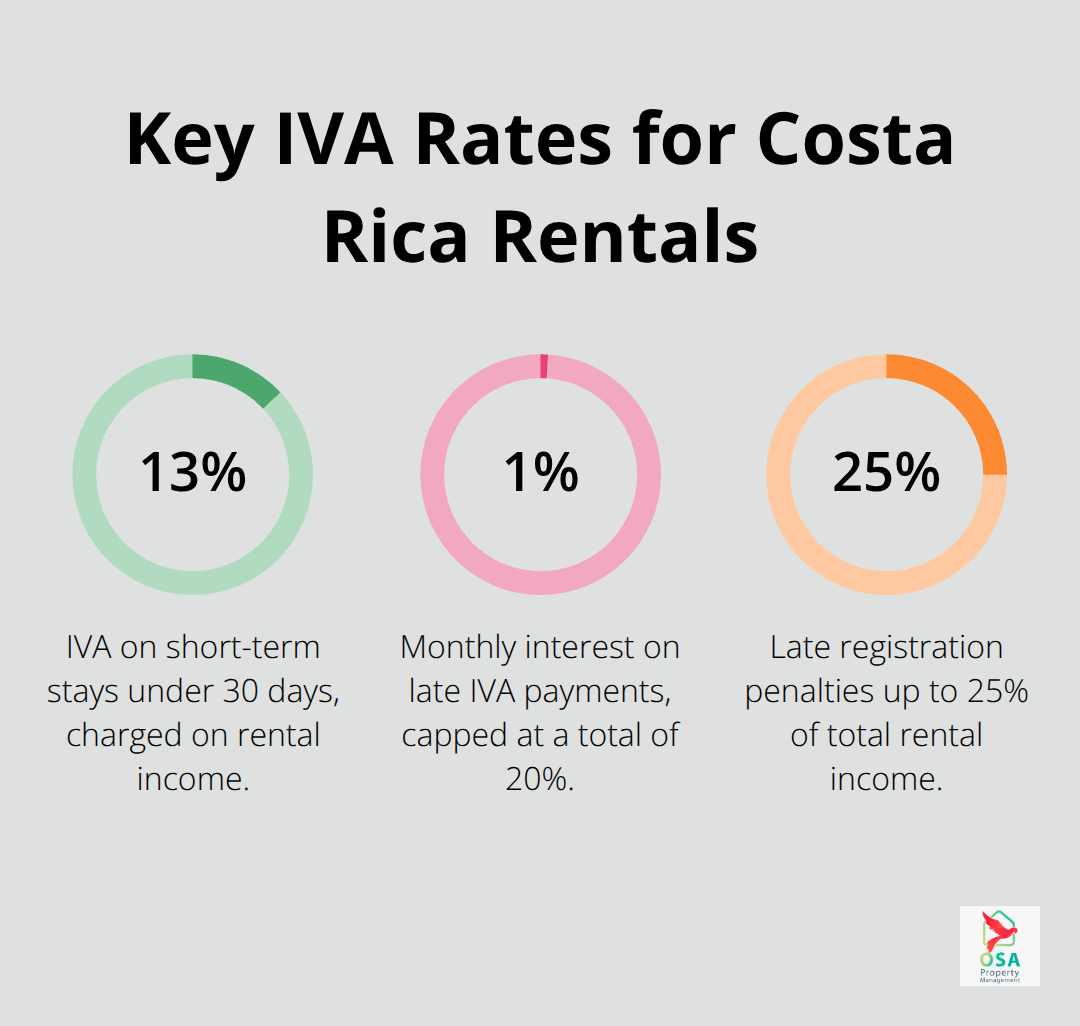
IVA at 13% applies directly to your rental income when guests stay fewer than 30 days. Short-term rentals in tourist zones like Manuel Antonio, Uvita, and Jaco fall under this requirement automatically. If a guest books your property for 29 days, you collect 13% IVA on top of the nightly rate. Once a booking extends past 30 consecutive days, IVA no longer applies to that rental income. This distinction matters because the vast majority of rental income in coastal areas gets taxed at the 13% rate. You don’t keep this money-it flows to Hacienda, Costa Rica’s tax authority. Many landlords mistakenly treat IVA as extra profit, then face penalties when Hacienda audits their records and finds uncollected or unreported amounts.
Registration Thresholds That Trigger Your Obligations
You must register with Hacienda and obtain a NITE identification number before depositing any rental funds into your bank account. Registration becomes mandatory the moment you start collecting rental income, not after you reach a certain threshold. However, the decision to register as an IVA taxpayer depends on your annual gross rental income. If your annual rental income stays below approximately 1,000,000 colones, IVA registration remains optional. But here’s the critical part: registration even at lower income levels unlocks input tax recovery. If you spend 2,000,000 colones on renovations with properly documented invoices, you recover roughly 260,000 colones in IVA paid to contractors. Without registration, that money vanishes. Late registration carries penalties up to 25% of total rental income, a cost that erases months of profit. Your contractor invoices must display both your NITE and their NITE to qualify for deductions; invoices without this data become worthless for tax purposes.
Monthly Filing Deadlines and Payment Reality
IVA returns file monthly through the D-104 form, due between the 1st and 15th of the following month. If the 15th falls on a weekend or holiday, you have until the next business day. Even months with zero rental income require a zero-return filing. Hacienda levies 1% interest per month on late payments, capped at 20%, plus penalties for missed deadlines. Automation matters here-cloud-based tools like QuickBooks Online or Xero cost about $15–$30 monthly and auto-fill D-104 data, reducing errors significantly. Hacienda cross-references your filings against what Airbnb and Vrbo report as of 2026, so your records must align perfectly with platform statements.
Maintaining a dedicated rental business bank account separates personal finances from rental operations and creates an auditable trail that survives Hacienda scrutiny. Contractors must receive payment via bank transfer or credit card; cash payments disqualify expense deductions entirely.
How Input Tax Recovery Works in Your Favor
The monthly tax cycle operates through input tax recovery-you collect 13% IVA from guests on the base rental fee, but you also paid 13% IVA on business expenses. If you collect $1,300 in IVA from $10,000 in monthly rent and spend $4,000 on deductible expenses (which carry $520 in IVA), you owe Hacienda only $780 that month. Unregistered operators cannot recover this input tax, which means they lose thousands annually on property improvements and maintenance. This mechanism transforms your business expenses into tax savings, provided invoices carry both NITEs and you maintain proper documentation. The tax authority expects four years of records, including lease terms, invoicing with NITE, utility bills tied to the rental, and platform statements that align with your filings. Organizing records by property in separate monthly folders expedites audits and protects you from penalties. Your next step involves understanding which specific expenses qualify for deduction and how to document them properly.
How to Build a Compliance System That Actually Works
Create a Monthly Organization Structure
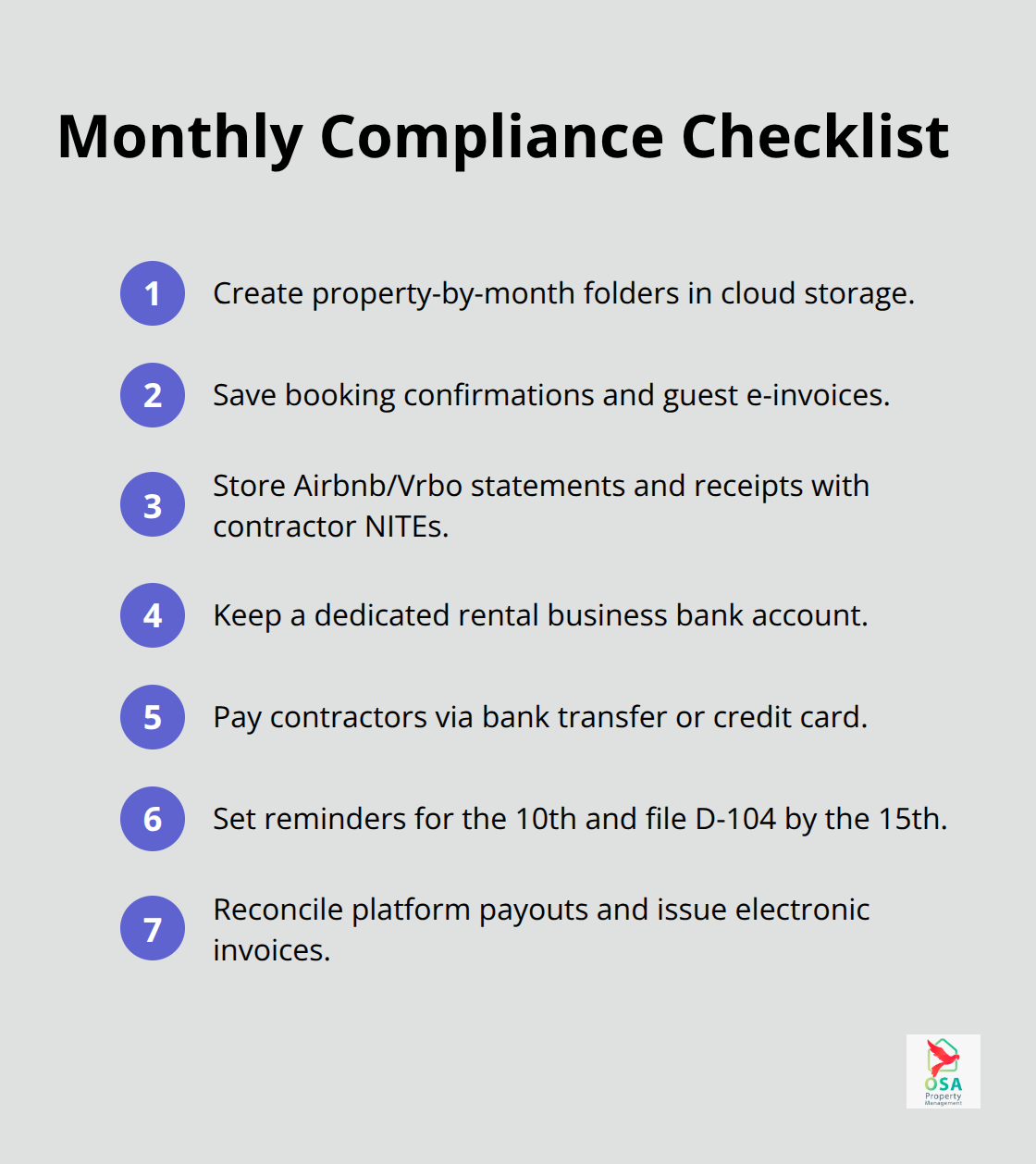
Compliance becomes manageable when you treat it like a monthly business operation rather than an annual scramble. Your first move is creating a dedicated folder structure on your computer or cloud storage, organized by property and month. Each folder contains your booking confirmations, guest invoices issued with electronic invoicing, platform statements from Airbnb or Vrbo, and expense receipts with contractor NITEs. This organization matters because Hacienda requires four years of records, and audits move faster when everything aligns. Set a calendar reminder for the 10th of each month to gather the previous month’s data before the filing deadline hits on the 15th.
Automate Your Monthly Close
Automation eliminates errors that manual reconciliation introduces. Cloud tools like QuickBooks Online or Xero cost $15–$30 monthly and automatically pull platform data, calculate your IVA liability, and pre-fill your D-104 return. Without automation, you manually reconcile Airbnb payouts against your invoices, a tedious process that introduces mistakes. Hacienda cross-references platform data against your filings, so mismatches trigger audits immediately. One landlord spent three months correcting a simple discrepancy that automation would have prevented. Your bank account matters equally-keep rental income completely separate from personal spending. This separation creates an auditable trail and demonstrates to Hacienda that you take compliance seriously.
Document Every Contractor Payment
When contractors invoice you, demand that both your NITE and their NITE appear on the invoice before you pay. Cash payments disqualify deductions entirely, so always pay via bank transfer or credit card with documentation. This requirement protects you because Hacienda rejects invoices lacking proper NITE data, and rejected invoices mean lost deductions.
Meet Monthly Filing Deadlines Without Exception
The monthly filing cycle demands discipline because penalties compound quickly. You owe the D-104 form between the 1st and 15th of the following month; if the 15th lands on a weekend or holiday, file by the next business day. Late payments trigger 1% monthly interest capped at 20%, plus additional penalties that can exceed your actual tax liability. Even zero-income months require filing a zero-return-skipping this step signals non-compliance and invites scrutiny. Many landlords fail at this stage because they assume no income means no filing obligation, but Hacienda expects consistent reporting.
Your input tax recovery calculation happens during this monthly close. If you collected $1,300 in IVA from guests on $10,000 in rent and spent $4,000 on deductible maintenance with $520 in IVA paid, you remit only $780 to Hacienda that month. Unregistered operators lose this entire $520 recovery annually, which adds up to thousands over time.
Avoid the Three Most Common Mistakes
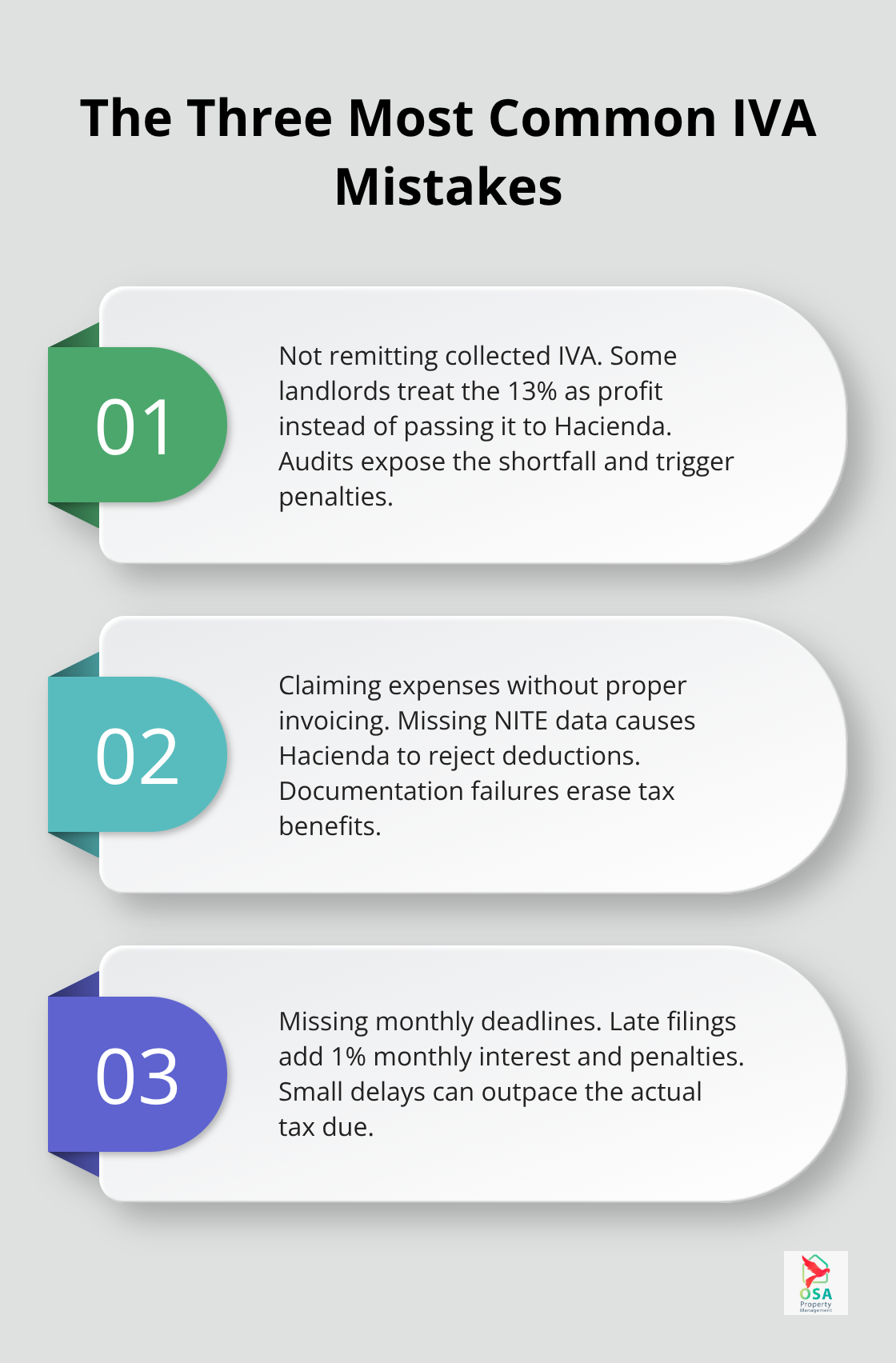
Common mistakes cluster around three areas. First, landlords collect 13% IVA from guests but fail to remit it, treating it as profit until an audit reveals the shortfall. Second, they claim expenses without proper invoicing, losing deductions when Hacienda rejects documents lacking contractor NITEs. Third, they miss monthly deadlines, triggering penalties that compound faster than their actual tax bill. The fix is straightforward: issue an electronic invoice for every reservation, maintain a dedicated rental account, automate your monthly filing, and pay all contractors with documented transfers. Compliance costs time upfront but costs far more when penalties arrive.
Once you establish these systems, your attention turns to understanding which specific expenses qualify for deduction and how to maximize your tax recovery through proper documentation.
Which Expenses Actually Reduce Your IVA Tax Bill
Deductible expenses are where landlords either maximize tax recovery or leave thousands on the table. Many owners claim expenses that Hacienda rejects because documentation fails, or worse, skip legitimate deductions because they assumed costs weren’t eligible. The reality is straightforward: deductible expenses including maintenance, repairs, management fees, utilities tied to the rental, insurance, and professional accounting all reduce your IVA liability when invoiced correctly. A 2,000,000 colones renovation with proper documentation yields approximately 260,000 colones in recoverable IVA, but that money vanishes if your contractor’s invoice lacks both your NITE and theirs.
Maintenance and Repairs That Qualify for Deduction
Maintenance and repair costs form the largest deduction category for rental properties. Paint, plumbing fixes, roof repairs, and structural work all qualify, but cosmetic improvements like upgrading cabinet hardware or redecorating do not. Hacienda distinguishes between repairs that preserve the property and improvements that enhance it. If your guest damages a wall, repainting it counts as a deductible repair. If you repaint to increase appeal before listing, that expense becomes a non-deductible improvement. This distinction determines whether you recover the IVA paid to contractors or lose it entirely.
Management Fees, Professional Services, and Tools
Property management fees typically run 8–12% for long-term rentals and 15–25% for short-term operations, and every peso qualifies for deduction when invoiced with both NITEs. Professional accounting fees between 150,000–300,000 colones annually pay for themselves by capturing missed deductions and preventing filing errors that trigger audits. Digital invoicing tools that cost $15–$30 monthly are deductible as well. These professional services create the documentation infrastructure that protects your tax position during audits.
Utilities and Insurance Tied to Your Rental
Utilities including electricity, water, and internet are deductible only when tied directly to the rental operation. If you maintain a separate utility bill for the rental property, the full amount qualifies. If utilities cover both your residence and the rental unit on a single bill, you must split the expense proportionally based on square footage or usage, and only the rental portion becomes deductible. Rental-specific insurance covering liability and property damage qualifies fully, but homeowner insurance on your primary residence does not. HOA fees also reduce your tax burden when the property is in a managed community.
Documentation Standards That Protect Your Deductions
The key to maximizing deductions is treating documentation standards for contractor invoices as non-negotiable. Every contractor invoice must display both your NITE and their NITE before you process payment. Every utility bill must clearly show it covers the rental property. Every professional service invoice must itemize what work was performed. Payments must flow through bank transfer or credit card, never cash. Maintain these invoices in your monthly folders alongside your platform statements and guest receipts. When Hacienda audits, complete documentation determines whether you recover thousands in tax credits or lose them entirely. One landlord discovered she had paid 800,000 colones for maintenance over two years but claimed zero deductions because her contractor’s invoices lacked NITE data. Correcting the documentation retroactively required additional accounting fees and penalty exposure. The lesson applies universally: demand proper invoicing upfront, verify NITE presence before payment, and store everything in your organized monthly structure. These expenses flow into your input tax recovery calculation monthly, offsetting the 13% IVA you collected from guests. Your actual tax burden depends entirely on this discipline.
Final Thoughts
Costa Rica’s IVA rental guidelines require consistent action across three core areas: register with Hacienda before depositing rental income, file your D-104 monthly between the 1st and 15th regardless of income level, and document every expense with proper NITE data on contractor invoices. Penalties compound faster than your actual tax liability when you miss deadlines or fail to collect the required documentation. Your compliance system succeeds when you automate monthly closes with cloud tools, organize records by property and month, and demand NITE data on every contractor invoice before payment.
The practical path forward starts immediately with your NITE registration and a dedicated rental business bank account. Set up your monthly folder structure on cloud storage, choose a cloud accounting tool like QuickBooks Online or Xero to automate your D-104 filings, and issue electronic invoices for every reservation. Mark your calendar for the 10th of each month to gather data and the 15th to file your return, treating this schedule as non-negotiable.
If managing these systems feels overwhelming, Osa Property Management handles tax compliance, accounting, and monthly declarations for landlords across Costa Rica’s rental markets. Their team manages the documentation, filing deadlines, and deduction tracking that protect your rental income from penalties. Compliance costs time upfront, but the alternative costs far more when Hacienda audits and penalties arrive.