
Ojochal property oversight requires balancing two competing demands: staying compliant with local regulations and maximizing your rental income. Most property owners in Ojochal struggle with one or the other, but the best operators master both.
We at Osa Property Management have seen firsthand how missed tax deadlines, improper insurance coverage, and poor documentation cost owners thousands in penalties and lost bookings. This guide walks you through the compliance requirements that matter and the strategies that actually increase your returns.
Why Compliance Protects Your Ojochal Investment
Understanding Ojochal's Rental Framework
Ojochal operates under Costa Rica's General Law of Urban and Suburban Rentals (Law No. 7527), which sets the framework for every rental agreement you sign. This law requires all residential leases to be written in Spanish to be legally binding, though providing an English translation prevents misunderstandings with international tenants. The minimum lease term is three years unless both parties agree otherwise, which means your rental agreement locks in predictable income for longer periods than many owners expect.
Currency and Rent Increase Rules
Currency matters significantly when you draft your lease. If you denominate rent in U.S. dollars, you cannot include annual increases during the initial three-year term. Colones-denominated leases allow increases capped at the government-published Consumer Price Index if inflation stays at or below 10 percent. Violations of these rules expose you to disputes that drag through housing courts, costing months of lost rental income and legal fees.
Tax Registration and Documentation Requirements
Tax obligations add another layer of complexity. Starting 2026, short-term rental income taxation Costa Rica 2026 12.75 percent applies to rentals under 30 days, and you must register with Costa Rica's Tourism Institute (ICT) to operate legally. Meticulous documentation of all expenses and revenue prevents penalties and gives your tax advisor complete data to work with.
Insurance Coverage for Vacation Rentals
Insurance and liability protection often get overlooked until something goes wrong. Standard homeowners policies do not cover vacation rental operations, so you need a dedicated short-term rental or commercial liability policy to protect against guest injuries, property damage claims, or theft. Without proper coverage, a single incident (a guest injured on your pool deck or damage from a burst pipe) wipes out years of rental profit.
Moving Forward with Compliance
The owners who stay compliant and insured operate with confidence because they know their investment is protected against the specific risks that vacation rental properties face. This foundation of legal and financial protection allows you to focus on the strategies that actually drive occupancy and revenue-which is where the next section takes you.
How to Price, Maintain, and Market Your Ojochal Rental for Maximum Income
Compliance protects your investment, but revenue comes from three operational decisions: what you charge guests, how well you maintain the property, and how effectively you fill your calendar. Ojochal vacation rentals achieve 75 to 90 percent occupancy in high season and 55 to 70 percent in green season, but only when owners apply data-driven pricing, consistent maintenance, and multi-platform marketing. Ocean-view properties in Ojochal typically yield 7 to 11 percent annual rental returns, yet most solo operators achieve far less because they leave money on the table through static pricing or poor visibility.
Dynamic Pricing Captures Peak Demand
Dynamic pricing adjusts nightly rates based on demand windows, seasonality, and local events. Properties that implement this approach lift occupancy from around 70 percent to 85 percent by exploiting peak periods while maintaining competitive rates during shoulder seasons. Real-time dynamic pricing requires you to monitor booking pace, competitor rates, and tourism calendars-tasks that demand constant attention if you manage the property yourself. The difference between static and dynamic pricing often amounts to thousands of dollars annually, yet most solo operators never implement it because the work overwhelms their schedule.
Marketing and Photography Drive Bookings
Professional photography and virtual tours increase inquiries by roughly 40 percent compared with phone photos. Marketing across multiple platforms such as Airbnb, Vrbo, and Booking.com with tailored descriptions expands your reach far beyond what a single listing generates. Each platform attracts different traveler segments, so you must craft descriptions that speak to each audience rather than copying the same text everywhere. High-quality images and virtual tours show potential guests exactly what they will experience, reducing cancellations and attracting renters who match your property type.
Maintenance and Guest Screening Sustain Revenue
Property maintenance directly impacts guest satisfaction and repeat bookings. Proactive care such as weekly pool maintenance and preventive inspections lowers emergency repairs and sustains occupancy around 85 to 90 percent, while deferred maintenance triggers negative reviews and cancellations that erase months of potential income. Guest screening matters as much as marketing because matching property type and location with renters reduces damage risk and increases the likelihood of five-star reviews that drive future bookings. Concierge services, including seven-day bilingual support that resolves issues within two hours, drive repeat bookings and referrals, transforming one-time guests into reliable revenue sources.
The Math Behind Professional Management
A professional management model costs 15 to 30 percent of rental income. Owners managing solo often report $50,000 annual income, while the same property under professional oversight generates $65,000 to $75,000 after management fees. This difference comes from dynamic pricing, guest screening, multi-platform marketing, proactive maintenance, and concierge service working together rather than competing for your limited time. Professional teams handle marketing, guest pre-arrival coordination, on-site management, and post-checkout processes to sustain occupancy and rental returns, while you receive financial statements and accounting records without the operational burden.
The choice between solo management and professional oversight ultimately determines whether your Ojochal property becomes a consistent income source or a part-time job that drains your attention. Once you master the operational side of your rental, you face a different challenge: protecting your returns against the compliance pitfalls that catch most Ojochal owners off guard.
Common Compliance Pitfalls Ojochal Property Owners Face
Tax Deadlines and Filing Errors
Tax deadlines slip past unnoticed because owners treat them as annual events rather than quarterly checkpoints, yet Costa Rica's 12.75 percent short-term rental tax starting 2026 demands meticulous tracking from day one. The Tourism Institute registration requirement means you cannot legally operate without ICT approval, but many owners rent for months before realizing they need it, then face retroactive penalties on all prior bookings. Owners who kept zero expense records suddenly face audits where they cannot prove deductions, turning what should be a 15 percent tax burden into a 25 percent one because they cannot document maintenance costs, utilities, or repairs.
Currency Mismatches in Lease Agreements
Currency mismatches in lease agreements cause disputes that land in housing courts. An owner who included a rent increase clause in a USD-denominated lease discovered mid-year that the law forbids any increases during the initial three-year term, forcing them to refund months of collected overage or face tenant complaints that destroyed their five-star reviews. These disputes consume months of lost rental income and legal fees that could have been prevented with proper lease documentation from the start.
Insurance Coverage Gaps
Insurance gaps hit hardest when they actually matter. A guest slip on a wet pool deck resulted in a liability claim that exceeded $50,000, but the owner's standard homeowners policy rejected it because vacation rental operations fall outside residential coverage, leaving them personally liable for the full amount and forcing a property sale to settle the claim. Standard homeowners policies do not cover vacation rental operations, so you need a dedicated short-term rental or commercial liability policy to protect against guest injuries, property damage claims, or theft.
Rental Classification and Documentation Failures
Documentation failures cost owners thousands because they confuse rental classification with tax status. Some owners operate short-term vacation rentals while filing taxes as long-term residential properties, triggering audits when the Tourism Institute reports their ICT registration under a different classification. Others maintain separate expense accounts for the property but fail to link them to the rental income they report, creating red flags that invite deeper scrutiny. Improper rental classification also affects liability insurance; if your policy covers residential long-term leases but you actually operate vacation rentals, a guest injury claim gets denied outright.
Building Sustainable Compliance Practices
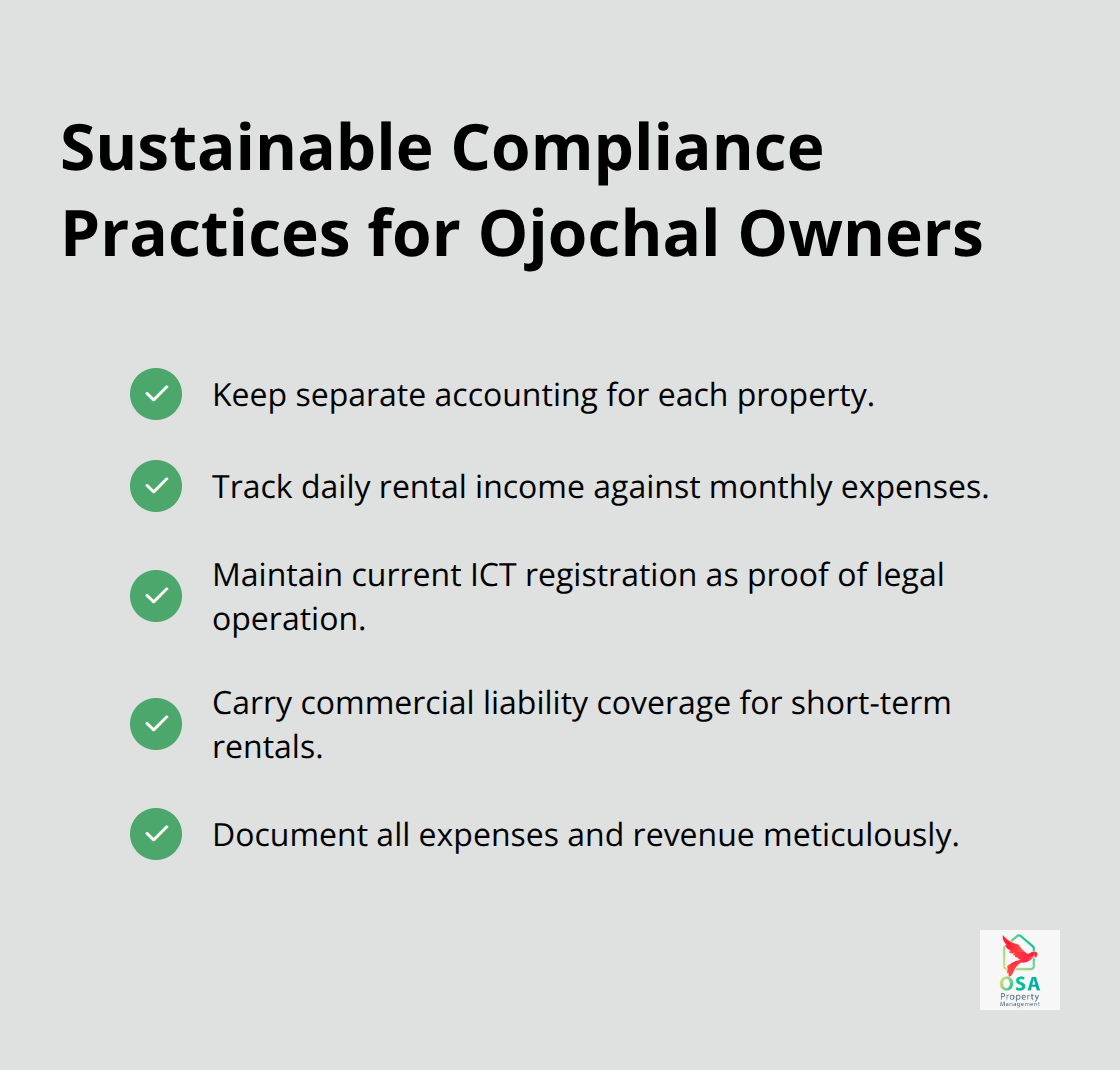
The owners who succeed in Ojochal keep separate accounting for every property, track daily rental income against monthly expense statements, maintain ICT registration as current proof of legal operation, and carry commercial liability coverage explicitly covering short-term vacation rentals. These practices cost minimal effort upfront but prevent penalties that consume years of rental profit.
Final Thoughts
Ojochal property oversight succeeds when compliance and revenue generation work together rather than against each other. Solo operators managing their own properties often report $50,000 in annual income while juggling tax deadlines, maintenance coordination, guest communication, and marketing across multiple platforms. The same property under professional management typically generates $65,000 to $75,000 after management fees, because experienced teams apply dynamic pricing, handle guest screening, maintain consistent property standards, and resolve issues before they become problems.
Professional oversight costs 15 to 30 percent of rental income, but the operational efficiency and revenue optimization typically return 15 to 25 percent higher net income than solo management produces. We at Osa Property Management have spent over 20 years building systems that handle exactly this balance, managing properties across Ojochal, Uvita, Dominical, Manuel Antonio, and throughout the southern Pacific region. Our team handles marketing, tax compliance, bill payment, accounting, concierge services, and maintenance coordination so owners can focus on their investment returns rather than daily operations.
If you own property in Ojochal or the surrounding region, contact Osa Property Management to discuss customized service packages that fit your budget and goals. The decision you make today determines whether your Ojochal property becomes a reliable income source or remains a part-time burden that never reaches its full potential.