
Property taxes in Costa Rica work differently than in most countries, and getting them wrong costs investors thousands of dollars annually. We at Osa Property Management have seen firsthand how proper property tax planning separates successful investors from those who overpay.
This guide walks you through Costa Rica’s tax system, proven strategies to reduce your burden, and the mistakes that drain your profits.
How Costa Rica Actually Calculates Your Property Tax
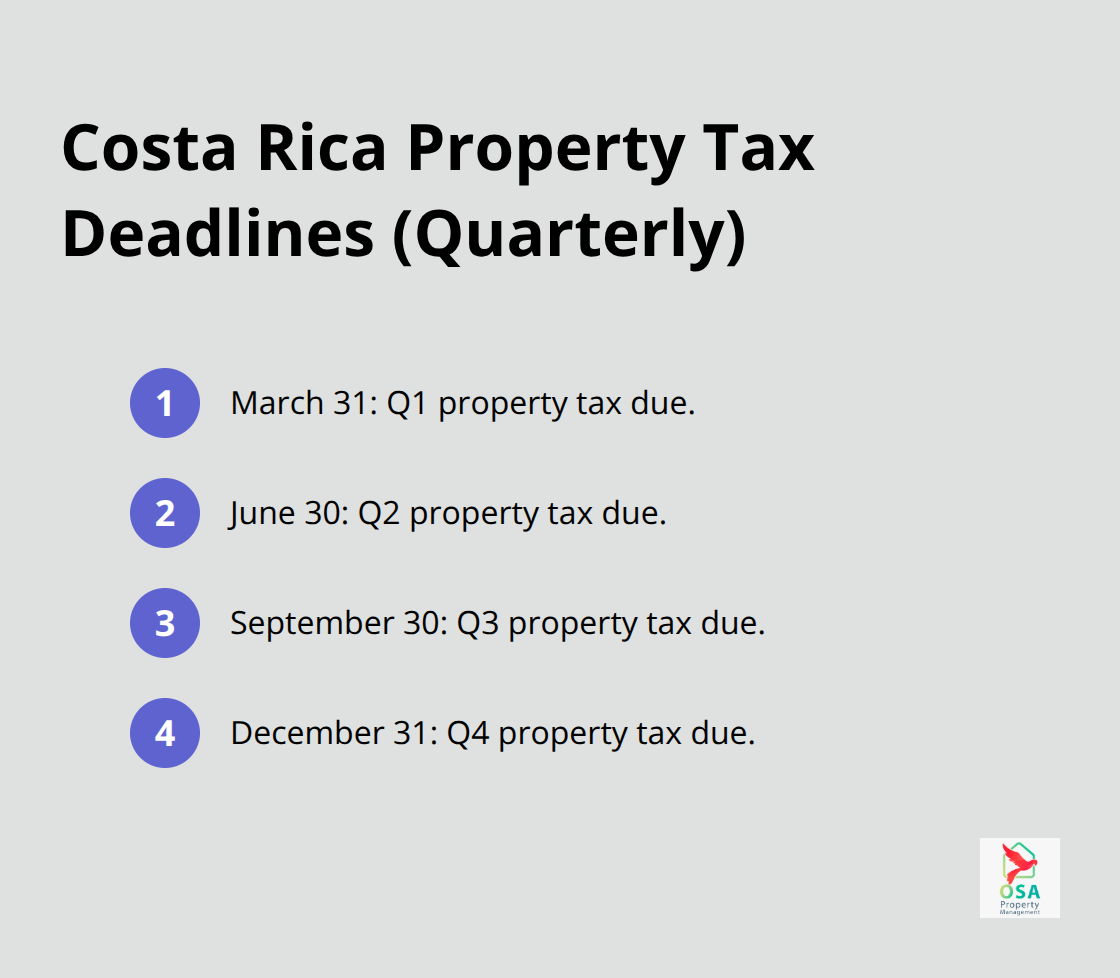
Costa Rica’s property tax system operates on a deceptively simple formula that catches most investors off guard: 0.25% of your property’s registered municipal value, collected quarterly by your local municipality. The critical word here is registered value, not market value. A property worth $500,000 on the open market might carry a registered value of $300,000, meaning your annual tax bill lands around $750 instead of $1,250. This gap exists because registered values lag behind market prices by years, sometimes decades. According to Costa Rica’s Ley 7509, the municipality reassesses property values every five years, which means purchasing right after a reassessment cycle saves you thousands in taxes for years until the next valuation occurs. Property tax payments fall due quarterly on March 31, June 30, September 30, and December 31, with penalties triggered immediately for late submissions. Most investors miss this because they assume annual billing like their home country uses.
Luxury Properties and Additional Tax Burdens
Properties valued above 133 million colones (approximately $230,000 as of August 2024) trigger an additional luxury tax ranging from 0.25% on top of your standard property tax. This isn’t a small add-on-a $300,000 property faces an extra tax burden annually. The threshold rises each year with inflation, so today’s non-luxury property might become luxury-taxed next year. You must calculate this on the combined land and construction value, and payment is due by January 15 with steep penalties for delays. Transfer taxes also matter significantly: you’ll pay approximately 1.5% at purchase, with sellers sometimes owing 2.5% to 3.75% depending on circumstances, according to Costa Rica’s Ministerio de Hacienda. These costs are due within 30 days of signing and often surprise investors who only budget for the property itself.
Rental Income Taxation and Deduction Rules
Rental income taxation works completely differently than property ownership taxes. Non-resident landlords pay 15% tax on 85% of gross rental income, yielding an effective rate of about 12.75%, according to the Ministerio de Hacienda. Most investors mistakenly believe they can deduct maintenance, utilities, and management fees from gross income before calculating this 15%-they cannot under the standard method. An alternative method exists if you employ staff: you can file annually on net income with deductions, though this requires professional setup and ongoing compliance. Maintenance and repair expenses, mortgage interest, property insurance, and HOA fees become deductible only if you elect the alternative method and maintain meticulous documentation. Electronic invoicing, now mandatory under Costa Rica’s factura electrónica system, automatically sends your expense records to the tax authority, making compliance tracking far easier than before. Understanding which method applies to your situation determines whether you overpay or optimize your tax position significantly.
How to Structure Ownership and Time Your Moves for Lower Taxes
Corporate Structures Cut Your Tax Bill Dramatically
The ownership structure you choose determines your tax liability far more than most investors realize. Costa Rican corporations offer significant advantages over direct foreign ownership, particularly for rental properties. When you own property through a Costa Rican S.A. (sociedad anónima), you sidestep the 15% non-resident rental income tax entirely, instead paying corporate tax on net profits. A $200,000 property generating $24,000 annually in rental income costs you $3,060 in taxes as a direct foreign owner (12.75% effective rate), but through a corporation paying net income tax, you owe approximately $1,500 after deducting maintenance, insurance, and management fees. The corporate structure also simplifies transfers to heirs and protects personal assets from liability. However, corporate ownership demands annual shareholder declarations with digital signatures and compliance costs around $200 to $400 yearly, so properties under $150,000 may not justify the overhead.
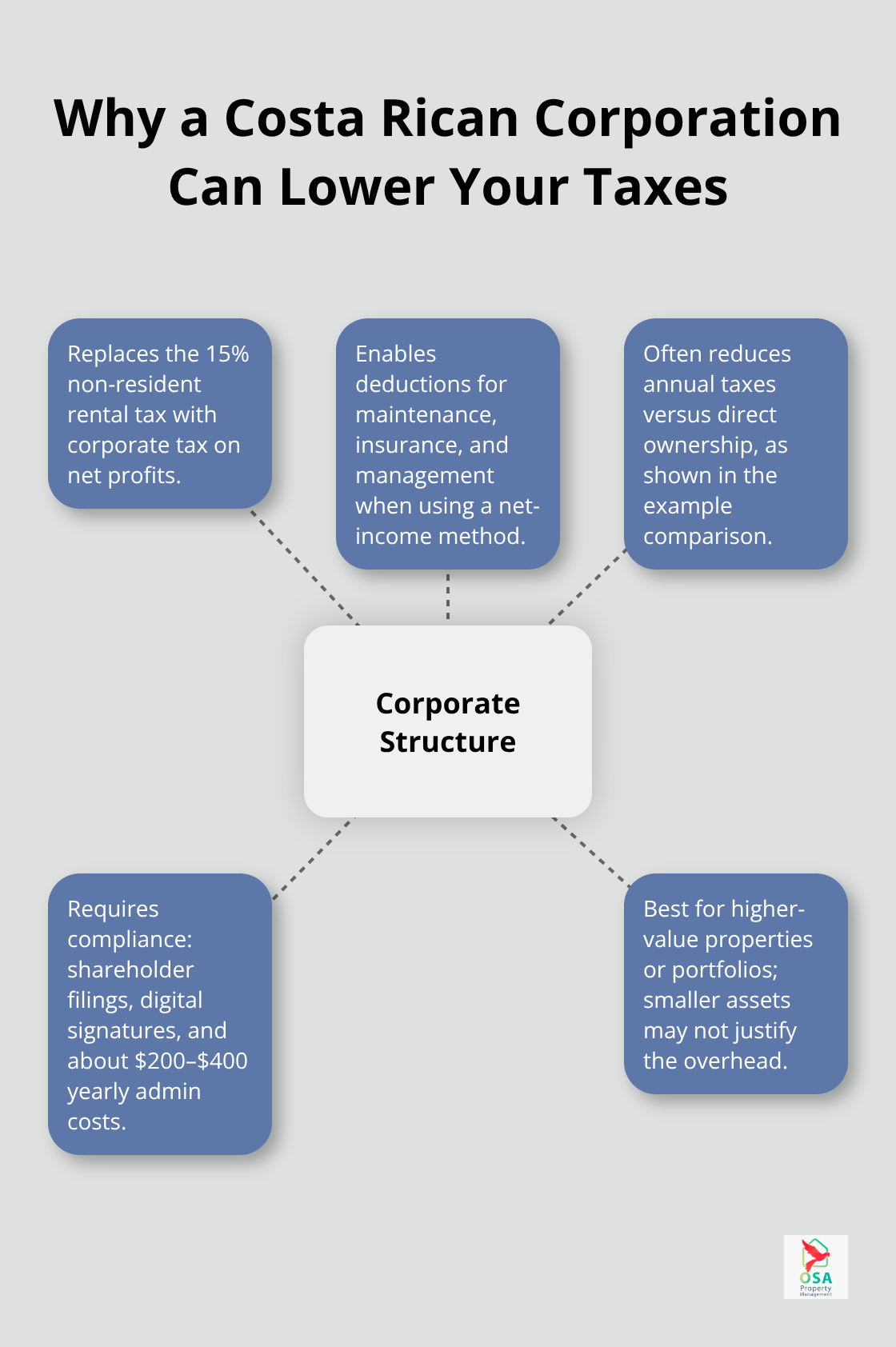
Corporate structures work best for portfolios exceeding $500,000 or properties generating significant rental income, as the tax savings rapidly exceed administrative expenses.
Reassessment Cycles Lock In Lower Taxes for Years
Timing your purchases and sales against the five-year reassessment cycle creates substantial savings without any legal complexity. Properties reassessed in 2024 carry lower registered values until 2029, meaning you purchase immediately after a reassessment to lock in lower taxes for four years. A $400,000 property with a registered value of $250,000 pays $625 annually in base property tax, but after reassessment that same property might jump to $350,000 registered value, pushing your annual bill to $875. Conversely, you sell before a reassessment year to maximize your proceeds because the buyer inherits the upcoming revaluation. Municipal records show reassessment schedules publicly, so checking your property’s last valuation date takes minutes and reveals exactly when your taxes will rise. For luxury properties above 133 million colones, delaying purchases until after a reassessment becomes even more critical because the additional luxury tax compounds on the new higher registered value.
Deductions Transform Your Tax Position
Abandon the standard rental income method if you employ any staff; the alternative method allowing expense deductions cuts your effective tax rate dramatically. Mortgage interest, property insurance, HOA fees, maintenance supplies, utilities, and management fees all reduce taxable income when properly documented through electronic invoicing. A property with $24,000 gross rental income and $8,000 in eligible expenses generates only $16,000 taxable income, dropping your corporate tax from $6,000 to $4,000 annually. Electronic invoicing now mandatory under Costa Rica’s factura electrónica system automatically submits your expense records to Hacienda, eliminating the documentation burden and audit risk that plagued investors before 2022. Most investors never switch to the alternative method because they assume the standard approach is simpler, but the tax savings justify hiring an accountant familiar with Costa Rican property deductions. This shift in approach transforms how you report income and determines whether you overpay or optimize your tax position significantly.
What Costs Investors Thousands in Missed Deductions and Unreported Income
Most investors in Costa Rica lose money through two preventable mistakes: they fail to switch from the standard rental income method to the alternative method that allows deductions, and they don’t track expenses with electronic invoicing from day one. The standard method taxes 15% on 85% of gross rental income regardless of what you actually spend on maintenance, repairs, insurance, or management fees. An investor collecting $24,000 annually pays $3,060 in taxes under this method, even if they spend $10,000 on legitimate property expenses.
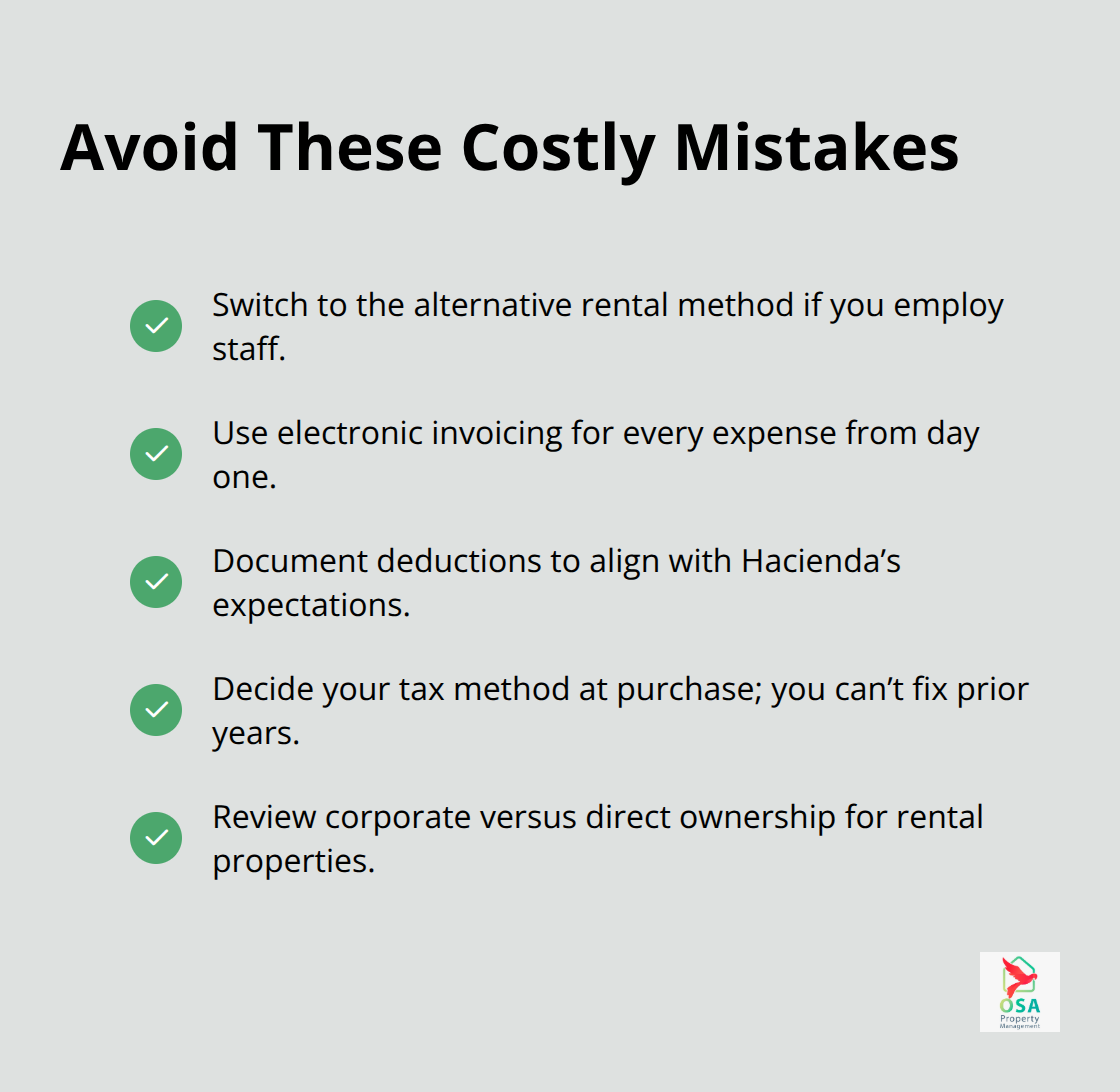
The alternative method requires you to have at least one employee on payroll, but most property managers already employ staff, making this requirement trivial to satisfy. Once you elect the alternative method and file the proper documentation with Hacienda, your taxable income drops to $14,000 after deductions, cutting your tax bill to roughly $1,400 depending on your corporate structure and net income brackets. This $1,660 annual difference compounds over years into tens of thousands in savings.
The Cost of Staying on the Standard Method Too Long
Investors who operate under the standard method for three or four years before switching leave behind thousands in overpaid taxes they cannot recover. The moment you purchase property in Costa Rica, you must decide which method applies to your situation and implement it correctly from your first rental payment. Switching retroactively provides no relief for prior years, so the delay itself becomes expensive. A property generating $24,000 annually in rental income costs you an extra $1,660 per year under the standard method-multiply that across a three-year delay and you’ve lost nearly $5,000 in recoverable taxes.
Electronic Invoicing Protects Your Deductions
Costa Rica’s factura electrónica system automatically submits expense records to Hacienda, eliminating the documentation burden that deterred investors from claiming deductions before 2022. When your property manager, contractor, or utility company issues a factura electrónica, that invoice flows directly to the tax authority, creating an audit trail that protects you rather than exposing you to scrutiny. Investors who manually track expenses in spreadsheets or paper receipts face skepticism from auditors and cannot prove deductions as convincingly as those with electronic records. A contractor bill for $5,000 in roof repairs plus 13% VAT becomes a documented deduction when issued electronically, whereas the same work paid in cash leaves you vulnerable to rejection during an audit.
Why Hacienda Scrutinizes Foreign Landlords Heavily
Foreign investors often underestimate how aggressively Hacienda scrutinizes non-resident rental income, particularly when deduction claims seem inconsistent with property condition or age. The Ministerio de Hacienda expects maintenance spending to correlate with property value and rental income, so claiming minimal deductions on a high-income property raises red flags immediately. Conversely, investors with complete electronic invoicing documentation rarely face challenges because the paper trail proves legitimacy. Your property manager should provide monthly statements showing every expense issued as a factura electrónica, giving you the documentation needed to file confidently and defend your deductions if questioned.
Final Thoughts
Property tax planning in Costa Rica rewards investors who act deliberately rather than reactively. The difference between overpaying and optimizing your tax position often exceeds $1,500 annually on a single property, compounding into tens of thousands across a portfolio. Elect the alternative rental income method if you employ any staff, implement electronic invoicing from your first rental payment, and time major purchases or sales around the five-year reassessment cycle to cut most investors’ tax bills by 30 to 40 percent.
Professional guidance matters because Costa Rica’s tax system contains traps that cost money silently. The standard rental income method feels simpler until you realize you’re overpaying by thousands annually. Reassessment schedules hide in municipal records until you know where to look, and corporate structures make sense for some portfolios but waste money on others. Deduction eligibility depends on employment status and filing method, not just property type, so getting these decisions right requires someone who understands both Costa Rican tax law and your specific situation.
We at Osa Property Management handle tax compliance, electronic invoicing, and expense documentation as part of comprehensive property management across Jaco, Manuel Antonio, Dominical, Uvita, Ojochal, and Golfito. Review your current ownership structure and rental income method against the strategies outlined here, then connect with a tax professional or property manager who understands Costa Rican requirements. The money you save by acting now compounds every year you own property in Costa Rica.