
Owning rental properties in Costa Rica can be profitable, but the tax system is complex and unforgiving. Many landlords lose money simply because they don’t understand how rental income Costa Rica is taxed or what expenses they can legally deduct.
We at Osa Property Management have helped dozens of property owners navigate these rules and keep more of what they earn. This guide breaks down everything you need to know about taxes on rental income in Costa Rica.
How Rental Income is Actually Taxed in Costa Rica
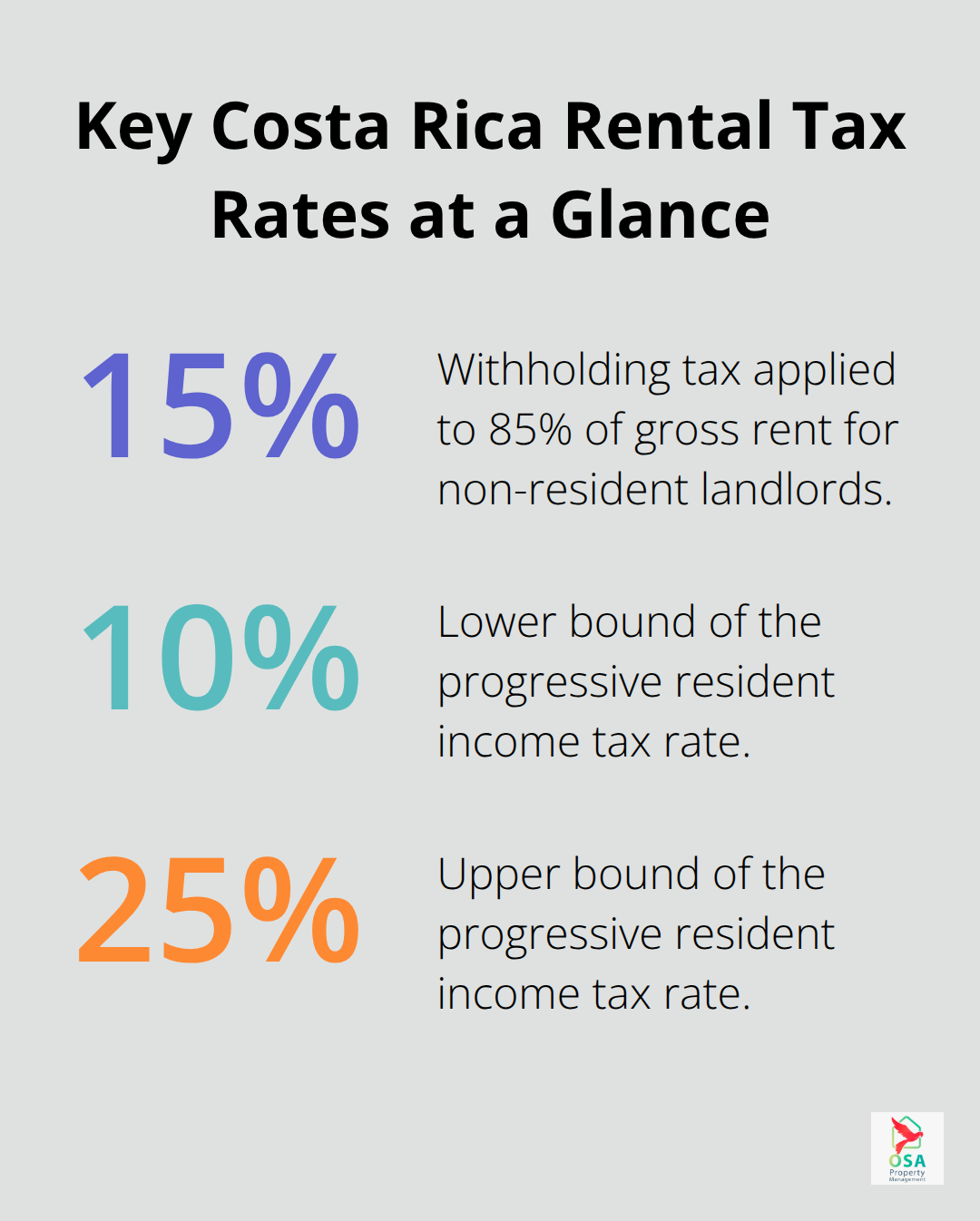
Costa Rica taxes rental income using a straightforward but often misunderstood system. Non-residents pay a 15% withholding tax on 85% of gross rental income, which works out to roughly 12.75% of your total rent. Residents face progressive rates ranging from 10% to 25% depending on their total income, with a tax-exempt threshold of about 3.8 million colones annually, or roughly $7,600. The Dirección General de Tributación applies these rates uniformly across all landlords, whether you rent long-term or operate short-term vacation rentals. If you earn $2,000 monthly in rent as a non-resident, you owe approximately $255 per month in taxes under the 15/85 rule. Residents with higher incomes pay more, but the system rewards those who document deductible expenses properly.
The Critical Difference Between Residents and Non-Residents
Non-residents must have a Costa Rican tax identification number and file monthly using Form D-125. Residents file annually but can claim deductions that dramatically lower their final tax bill. This distinction matters enormously because residents who properly document expenses often recover thousands in deductions that non-residents cannot access. Your residency status determines not just your tax rate but your entire filing strategy and the deductions available to you.
Monthly Filing Deadlines Create Immediate Penalties
Monthly payments are mandatory regardless of whether you collected rent that month. You must file and pay between the 1st and 15th of the following month, meaning January rental income is due by February 15th. Missing even one deadline incurs a 1% monthly penalty on the outstanding balance, and multiple missed filings trigger an audit. If you use platforms like Airbnb or VRBO, these companies now report your income directly to Costa Rican tax authorities as of 2026, so your personal filings must match platform data exactly. Discrepancies between what platforms report and what you file create immediate red flags with the tax authority.
How Deductions Reduce Your Actual Tax Burden
The annual return, filed by March 16th, is where deductions actually reduce your tax burden. Property taxes of 0.25% on assessed value, HOA fees, maintenance costs, insurance premiums, mortgage interest, and property management fees all stack together to create legitimate deductions. A $250,000 property with $625 in annual property taxes, $1,800 in HOA fees, and $5,000 in maintenance costs already generates $7,425 in deductions before considering insurance or management fees. These deductions matter enormously because they offset the income reported to Hacienda and can result in refunds if deductions exceed gross rental income.
Electronic Invoices Determine What You Can Actually Deduct
Every single deductible expense must come with a factura electrónica, Costa Rica’s mandatory electronic invoice system. Paper receipts are rejected by tax authorities and create audit risk. Contractors who refuse to issue digital invoices should be replaced immediately because their invoices provide zero tax benefit. When you hire someone for a $10,000 kitchen renovation, the contractor must issue an invoice showing 13% IVA, making the total $11,300. That 13% VAT becomes recoverable if you have proper IVA registration and the invoice includes your tax ID.
Landlords who pay contractors in cash or accept informal receipts essentially throw away thousands in potential deductions annually. The best approach involves maintaining a dedicated rental business bank account and paying all contractors through bank transfer or credit card, creating an automatic paper trail. Cloud-based accounting software like QuickBooks Online or Xero costs roughly $15–30 monthly and automatically categorizes expenses, making your annual tax return preparation straightforward. Without this organization, you lose deductions because you cannot document them to tax authorities.
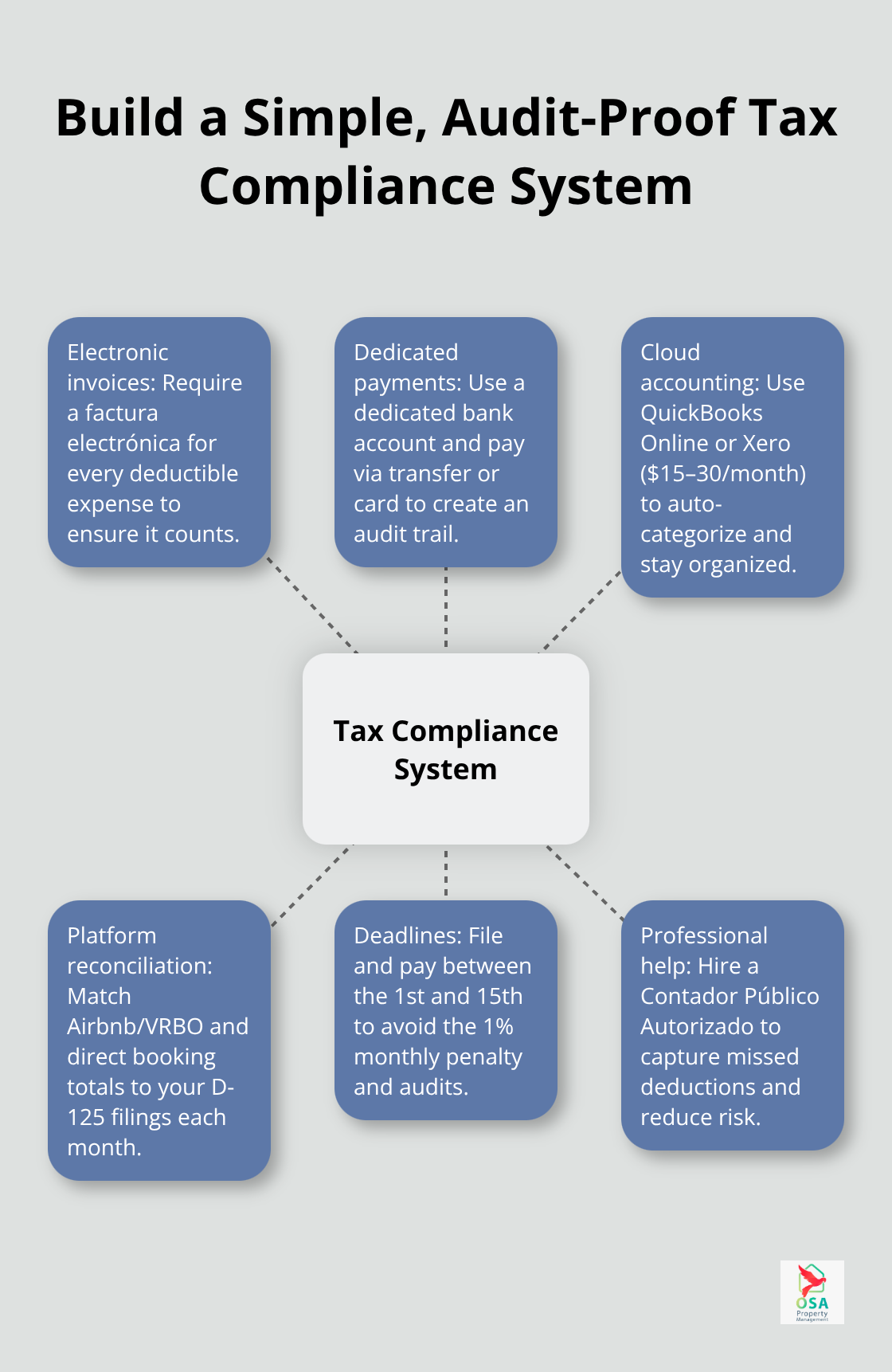
Professional accountants in Costa Rica, called Contadores Públicos Autorizados, typically charge $150,000–300,000 colones annually but identify deductions most landlords miss, often paying for themselves through recovered expenses and optimized tax strategy. Property management firms that handle accounting and tax compliance can streamline this process further, ensuring every expense receives proper documentation and classification. The mistakes landlords make in this area-paying cash, accepting paper receipts, or skipping professional help-cost far more than professional services ever would.
Where Landlords Lose Money on Taxes
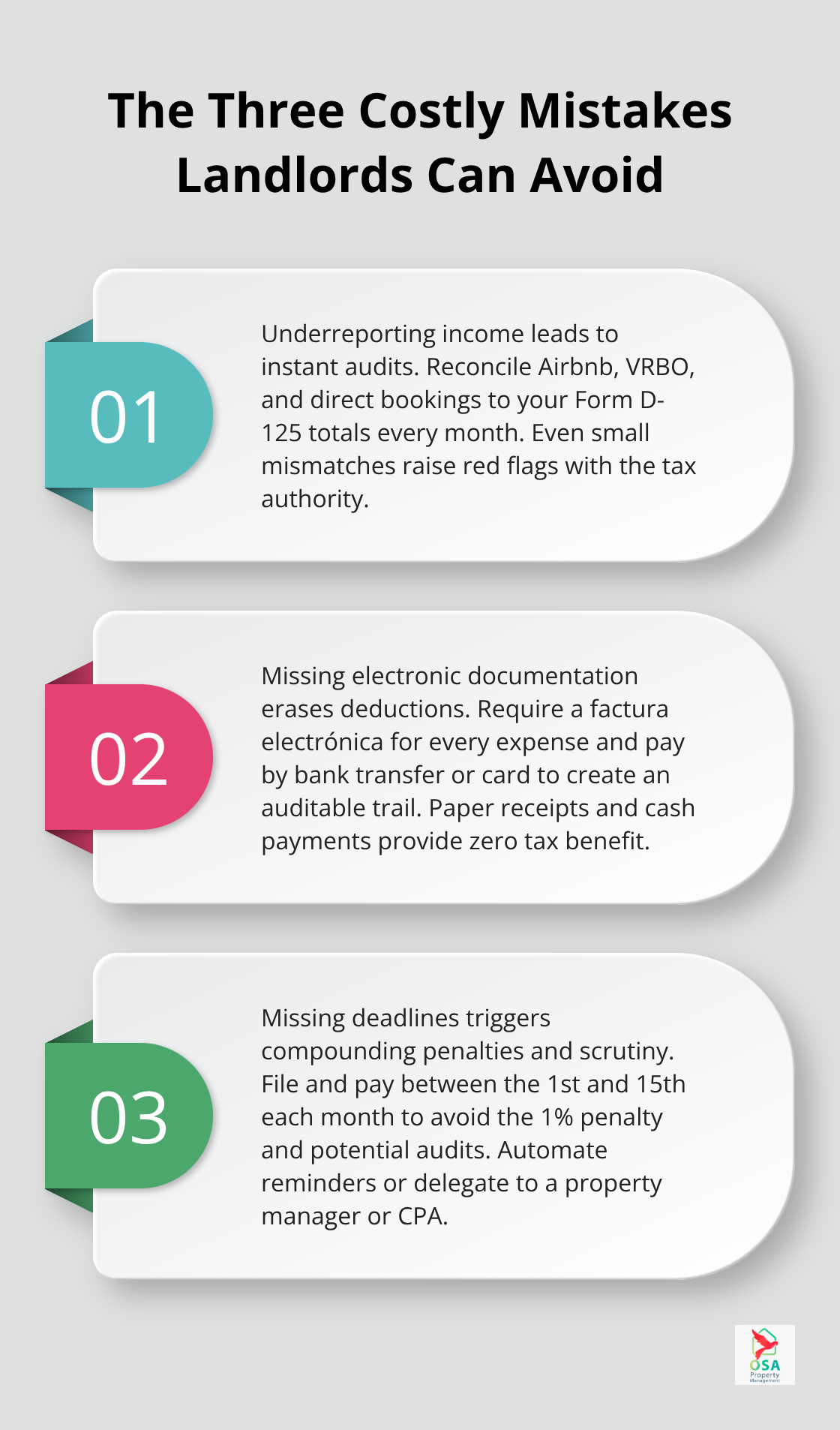
Landlords in Costa Rica consistently make three costly mistakes that cost them thousands annually, and most stem from incomplete understanding of how the tax system actually works rather than deliberate evasion. The first mistake is underreporting income, which happens when landlords fail to reconcile platform reports with their personal filings. Airbnb, VRBO, and other platforms now report your transaction data directly to the Dirección General de Tributación as of 2026, meaning the tax authority knows exactly how much you earned before you file anything. If your monthly Form D-125 filing shows $1,500 in rental income but Airbnb reported $2,000 to Hacienda, that $500 discrepancy triggers an audit immediately. The penalty is severe: non-compliance results in fines ranging from 25% to 100% of unpaid taxes plus daily interest.
Many landlords also forget that income gaps create suspicion. If you report zero income for a month because your property was vacant, that’s fine, but the tax authority expects your filings to match platform data exactly across the entire year. Rental income from all channels, including direct bookings on your own website, must be reported and reconciled monthly.
Income Mismatches Trigger Audits
Platform reporting has fundamentally changed how tax authorities verify landlord compliance. The tax authority cross-references what platforms report against what you file, and even small discrepancies invite investigation. A landlord who collects $24,000 annually across Airbnb and direct bookings but files only $20,000 on Form D-125 faces immediate scrutiny. The audit process demands back payments, penalties, and professional accounting fees to resolve-costs that dwarf the original tax liability. Landlords operating multiple properties or living outside Costa Rica often struggle to track income across channels, making reconciliation errors common. Setting up a single spreadsheet that consolidates all rental income sources (Airbnb, VRBO, direct bookings, and cash payments) takes roughly two hours monthly and eliminates this risk entirely.
The Deduction Trap: Documentation Determines Everything
The second mistake is claiming expenses without proper electronic documentation, which essentially means the deduction disappears. A contractor who accepts cash and provides a paper receipt has just cost you a deduction that could have saved hundreds in taxes. That same contractor issuing a factura electrónica with your IVA registration number would have been fully deductible. Landlords often assume all maintenance, repairs, and professional fees are deductible without realizing that the tax authority rejects any expense lacking a digital invoice. A $5,000 roof repair paid in cash with a handwritten receipt yields zero tax benefit, while the same repair documented electronically would reduce your tax liability by roughly $500 to $750 depending on your tax bracket. The cost of hiring a Contador Público Autorizado, typically 150,000 to 300,000 colones annually, often pays for itself by identifying missed deductions and ensuring every contractor invoices electronically. Cloud-based accounting software like QuickBooks Online or Xero (costing $15–30 monthly) automatically categorizes expenses and creates an audit trail that protects you if questions arise.
Missing Deadlines Costs More Than You Think
The third mistake is missing filing deadlines, which incurs immediate penalties regardless of circumstances. Monthly payments due between the 1st and 15th of the following month are non-negotiable. A single missed deadline costs 1% of the outstanding balance monthly, and repeated missed filings trigger audits that demand back payments, penalties, and professional accounting fees to resolve. Landlords who manage multiple properties or live outside Costa Rica often lose track of the calendar. Setting automated reminders on your phone or delegating filing to a property management firm eliminates this risk entirely and costs far less than penalties and audit defense. The tax authority shows no flexibility on deadlines-vacation, illness, or travel outside Costa Rica provides no excuse for late payment. A landlord who misses three consecutive monthly filings faces penalties exceeding 3% of the outstanding balance plus daily interest, transforming a manageable tax bill into a financial crisis. Professional property management services handle this layer entirely, managing your monthly filings, reconciling platform income, and ensuring every contractor provides proper documentation. This approach transforms tax compliance from a source of stress into a predictable, manageable business expense. Understanding these three mistakes positions you to avoid them, but the real challenge lies in implementing systems that prevent errors from occurring in the first place.
How to Structure Your Rental Business for Maximum Tax Efficiency
The single most impactful decision you can make is whether to own your rental property individually or through a Costa Rican company, and this choice determines your entire tax trajectory. Individual ownership under the 15/85 rule costs non-residents roughly 12.75% of gross rental income monthly, with deductions claimed only on your annual return filed by March 16th. A Costa Rican company triggers corporate tax rates that scale with revenue relative to the monthly base salary benchmark of 450,200 colones, or about $790. Companies earning less than 120 times this benchmark pay 25% of the base salary annually in corporate tax, roughly $237 per year, while inactive companies pay the same flat rate regardless of income. This structure sounds attractive until you realize that corporate entities demand shareholder declarations annually, require a digital signature from a Costa Rican bank, and impose compliance costs that often exceed individual ownership taxes for properties generating under $50,000 annually. Landlords who switch to corporate structures often discover that their property’s actual revenue does not justify the added complexity and accounting fees. For most rental properties under $100,000 in annual gross income, individual ownership with meticulous deduction documentation outperforms corporate structures financially and operationally. The exception is high-volume operators managing five or more properties or earning over $200,000 annually, where corporate structures can legitimately reduce tax burden when structured with professional guidance from a Contador Público Autorizado who understands both Costa Rican and your home country’s tax systems.
Your Deduction Strategy Determines Real Profitability
Deductions form the backbone of tax efficiency, yet most landlords capture only 40 to 60 percent of what they legally claim. Property taxes at 0.25% of assessed value, HOA fees, maintenance reserves, insurance premiums ranging $400 to $800 yearly, mortgage interest on the full loan balance, and property management fees all compound into substantial tax relief. A $250,000 property generating $24,000 annually in rental income could accumulate $7,425 in property taxes and HOA fees alone, plus maintenance reserves and $400 to $800 in insurance, totaling substantial annual deductions. These deductions reduce your taxable income significantly, potentially creating a refund if total deductions exceed your gross rental income for the year. The critical variable is documentation. Every expense must arrive with a factura electrónica bearing your IVA registration number, and every contractor must receive payment through bank transfer or credit card to create an audit trail. Landlords who pay contractors in cash lose these deductions entirely because the tax authority will not recognize them without electronic invoices. Cloud-based accounting software like QuickBooks Online or Xero costs $15 to $30 monthly and automatically categorizes expenses, making your annual tax preparation straightforward and audit-proof. This system takes roughly 30 minutes monthly to maintain and eliminates the frantic scrambling that happens when landlords attempt to reconstruct a year’s worth of expenses in March. Professional Contadores Públicos Autorizados typically charge $150,000 to $300,000 colones annually but identify overlooked tax deductions most landlords miss, often recovering $3,000 to $8,000 in additional tax relief that pays for their services multiple times over.
Professional Guidance Prevents Costly Mistakes
Working with a tax professional is not optional if you want to maximize efficiency and minimize audit risk. Costa Rican tax law changes annually, and 2026 brought platform-reporting requirements that fundamentally shifted how tax authorities verify landlord compliance. A qualified Contador Público Autorizado understands the interplay between the 15/85 rule, IVA registration thresholds, electronic invoicing requirements, and annual deduction claims in ways that most landlords cannot navigate independently. They also understand cross-border considerations if you are a US citizen, advising on Foreign Tax Credit calculations and the Foreign Earned Income Exclusion to prevent double taxation. The investment in professional guidance typically ranges $150,000 to $300,000 colones annually, or roughly $280 to $560 per year, which is negligible compared to the audit defense costs and recovered deductions they facilitate. Property management firms that integrate accounting and tax compliance streamline this process further through monthly filings, electronic invoicing verification with every contractor, and reconciliation of platform income against your personal filings before submission. This integrated approach eliminates the coordination problems that arise when landlords juggle property managers, accountants, and platforms independently, each operating on different calendars and standards. The real cost of tax inefficiency is not the professional fees you pay but the deductions you miss, the penalties you incur from late filings, and the audit defense costs that follow from documentation failures. Landlords who treat tax compliance as an afterthought consistently lose more money than those who invest in proper structure and professional support from the beginning.
Final Thoughts
Rental income in Costa Rica demands precision, documentation, and consistent monthly attention. The tax system itself is straightforward-15% withholding on 85% of gross rent for non-residents, progressive rates for residents-but execution separates successful landlords from those who lose money to penalties and missed deductions. Your filing deadlines are absolute, your electronic invoices are non-negotiable, and your platform income must reconcile perfectly with your personal filings.
The three mistakes we covered-underreporting income, claiming expenses without proper documentation, and missing deadlines-are entirely preventable. A single spreadsheet tracking all rental income sources takes two hours monthly and eliminates audit risk. Requiring every contractor to issue a factura electrónica ensures your deductions actually count, and setting phone reminders for the 15th of each month prevents penalties that compound into financial crises.
The real opportunity lies in capturing deductions most landlords miss. Property taxes, HOA fees, maintenance reserves, insurance, mortgage interest, and management fees stack into thousands of dollars annually in legitimate tax relief (a $250,000 property easily generates $7,000 to $10,000 in annual deductions before considering professional accounting fees). Professional support transforms tax compliance from a source of stress into a predictable business expense, and a Contador Público Autorizado typically costs $150,000 to $300,000 colones annually but identifies overlooked deductions worth thousands. If you want professional support navigating these rules and maximizing your rental income in Costa Rica, contact Osa Property Management to discuss how we can streamline your tax obligations and protect your rental income.