

Rental property owners in Costa Rica face complex tax obligations that many overlook. At Osa Property Management, we’ve seen firsthand how confusion about renter tax guidelines CR costs owners thousands in missed deductions and penalties.
This guide walks you through what you must report, what you can deduct, and the mistakes that land owners in trouble with tax authorities.
Who Must Report Rental Income and What Tax Rules Apply
Registration and Tax Authority Requirements
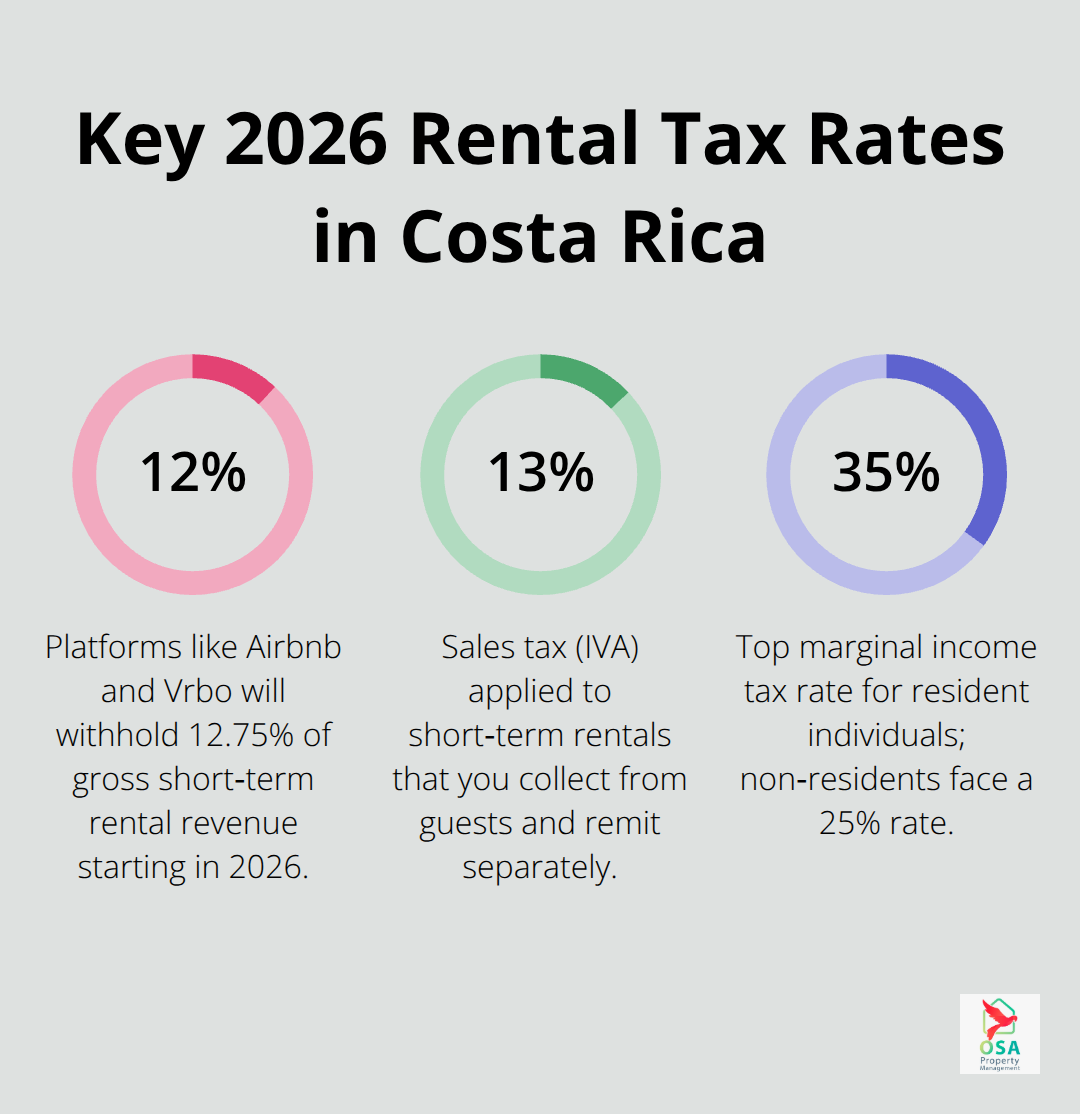
Capital gains are included as part of income and taxed at the individual’s marginal/graduated tax rate for residents (highest of 35%) and 25% for non-residents, and the tax authority, known as the Dirección General de Tributación (DGT), requires all property owners who earn rental revenue to register and file returns. If you own property in Costa Rica and receive rental payments-whether from short-term vacation rentals under 30 days or longer-term leases-you must report that income. The DGT treats rental income the same way it treats salary or business income, meaning no exemption exists based on how much you earn or how many weeks per year you rent your property.
Non-compliance carries real penalties. Failure to register in the Registro Único de Contribuyentes costs you 215,500 CRC per month, up to 1,293,000 CRC total, according to Article 78 of Costa Rica’s Income Tax Law. You must register with the DGT now via their online portal or through a local tax representative, even if you haven’t earned significant income yet. Once platform data starts flowing to authorities in 2026, being in the system protects you from administrative penalties.
Tax Brackets and Platform Withholding
The individual income tax brackets for 2026 range from 0% on income up to 3,549,000 CRC annually, then 10%, 15%, 20%, and up to 30% on income above 17,716,000 CRC. For short-term rental income specifically, platforms like Airbnb and Vrbo will withhold 12.75% of your gross revenue starting in 2026 and remit it directly to the DGT as part of a global tax transparency framework. This withholding applies regardless of your actual tax bracket, so you need to price your listings with this deduction in mind.
Additionally, short-term rentals are subject to a 13% sales tax (IVA) that you collect from guests and remit separately. The Costa Rica tax authority is strengthening enforcement in 2026, particularly in high-tourism areas like Manuel Antonio and Santa Teresa where rental activity concentrates.
Filing Deadlines and Documentation Requirements
Filing deadlines matter because penalties accumulate quickly. The main income tax return (D-101) is due March 16 each year, while monthly VAT returns (D-104) are due by the 15th of the following month. Late payments incur additional charges that compound monthly.
Electronic invoicing became mandatory in Costa Rica, and every rental transaction must generate an electronic invoice that you store and can produce for audits. This requirement applies whether you manage your property yourself or work with a professional manager. You’ll also need current ICT (Costa Rican Tourism Institute) registration for tourist lodging properties, which typically costs around $200 for first-time registration and $100–$500 annually for renewals.
Municipal Permits and Ownership Structure
Municipal permits and zoning clearance are separate obligations-your local municipality requires a patente comercial (business permit) costing roughly $200–$800 per year, and you must confirm that your zone actually permits short-term rental activity before listing. Municipal income tax rates vary by location, so contact your municipality directly to learn the exact rate and filing requirements for your area.
Many property owners assume that owning property through a corporation (SA or SRL) exempts them from rental taxes, but this is false. Corporate ownership affects how you report and distribute income, not whether taxes apply. The ownership structure determines your filing method and tax brackets but does not eliminate the obligation to pay.
Building Your Compliance System
Maintaining robust documentation is non-negotiable: keep proof of ICT registration, all electronic invoices, platform payout statements, and tax filings in one organized system. This paper trail reduces enforcement risk significantly and makes audits straightforward if they occur. Consult a Costa Rica-based accountant who understands both your ownership structure and your specific rental model to ensure you’re filing under the correct tax regime, especially if you’ve been operating informally. Understanding your tax obligations sets the foundation for identifying which expenses you can actually deduct from your rental income-a distinction that separates owners who maximize their returns from those who leave money on the table.
What Expenses Can You Actually Deduct
Rental property owners in Costa Rica can deduct legitimate business expenses from their gross rental income, but the Dirección General de Tributación (DGT) draws hard lines between what qualifies and what doesn’t. We work with property owners who either miss deductions they’re entitled to or incorrectly claim personal expenses, both of which trigger audits. The key is understanding that the DGT allows deductions only for costs directly tied to generating rental income. Your mortgage principal payments don’t count. Your property’s appreciation doesn’t count. But the costs to maintain, operate, and manage your rental business absolutely do. Tracking these expenses with electronic receipts and invoices protects you during enforcement periods like 2026 when the DGT strengthens platform data matching. Maintain separate documentation for each expense category and reconcile monthly against your platform payouts so discrepancies surface before an audit does.
Maintenance, Repairs, and Property Upkeep
Property maintenance and repairs qualify as fully deductible as long as they preserve the property’s current condition rather than improve it. Fixing a broken air conditioning unit qualifies; installing a brand-new premium system to attract higher-paying guests does not. Roof repairs, plumbing fixes, painting interior walls, replacing worn flooring, and fixing electrical problems all count. The distinction matters because improvements that increase property value must be capitalized and depreciated over 27.5 years for residential rental property or 39 years for commercial property, not claimed as immediate deductions.
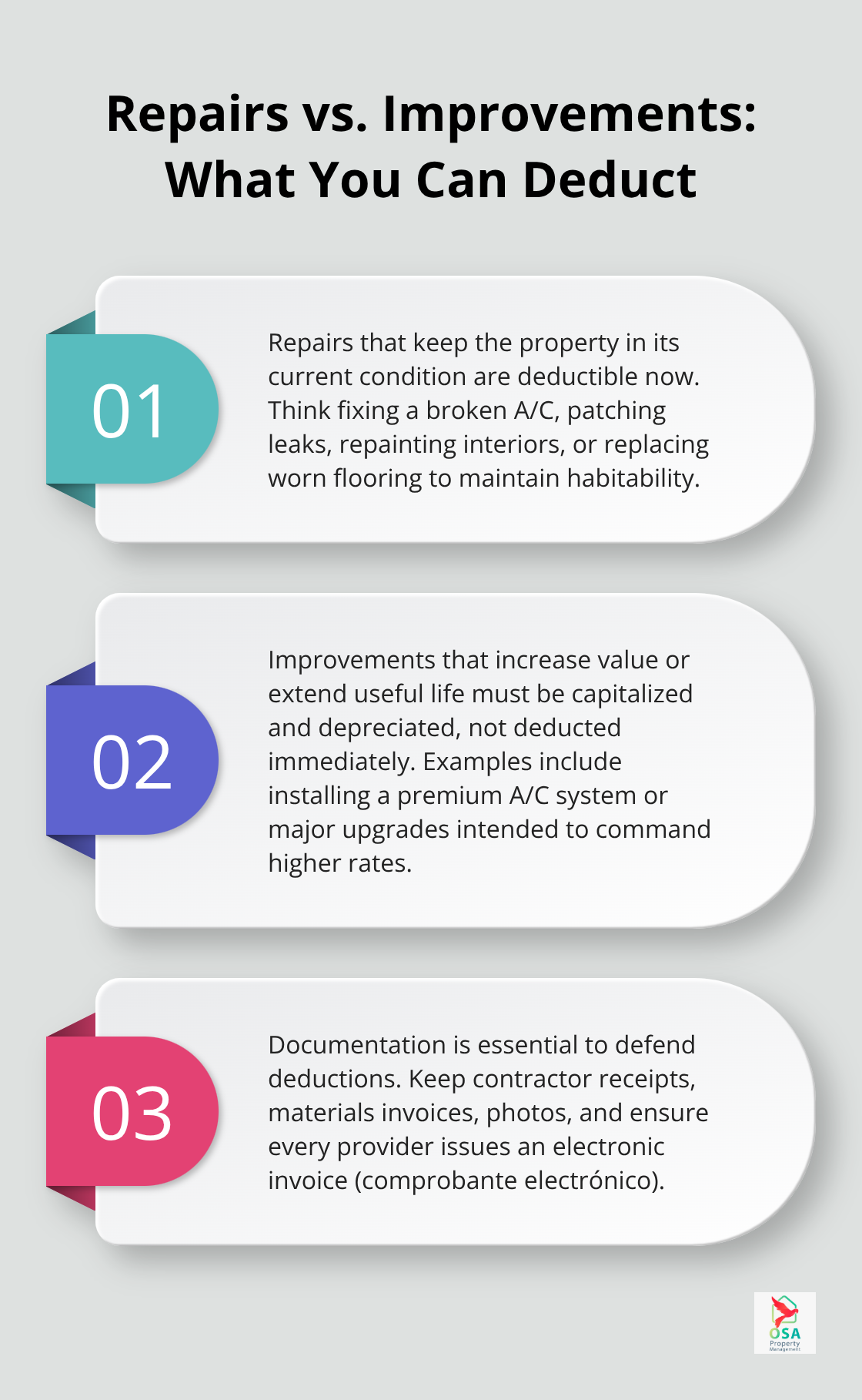
Keep receipts from contractors, purchase invoices for materials, and photos documenting the work. If you hire a contractor without an electronic invoice, the expense becomes harder to defend in an audit. Costa Rica requires electronic invoicing, so insist that any service provider issues a comprobante electrónico. The DGT cross-references platform revenue against claimed deductions, so a $50,000 annual rental income with $45,000 in claimed repairs raises red flags immediately. Try realistic figures: typical maintenance costs run 5 to 15 percent of gross rental income depending on property age and condition.
Utilities, Insurance, and Operational Costs
Utilities consumed during guest stays qualify as deductible. If your property includes electricity, water, internet, or gas in the rental rate, those costs reduce your taxable income. However, utilities you’d pay regardless-like property taxes or common area electricity in a condo-belong in a different category. Property insurance specifically covering short-term rental liability qualifies as deductible, but your homeowner’s policy may not cover rental activity at all. Many standard home insurers exclude short-term rentals entirely, so confirm your policy actually covers vacation rentals before claiming those premiums. Short-term rental insurance typically costs more but is mandatory for compliance. Administrative costs including ICT registration fees (around $100 to $500 annually), municipal business permit renewals ($200 to $800 per year), and accounting or bookkeeping services all qualify as deductions. Electronic invoicing platform fees, if you use a third-party system, are deductible. Property management fees paid to a professional manager are fully deductible as a business expense, and using a manager creates a clear audit trail because their invoices document the cost directly.
Professional Services and Tax Preparation
Fees paid to accountants, tax preparers, and legal professionals for rental-related work are deductible. This includes the cost of having someone prepare your D-101 income tax return, file your monthly D-104 VAT returns, and advise you on your ownership structure. Many owners skip this expense to save money but end up paying far more in penalties when they misfile. A qualified Costa Rican accountant familiar with rental income typically charges $300 to $800 annually for ongoing compliance, far less than the 215,500 CRC monthly penalties for failing to register. If you hire someone to manage guest communications, handle reservations, or coordinate maintenance, those labor costs are deductible if the person issues an electronic invoice. Marketing expenses including photography, virtual tours, listing fees on platforms, and website maintenance count as deductible business expenses. However, personal travel to inspect the property or market it in person doesn’t qualify. The rule is straightforward: if the expense directly generates or maintains rental revenue and you have an electronic invoice to prove it, claim it. If you’re uncertain whether an expense qualifies, ask your accountant before paying. The cost of one clarifying conversation is nothing compared to the cost of defending a disallowed deduction during an audit. Understanding which expenses reduce your tax liability sets the stage for recognizing the mistakes that most rental owners make-errors that cost far more than the deductions they miss.
Common Tax Mistakes Rental Owners Make
Rental property owners in Costa Rica make three critical errors that cost thousands in penalties and missed deductions. The first mistake is underreporting income by omitting certain revenue streams from tax filings. Many owners report platform payouts from Airbnb or Vrbo but fail to include direct bookings made outside platforms, payments received in cash, or income from partial-month rentals.
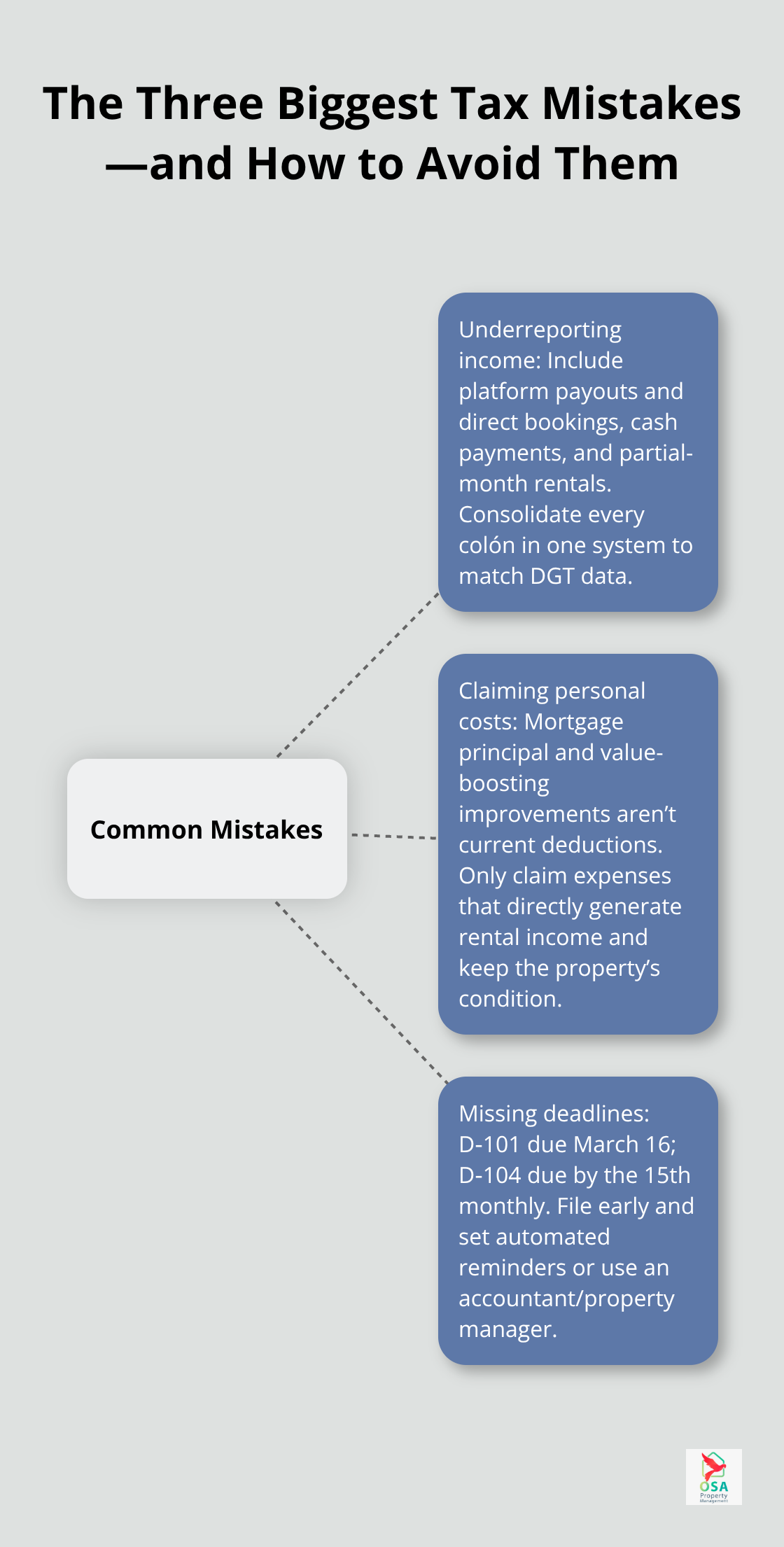
The DGT cross-references platform data against your filed returns starting in 2026, so discrepancies trigger audits immediately. If you earn 500,000 CRC annually but report only 400,000 CRC because you excluded direct bookings, the authority sees the gap and assumes intentional evasion rather than honest error.
Underreporting Income Across All Sources
Penalties for under-reporting rental income run 215,500 CRC per month up to 1,293,000 CRC total according to Article 78 of Costa Rica’s Income Tax Law, far exceeding the tax you’d have owed on that unreported income in the first place. The solution is straightforward: track every colón from every source. If a guest books directly through your website, that payment counts. If someone pays you cash for a three-week stay, that counts. Use a single spreadsheet or accounting software that consolidates all income sources alongside your platform payouts so nothing disappears between your records and your tax return.
Claiming Personal Expenses as Business Deductions
The second mistake is claiming personal expenses as business deductions. Owners routinely deduct mortgage principal, property improvements, personal travel to the property, or meals eaten while staying at the rental. These do not qualify. The DGT allows deductions only for costs that directly generate rental income and maintain the property’s current condition, not improve it. A new air conditioning system to attract guests is a capital improvement, not a repair. Your mortgage principal is a personal financial obligation, not a business expense. Meals you eat while inspecting the property are personal consumption.
When your claimed expenses exceed 40 to 50 percent of gross rental income, auditors flag the return for closer review. If you claim 300,000 CRC in deductions on 400,000 CRC in rental income, you land in dangerous territory. Legitimate deductions typically run 15 to 35 percent of gross revenue depending on property age and management model. The DGT cross-references your claimed deductions against industry benchmarks, so outliers attract immediate attention.
Missing Filing Deadlines and Accumulating Penalties
The third mistake is missing deadlines. The D-101 income tax return is due March 16 each year. The D-104 VAT return is due by the 15th of the following month. Late payments incur additional charges that compound monthly, turning a manageable tax bill into a financial crisis. A 100,000 CRC payment due March 16 costs an extra 1,000 CRC in penalties if filed on March 17, then 2,000 CRC if filed in April, and the costs accelerate from there.
Electronic filing is mandatory in Costa Rica, so no excuse exists for missing the deadline due to postal delays or paperwork getting lost. Set calendar reminders 30 days before each deadline and file early. If you lack the expertise to file correctly, hiring an accountant costs 300 to 800 CRC annually and eliminates the risk of costly errors. That investment pays for itself the first time you avoid a penalty. Professional property managers in areas like Manuel Antonio and Uvita handle tax compliance as part of their service offerings, eliminating this burden for owners who choose professional management.
Final Thoughts
Costa Rica’s renter tax guidelines CR demand discipline, but owners who register with the DGT, track all income sources, claim only legitimate deductions, and file on time avoid penalties that dwarf the taxes they owe. The 2026 enforcement surge means that informal compliance no longer works-platform withholding, electronic invoicing requirements, and data sharing between Airbnb, Vrbo, and tax authorities eliminate the gaps where owners once hid income. Your best protection is a system that consolidates all rental income in one spreadsheet, maintains electronic invoices for every expense, reconciles monthly against platform payouts, and sets calendar reminders for filing deadlines.
Professional property management serves double duty as a tax strategy. A manager issues electronic invoices for their fees, creating an audit trail that strengthens your compliance posture, and they handle tax coordination as part of their service, ensuring nothing falls through the cracks. We at Osa Property Management manage properties across Tarcoles, Jaco, Dominical, Manuel Antonio, Ojochal, Uvita, and Golfito with a team of over 40 full-time employees who handle accounting and tax compliance alongside marketing and maintenance.
Start now by registering with the DGT if you haven’t already, verifying your ICT registration is current, confirming your municipal permits are in place, and consulting a Costa Rican accountant to review your ownership structure. These steps take days but protect you for years. High-tourism areas like Manuel Antonio and Uvita demand active local enforcement, so verify municipal requirements directly with your municipality.