

Tarcoles rental property investors have a genuine opportunity right now. The market combines strong tourism demand with a stable legal framework that makes foreign ownership straightforward.
We at Osa Property Management have seen firsthand how the right strategies can transform rental income in this region. This guide walks through the proven approaches that work.
Why Tarcoles Works for Rental Investors
Tourism Demand Drives Real Occupancy Numbers
Tarcoles sits at the intersection of three forces that drive rental income: tourism demand and consistent visitor numbers in Tarcoles, straightforward legal access for foreign owners, and rental rates that reward active management. Costa Rica welcomed over 3 million tourists in 2019, and Tarcoles captures a meaningful share through its proximity to Marino Ballena National Park and the Carara ecosystem. That tourism translates into real occupancy numbers. According to AirDNA data, the typical Tarcoles property generates an average daily rate around $225.50, with seasonal swings that matter. The dry season from December through April commands 30 to 50 percent higher nightly rates than the green season, meaning investors who understand pricing dynamics can capture substantially more revenue in peak months.
The market shows about 3 percent overall growth with listings up 8 percent year-over-year, signaling healthy competition but also indicating that poorly managed properties lose ground fast. Tarcoles has 688 short-term rental listings with roughly 35 percent occupancy year-round, meaning two-thirds sit empty on any given night. That gap exists because most property owners either underprice, fail to optimize their listings, or lack the bandwidth to manage dynamic pricing across multiple platforms.
Legal Framework and Affordable Entry Points
Foreigners can own property in Tarcoles under the same rights as Costa Rican citizens, and residency is not required. Closing costs run roughly 3 to 5 percent of purchase price, and annual property taxes average about 0.25 percent of registered municipal value, making ownership cost-effective. The maritime zone does impose restrictions: the first 50 meters from the high tide line is public, and the next 150 meters fall under concession rules that typically require a Costa Rican partner or corporation for foreigners. Title searches through the National Registry are non-negotiable before purchase.
Current Tarcoles listings span from $55,000 for small lots to $2,495,000 for premium oceanfront estates, offering genuine entry points across multiple budget levels. This range means investors with different capital bases can participate in the market without overextending themselves.
Execution Separates Winners from Underperformers
What separates winners from underperformers is execution. Professionally managed properties achieve higher occupancy rates than self-managed rentals, with properties that adjust pricing strategically maintaining occupancy in the 70 to 80 percent range. That difference compounds into six figures over a few years. High-quality photography converts 30 to 40 percent more browsers into bookers, and listings that emphasize proximity to national parks and local dining command higher rates than generic feature lists.
Multi-channel distribution matters enormously: roughly 79 percent of Tarcoles listings sit on Airbnb, 6 percent on VRBO, and 15 percent on both, meaning properties absent from secondary platforms leave money on the table. The market rewards specificity and active management, not passive ownership. Properties that tell a guest-focused story and maintain presence across multiple booking channels capture demand that competitors miss entirely.
How to Turn Empty Days Into Revenue
Dynamic Pricing Captures Seasonal Demand Swings
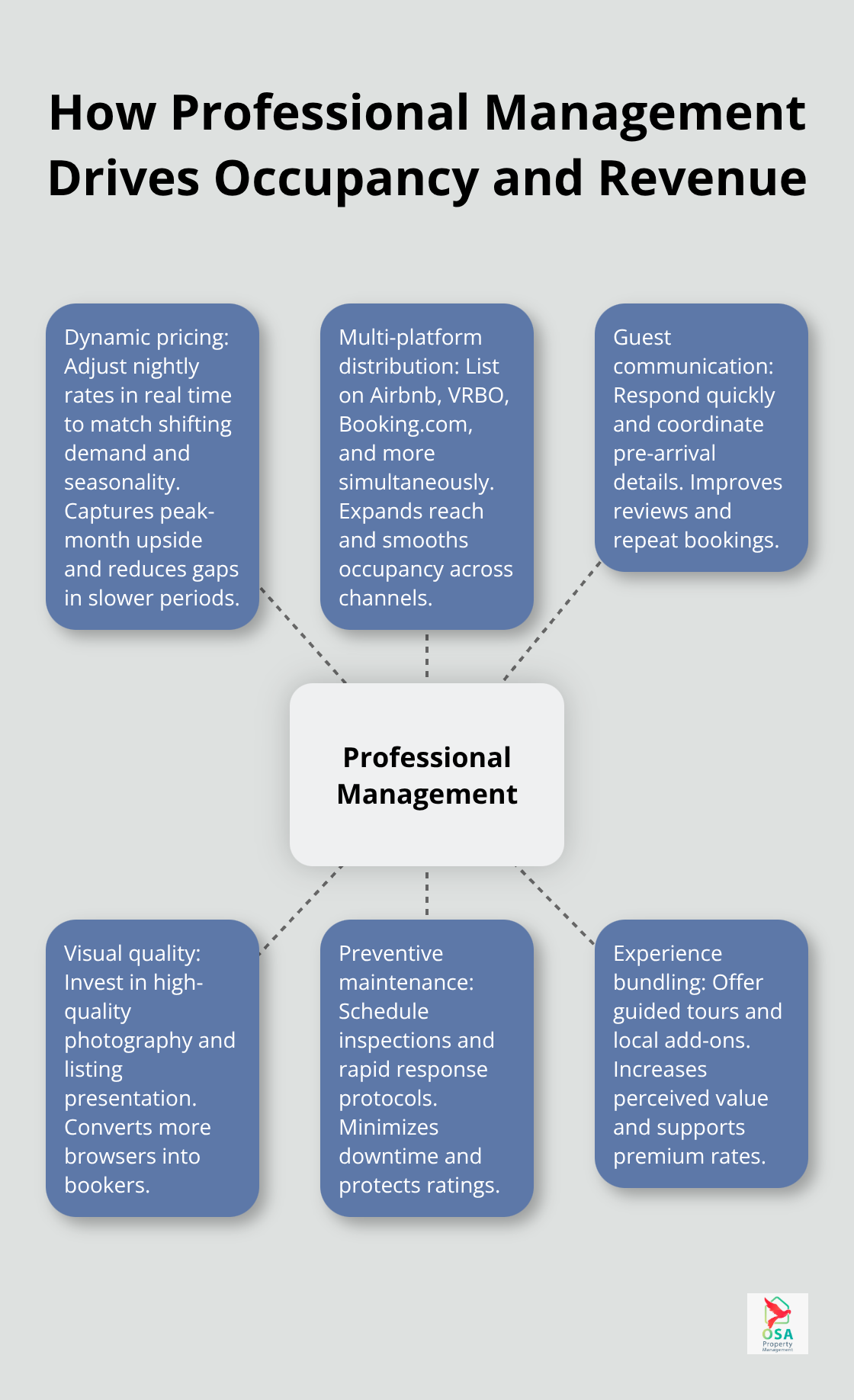
Professional management transforms Tarcoles properties from underperformers into revenue generators, and the numbers prove it. Professionally managed properties in Tarcoles achieve 70 to 80 percent occupancy annually, while self-managed properties often dip below 30 percent during slower months. This gap exists because dynamic pricing, multi-platform distribution, and responsive guest coordination require constant attention. A property manager adjusts nightly rates in real time as demand shifts, lists across Airbnb, VRBO, and Booking.com simultaneously, and handles guest communication before arrival to drive repeat bookings.
Seasonal demand swings are severe: dry season rates run 30 to 50 percent higher than green season rates, and a static pricing approach leaves thousands on the table. According to AirDNA, the typical Tarcoles property commands around $225.50 per night, but properties that implement seasonal pricing and respond to local events-school holidays, festivals, weather patterns-consistently outperform that baseline.
Visual Quality and Guest Experience Command Premium Rates
High-quality photography converts 30 to 40 percent more browsers into bookers, making visual quality a top driver of early inquiries. Listings that emphasize proximity to Marino Ballena National Park, hiking trails, and local dining command higher rates than generic feature lists. Guest coordination before arrival-airport transfers, WiFi setup, activity guidance-justifies premium pricing through enhanced experience. Bundling exclusive experiences (such as private tours near Marino Ballena National Park) increases perceived value and supports higher nightly rates.
Preventive Maintenance Protects Occupancy and Revenue
Preventive maintenance protects occupancy far more effectively than reactive repairs. A $400 quarterly HVAC inspection prevents a $3,000 emergency replacement that forces cancellations during peak season. Quarterly inspections, vetted local contractors, and rapid emergency response keep properties guest-ready and reviews strong. Tracking maintenance costs against occupancy gains reinforces viewing prevention as an investment, not an expense.
Flexibility in Minimum Stay Policies Captures Last-Minute Bookings
Minimum stay policies shape demand significantly: 52.5 percent of Tarcoles listings require a 2-night minimum, 40.3 percent require 30 nights or more, and only 0.1 percent accept 1-night stays. Flexibility captures last-minute bookings that competitors turn away. With 688 listings in Tarcoles and roughly 35 percent occupancy year-round, the market rewards active management over passive ownership.
Professional Management Delivers Consistent Results
Properties that coordinate pricing, guest communication, and maintenance across multiple platforms deliver consistent results without the operational burden falling on owners. With 688 listings competing for attention and only 35 percent occupancy year-round, the difference between active management and passive ownership compounds into six figures over a few years. The market rewards specificity and constant optimization, not set-and-forget approaches. Properties that tell a guest-focused story and maintain presence across multiple booking channels capture demand that competitors miss entirely, positioning them to scale revenue as tourism demand continues to grow in the region.
What's Driving Tarcoles Growth Right Now
New Listings Signal Investor Confidence
Tarcoles is experiencing genuine momentum from three distinct sources, and each one creates real income opportunities for rental investors. New property listings in the area jumped 100 percent between February 28 and March 31, 2026 compared to the prior month, according to OMNI MLS IDX data, signaling accelerating buyer interest. This uptick matters because fresh listings indicate confidence from investors who see profit potential, and that confidence spreads. International buyers recognize what the numbers show: Costa Rica's stable economy create predictable cash flow for rental properties. The market spans genuine entry points-from $55,000 for small lots to $2,495,000 for premium estates-which means foreign capital keeps flowing into the region.
International Capital Drives Competition and Higher Rates
That inflow of international buyers drives competition for rental inventory, which in turn justifies higher nightly rates and attracts professional management firms that optimize pricing and occupancy. Properties positioned near tourism anchors command premium rates when owners implement active management strategies. The influx of capital from abroad signals that investors recognize the region's potential, and that recognition translates into stronger demand for well-managed rental properties.
Ecotourism Creates Sustained Premium Demand
Ecotourism activity in Tarcoles generates measurable economic value beyond casual tourism. Crocodile tourism generated an estimated USD 5,292,073.81 per year in indirect sales according to 2014 research, and that figure reflects only one attraction in a region rich with nature-based experiences. The Carara ecosystem, Marino Ballena National Park, and river tours create sustained demand from guests willing to pay premium rates for properties near these attractions. Properties that emphasize proximity to conservation-focused activities and bundle experiences like guided nature tours consistently command higher nightly rates than generic listings.
Infrastructure Improvements Lower Friction for Travelers
Infrastructure improvements-better road access, expanded airport capacity, and enhanced telecommunications-lower friction for international travelers, which directly translates to higher occupancy. Rental investors who position properties near tourism anchors and invest in reliable internet and modern amenities capture demand that self-managed competitors miss. The region's tourism model is locally driven and organic rather than dependent on a single operator, which means demand remains resilient across market cycles.
Eco-Conscious Travelers Tolerate Premium Pricing
Investors who align property positioning with ecotourism appeal and conservation messaging attract eco-conscious travelers who tolerate premium pricing and generate positive reviews that sustain future bookings. This alignment between property strategy and visitor values creates a competitive advantage that compounds over time as reputation builds and occupancy stabilizes at higher rates.
Final Thoughts
Tarcoles rental property investors operate in a market where execution determines outcomes. The fundamentals are clear: tourism demand remains strong, legal frameworks favor foreign ownership, and occupancy gaps exist because most properties lack active management. Properties managed with dynamic pricing, multi-platform distribution, and guest-focused positioning consistently achieve 70 to 80 percent occupancy, generating six figures more annually than underperformers sitting at the 35 percent average across 688 listings.
We at Osa Property Management have spent over 16 years building systems that deliver these results for property owners across Tarcoles, Jaco, Dominical, and the broader southern Pacific zone. Our team handles marketing, guest relations, maintenance coordination, and tax compliance so owners focus on returns rather than operations. New listings jumped 100 percent in March 2026, signaling accelerating competition, and properties that implement professional management now capture market share before the window tightens.
Contact Osa Property Management to discuss how professional management can transform your property from underperformer into a consistent revenue generator. Tarcoles rental property investors who act decisively on these strategies position themselves to scale revenue as tourism demand continues growing in the region.