

VAT compliance trips up many landlords in Costa Rica. The tax rules are specific, the deadlines are strict, and mistakes can be costly.
We at Osa Property Management have seen firsthand how confusion about VAT guidelines Costa Rica leads to missed deductions, late filings, and unnecessary penalties. This guide breaks down exactly what you need to know and do.
How VAT Actually Works for Costa Rican Landlords
VAT in Costa Rica is a 13% consumption tax applied to short-term rentals under 30 days, according to the Dirección General de Tributación. When a guest books your property for fewer than 30 days, you collect 13% on top of the nightly rate and remit it monthly to the tax authority. This 13% belongs to the government, not your pocket. A $1,000 booking becomes $1,130 to the guest. Many landlords treat this extra $130 as income, then face cash flow disasters when the monthly VAT payment comes due.
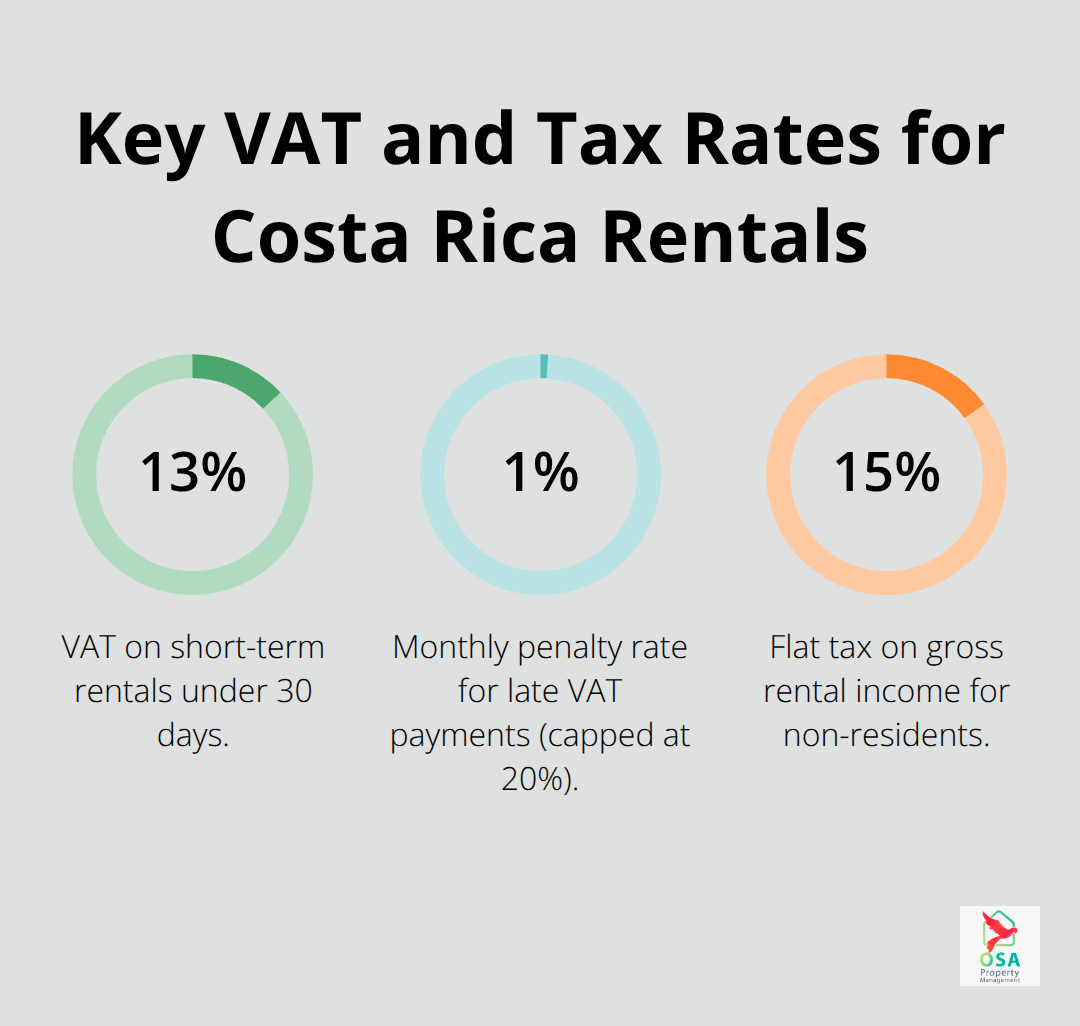
Long-term rentals exceeding 30 days follow different rules. If the monthly rent stays at or below the average Costa Rican base salary threshold of approximately CRC 650,000 (about USD 1,085), the lease remains VAT-exempt. Rent above that threshold triggers VAT at 13%. This distinction matters enormously for your annual tax bill. A property generating $1,500 monthly under a long-term lease avoids VAT entirely, saving roughly $1,950 annually compared to short-term operations at equivalent revenue. Tourist hotspots like Manuel Antonio, Uvita, and Dominical see regular Hacienda audits, so accuracy here is not optional.
Registration and Invoice Requirements
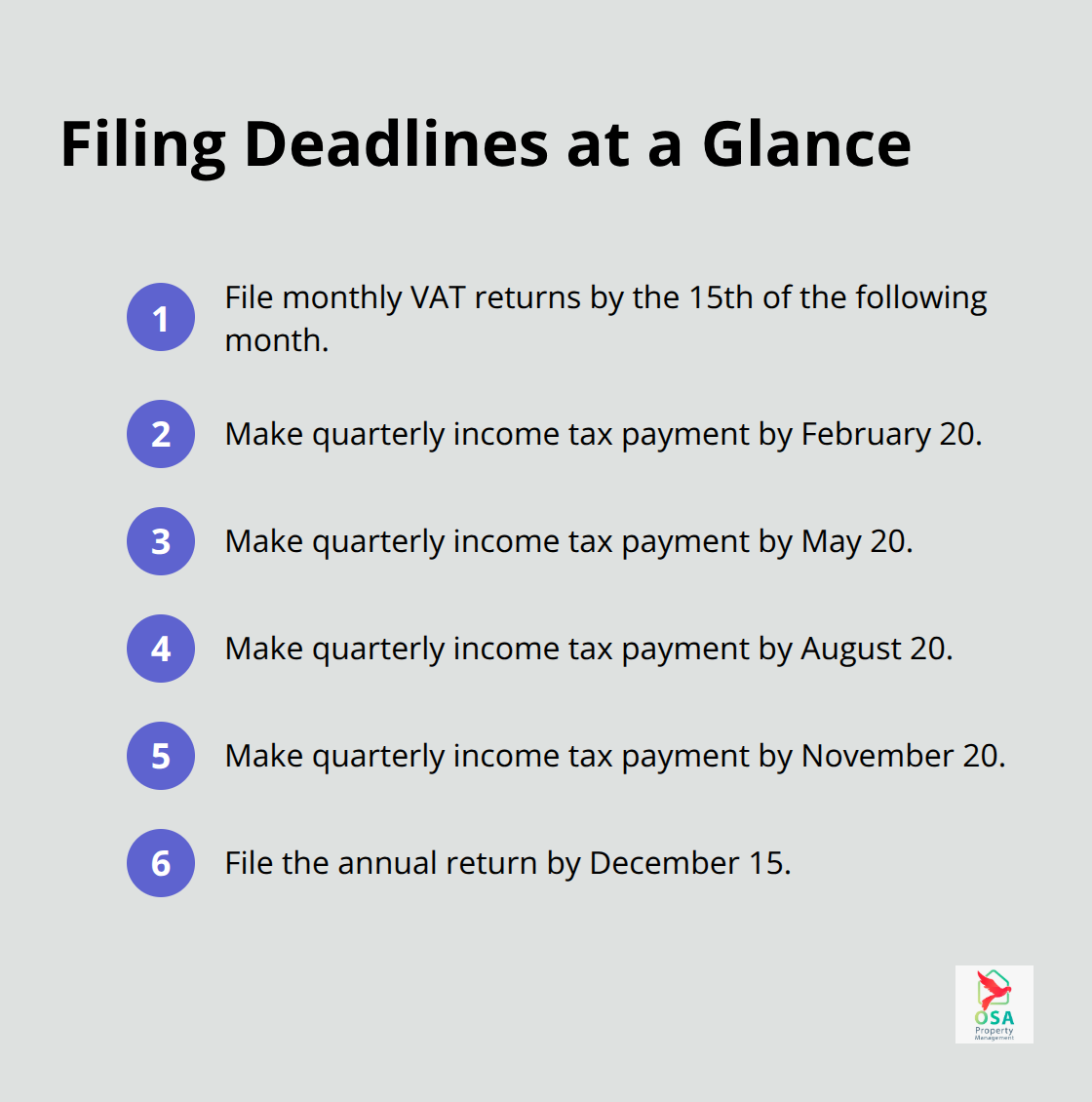
You must register with Hacienda before your first guest arrives. Non-residents need to appoint a local representative, called an NIT, to handle tax filings. Registration triggers your obligation to issue monthly VAT returns by the 15th of the following month. Airbnb and VRBO handle VAT collection automatically for platform bookings, but you still must report all rental income for income tax purposes. Private bookings require electronic invoices generated through Hacienda’s system using a digital signature from a Costa Rican bank, or you can grant power of attorney to a local accountant to issue them.
Missing the monthly VAT deadline carries penalties that compound at 1% monthly, capped at 20% of the tax owed. A $10,000 monthly short-term rental subject to 13% VAT generates $1,300 in VAT liability each month. One missed payment of $1,300 grows to $1,560 after penalties, then $1,873 the following month if unpaid. The financial damage accelerates fast.
Professional Support Reduces Costs and Risk
Hiring a Costa Rican accountant costs $300 to $600 annually but typically saves $2,000 to $5,000 through optimized deductions and timely quarterly payments on February 20, May 20, August 20, and November 20, plus the December 15 annual return. This investment pays for itself many times over.
Deductions That Reduce Your Tax Burden
Residents can deduct maintenance, repairs, property management fees, insurance, utilities paid for tenants, mortgage interest (not principal), property taxes, and advertising from rental income before tax. Non-residents cannot deduct any expenses and pay a flat 15% tax on gross rental income. Starting in 2025, energy-efficient upgrades became deductible. Residential properties depreciate at 2% annually over 50 years.
Using cloud accounting software like QuickBooks Online or Xero increases deductible capture by 15% to 20% compared to manual tracking. Separate bank accounts for each property and detailed expense records kept for four years protect you during audits. Hacienda cross-references platform reports like Airbnb against your filings, so discrepancies trigger investigations. The difference between organized records and sloppy bookkeeping often means the difference between capturing legitimate deductions and losing them entirely.
What Happens When Records Fall Short
Audit risk intensifies in tourist-heavy regions. Hacienda audits cross-reference lease agreements with digital payment records; rent deposits must align with contract dates exactly. Store lease documents, signed and dated, along with property classification and permit records for at least four years to withstand audits. Electronic invoices must clearly indicate when VAT applies and when exemptions take effect; vague invoicing can trigger audit flags.
The stakes are high enough that getting your VAT structure right from the start matters more than trying to fix problems later. Understanding which rental model fits your property-short-term, long-term exempt, or long-term taxable-sets the foundation for everything that follows.
VAT Obligations for Rental Income
Register Before Your First Guest Arrives
Register before your first guest arrives, not after. The Dirección General de Tributación requires this upfront, and the timeline matters. Short-term rental properties must also register with the National Tourism Registry administered by the Instituto Costarricense de Turismo, plus obtain a municipal business license from your local government. Non-residents complicate this by needing to appoint a local representative called an NIT to handle filings on their behalf. Skip any of these steps and you operate illegally, risking fines and property suspension. The registration process itself takes weeks, so start immediately if you have not yet completed it.
Monthly VAT Returns and Penalty Compounding
Once registered, your obligation to file monthly VAT returns by the 15th of the following month begins automatically. One missed deadline triggers penalties that compound at 1% monthly, capped at 20%. Miss two months and a $1,300 VAT payment becomes $1,560 after the first penalty, then $1,873 after the second. The compounding effect punishes delay severely.
Deductions: Residents Versus Non-Residents
Deductions separate residents from non-residents entirely. Residents deduct maintenance, repairs, property management fees, insurance, utilities paid for tenants, mortgage interest, property taxes, and advertising before calculating income tax. Non-residents pay a flat 15% tax on gross rental income with zero deductions allowed. Energy-efficient upgrades became deductible starting in 2025, giving residents a new opportunity to reduce taxable income. Residential properties depreciate at 2% annually over 50 years, adding another deduction layer.
Capture Deductions With Cloud Accounting and Separate Accounts
Cloud accounting software like QuickBooks Online or Xero increases deductible capture by 15% to 20% compared to manual methods because these platforms automatically categorize expenses and flag items you might miss. Separate bank accounts for each property prevent mixing personal and rental funds, a mistake that auditors flag immediately. Hacienda cross-references Airbnb and VRBO reports against your filed returns, so discrepancies trigger investigations.
Documentation Standards for Audit Readiness
Store lease documents signed and dated, property classification records, and municipal permits for at least four years. Electronic invoices must clearly indicate when VAT applies and when exemptions take effect; vague invoicing creates audit flags. Quarterly tax payments due February 20, May 20, August 20, and November 20 plus the December 15 annual return require organized records to support every number claimed. A local Costa Rican accountant costs $300 to $600 annually but saves $2,000 to $5,000 through optimized deductions and timely filings. That investment returns itself several times over, and the accountant also handles the complexity of quarterly deadlines so you avoid penalties altogether. With these registration, deduction, and documentation systems in place, you shift focus to the mistakes that still trip up landlords even after they’ve registered correctly.
Where Landlords Lose Money on VAT
Mistake One: Mixing VAT With Rental Income
The gap between what landlords think they owe and what they actually owe often comes down to three operational mistakes that compound over months. The first mistake treats VAT as income rather than a liability held in trust. When a guest pays $1,130 for a $1,000 booking, that $130 is government money sitting in your account. Deposit it into your personal checking account alongside rental income and you face a cash crisis on the 15th when the VAT payment deadline arrives.
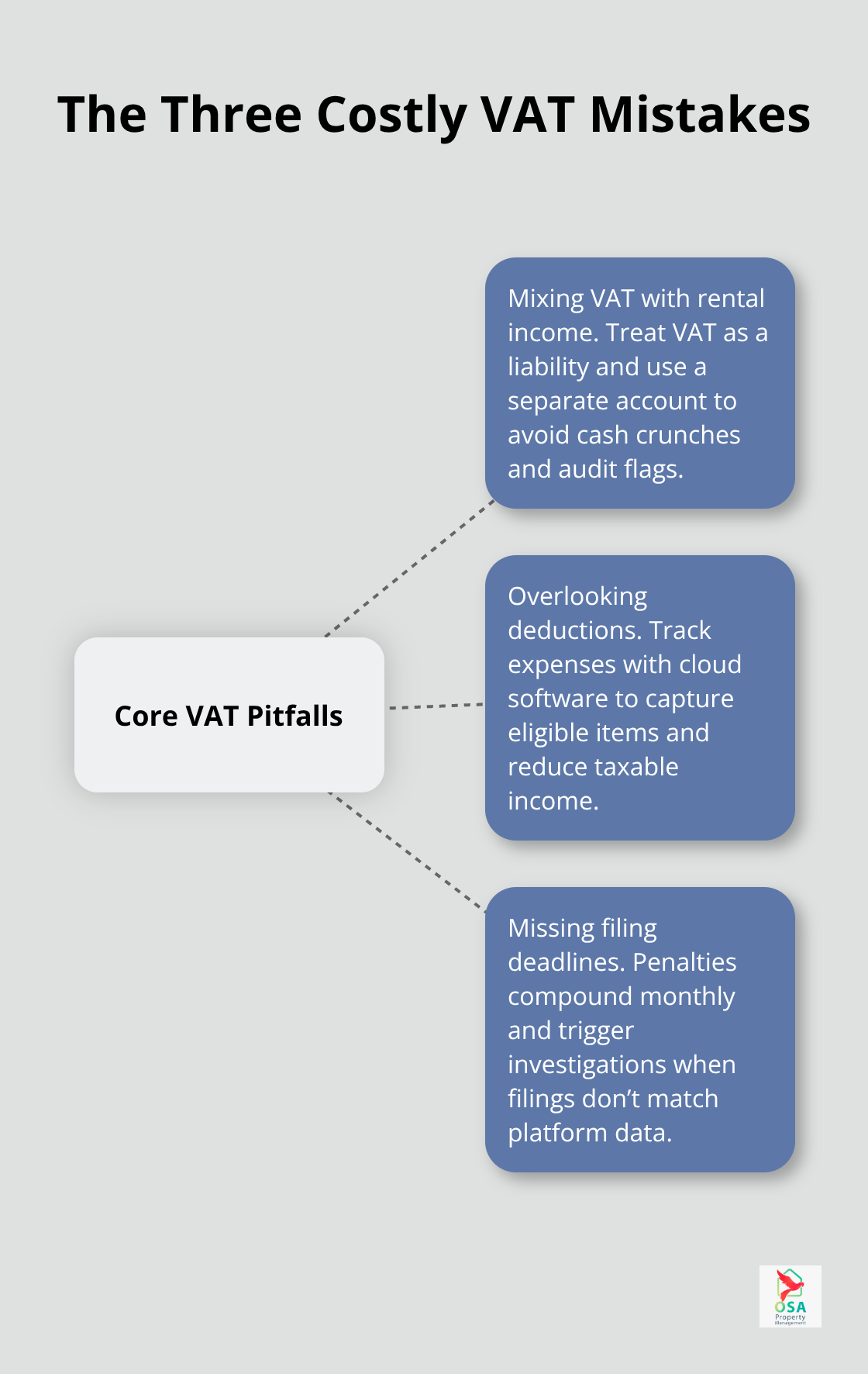
Worse, Hacienda audits cross-reference your bank deposits against your VAT filings. A deposit of $1,130 followed by a VAT remittance of only $1,000 signals misreporting. The Dirección General de Tributación flags these discrepancies immediately. Separate bank accounts for short-term rentals solve this entirely. One account holds rental revenue, another holds VAT collected. This single practice eliminates the largest source of audit triggers and prevents the cash flow shock that blindsides unprepared landlords.
Mistake Two: Overlooking Deductions Through Poor Tracking
The second mistake misses deductions because expense tracking happens sporadically or not at all. Residents can deduct maintenance, repairs, property management fees, insurance, utilities paid for tenants, mortgage interest, property taxes, and advertising before calculating income tax. Energy-efficient upgrades became deductible starting in 2025. A $3,000 roof repair, a $1,200 water heater replacement, and $600 in advertising expenses add up to $4,800 in deductions that reduce taxable income. Cloud accounting software like QuickBooks Online or Xero captures 15 to 20 percent more deductions than manual spreadsheets because these systems automatically categorize transactions and flag eligible expenses you might overlook. Without this automation, landlords routinely leave $2,000 to $5,000 in annual deductions on the table. Residential properties depreciate at 2 percent annually over 50 years, another deduction layer many owners never claim. A local Costa Rican accountant costs $300 to $600 annually and typically recovers $2,000 to $5,000 in missed deductions, making the investment return itself many times over.
Mistake Three: Missing Filing Deadlines and Creating Audit Flags
The third mistake neglects filing deadlines entirely or files late sporadically. Monthly VAT returns due by the 15th of the following month, quarterly income tax payments on February 20, May 20, August 20, and November 20, plus the annual return by December 15 create a strict calendar. One missed deadline triggers penalties that compound at 1 percent monthly, capped at 20 percent. A $1,300 VAT payment missed in February becomes $1,560 by March, then $1,873 by April if still unpaid. The compounding effect accelerates the debt faster than many landlords realize. Electronic invoices must clearly indicate when VAT applies and when exemptions take effect; vague invoicing creates audit flags that invite deeper scrutiny. Hacienda maintains digital records of all platform-reported income from Airbnb and VRBO, so filing discrepancies trigger automatic investigations.
How to Prevent These Three Mistakes
Separate accounts, cloud accounting, and calendar discipline tied to professional support prevent all three mistakes entirely. One account for rental revenue and another for VAT collected eliminates cash flow surprises and audit red flags. Cloud software captures deductions that manual methods miss, and a local accountant recovers thousands in overlooked deductions while handling quarterly deadlines so you avoid penalties altogether. These three systems work together to keep your rental operation compliant and profitable.
Final Thoughts
VAT compliance in Costa Rica requires three operational systems: separate accounts, cloud accounting, and professional support. These systems work together to keep your rental operation compliant while capturing every deduction you qualify for. A local Costa Rican accountant costs $300 to $600 per year and typically saves $2,000 to $5,000 through optimized deductions and timely quarterly payments on February 20, May 20, August 20, and November 20, plus the December 15 annual return.
The VAT guidelines Costa Rica imposes are strict but manageable when you follow them from the start. Register with Hacienda before your first guest arrives, file monthly VAT returns by the 15th, keep four years of signed lease documents and invoices, and separate your short-term rental account from personal funds. Use cloud software to track deductions automatically so you avoid the three mistakes that cost landlords thousands annually: mixing VAT with income, overlooking deductions, and missing filing deadlines.
Professional property management handles this complexity entirely. We at Osa Property Management manage properties across Tarcoles, Jaco, Dominical, Manuel Antonio, Ojochal, Uvita, and Golfito and handle accounting, tax compliance, and all VAT filings so you focus on ownership rather than bureaucracy. Contact us today to discuss how we can manage your rental operation and keep your VAT obligations on track.