Property ownership in Costa Rica comes with tax responsibilities that many owners find confusing. The rules around Costa Rica property taxes vary by region, involve multiple deadlines, and include deductions most people miss. At Osa Property Management, we've helped countless owners navigate this landscape and reduce their tax burden. This guide breaks down everything you need to know to stay compliant and optimize what you owe.
How Costa Rica Property Taxes Work
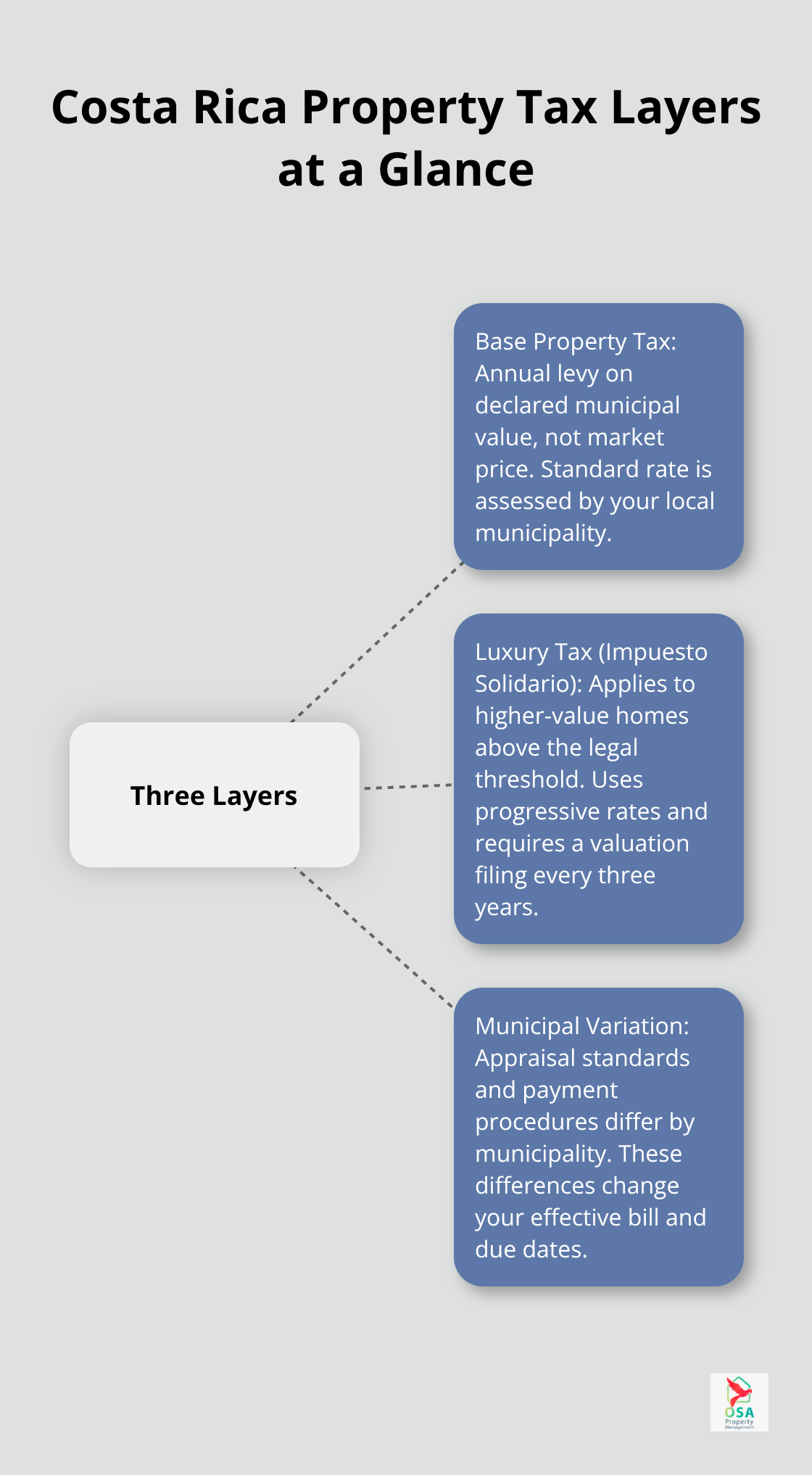
Costa Rica's property tax system appears straightforward initially but contains layers that catch owners off guard. The base annual property tax rate is
0.25% – 0.55% of your property's declared municipal value, not its market price. This distinction matters significantly because municipal valuations typically run 30–50% below what you actually paid. A property purchased for $200,000 might receive a municipal assessment of $120,000, resulting in an annual tax of around $300 instead of $500. The municipality updates this assessment every five years, and if you fail to file a declaration during that window, the municipality can reassess your property unfavorably and impose penalties. Payment must be made by January 15th of each year, or penalties will be imposed. Paying online through your municipality's portal requires your finca registration number, passport or cédula, and your most recent tax receipt. Foreign owners should watch for international transaction fees when using credit cards, which remain the most convenient payment method from abroad.
The Luxury Tax Creates a Second Layer for Higher-Value Properties
Properties with construction value above approximately $240,000 enter a second tax system called the
Impuesto Solidario, or Solidarity Tax. This tax applies separately from your base property tax and uses progressive rates depending on total property value. For 2025, the tax brackets published by Costa Rica's Ministry of Finance start at 0.25% for properties valued up to 364 million colones (roughly $715,000), then increase through seven tiers to 0.55% for properties exceeding 2.191 billion colones (approximately $4.3 million). The calculation includes construction value plus land value if the combined total exceeds the threshold. This tax funds social housing programs, and you must file a valuation declaration every three years while paying annually in January. Raw land with no legal dwellings, agricultural properties, and commercial real estate qualify for exemptions, but residential properties above the threshold have no escape. Missing the January deadline triggers interest charges and penalties that compound quickly.
Municipal Variation Creates Real Differences in Your Tax Bill
Each of Costa Rica's 81 municipalities sets its own property assessment methodology and collection procedures, creating genuine regional differences in tax burden. A property in Manuel Antonio faces different assessment criteria than an identical property in Uvita, even though both sit in the same region. Some municipalities charge quarterly, others annually, and a few allow biannual payments. Payment portals vary by location, with some municipalities offering online options while others require in-person payment at municipal offices. The declared value that forms your tax base depends heavily on your municipality's appraisal standards, which means property owners in different areas pay different effective rates even at the same purchase price. This variation makes generic advice useless-you need to contact your specific municipality or work with someone familiar with your local tax office to understand exactly what you owe and when. Understanding these three layers of Costa Rica's property tax system positions you to avoid costly mistakes. The base rate, the luxury tax threshold, and municipal variations all interact to determine your actual liability. Getting this foundation right before filing your first declaration prevents the penalties and reassessments that plague unprepared owners. The next section covers the specific deadlines and documentation requirements that keep you compliant with Costa Rica's tax authorities.
When and How to Pay Your Costa Rica Property Taxes
Costa Rica's tax payment system operates on fixed deadlines that vary depending on whether you owe base property tax, luxury tax, or both. Base property tax payments split into four quarterly installments due on
March 31, June 30, September 30, and December 31, though you can pay the full year upfront and receive a small discount from some municipalities. Luxury tax payments concentrate in January, typically due by January 15, with no quarterly option. Missing these deadlines triggers immediate penalties starting at
1.5% monthly interest on unpaid amounts, escalating to enforcement actions including liens on your property. The practical approach: set phone alerts for two weeks before each deadline, gather your documents now rather than scrambling later, and confirm payment within three days by checking your municipal balance online.
Documentation You Must Maintain
Your finca registration number forms the foundation of every tax filing and payment. This appears on your property deed and stays constant throughout ownership, so store it where you can access it within seconds. Your most recent tax receipt proves your payment history and accelerates future filings, yet most owners misplace this document within months. The municipality requires your cédula number if you're a Costa Rican resident or your passport number if you're foreign, and payment portals reject submissions without exact matches. Construction cost documentation, appraisals, and improvement receipts become critical if your property exceeds the luxury tax threshold because the calculation includes land value plus construction value. The Dirección General de Tributación audits luxury tax filings every three years, and owners without supporting documents face reassessment penalties. Municipal assessments can be challenged within specific windows, but only if you maintain contemporaneous evidence of property value. Create a digital folder organized by year containing your tax receipts, payment confirmations, valuation documents, and any correspondence with the municipality, then back this up to cloud storage. This preparation takes three hours initially but saves you from frantic searching during audits or payment disputes.
Late Payment Consequences Escalate Quickly
Penalties for missing property tax deadlines start at
1.5% monthly interest on unpaid amounts. Luxury tax penalties follow the same structure, but the base amounts run substantially higher because the tax itself applies to properties valued above $240,000. The municipality can file a lien against your property after penalties accumulate, which blocks your ability to sell, refinance, or transfer title until resolved. Attempting to sell a property with tax liens creates legal complications that delay closing and reduce your net proceeds significantly.
How to Pay Online From Abroad
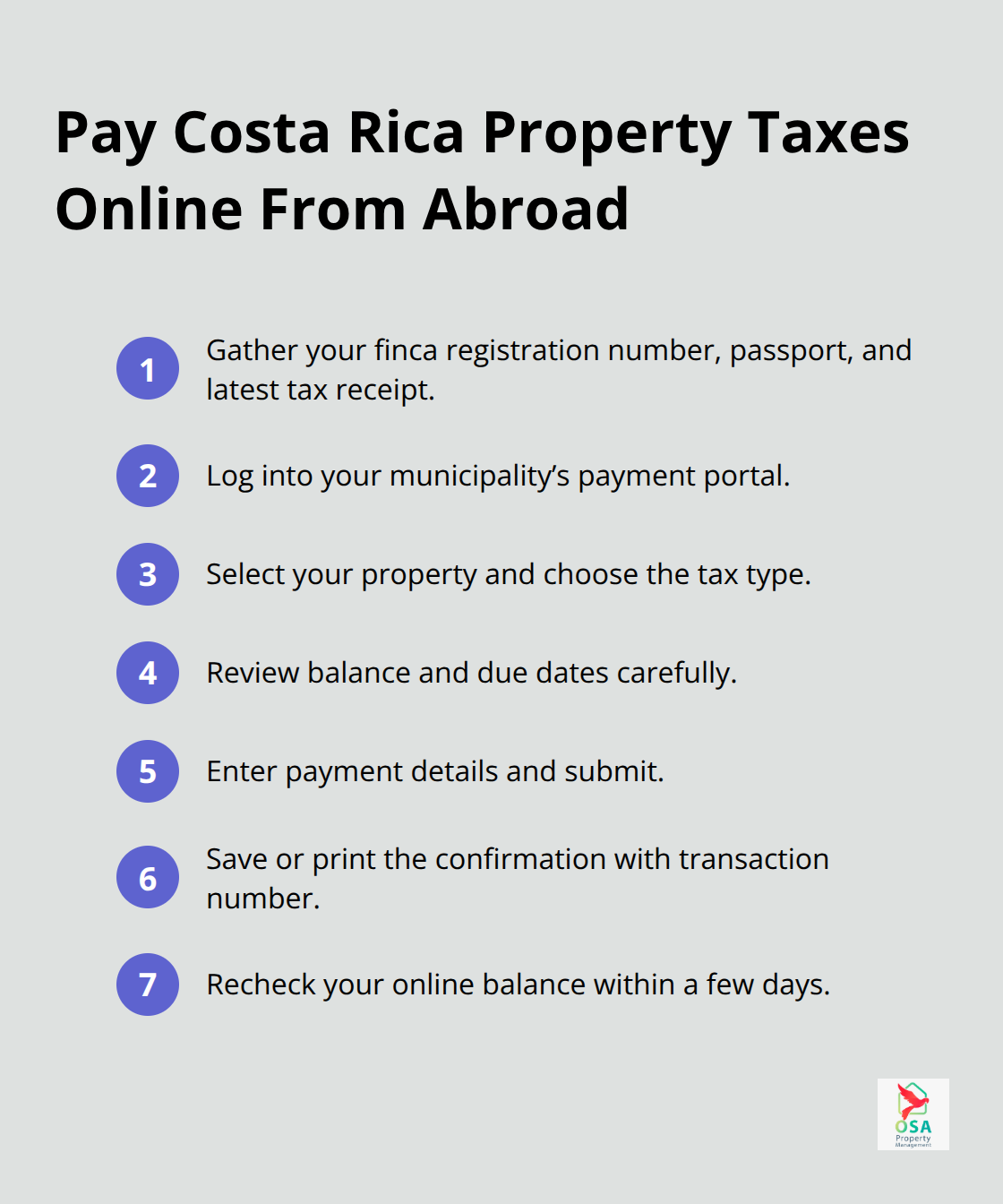
The national revenue department pursues collection through Costa Rica's court system when penalties mount, adding legal fees to your obligation. Foreign owners benefit from online payment portals that accept credit cards, debit cards, and bank transfers (though watch for international transaction fees on credit card payments). Gather your finca registration number, passport, and most recent tax receipt before logging into your municipality's payment portal. Select your property, choose the tax type (base property tax or luxury tax), and review the current balance and due dates. Finalize the payment, save or print the confirmation with the transaction number and amount, then verify the payment several days later by checking your balance online.
Contact the municipality promptly if discrepancies appear. This process takes less than thirty minutes and protects you completely from accidental late fees that compound into thousands. The next section covers strategies that reduce your overall tax burden through legal deductions and professional compliance services, helping you keep more of what you earn from your Costa Rica property.
How to Reduce Your Property Tax Burden in Costa Rica
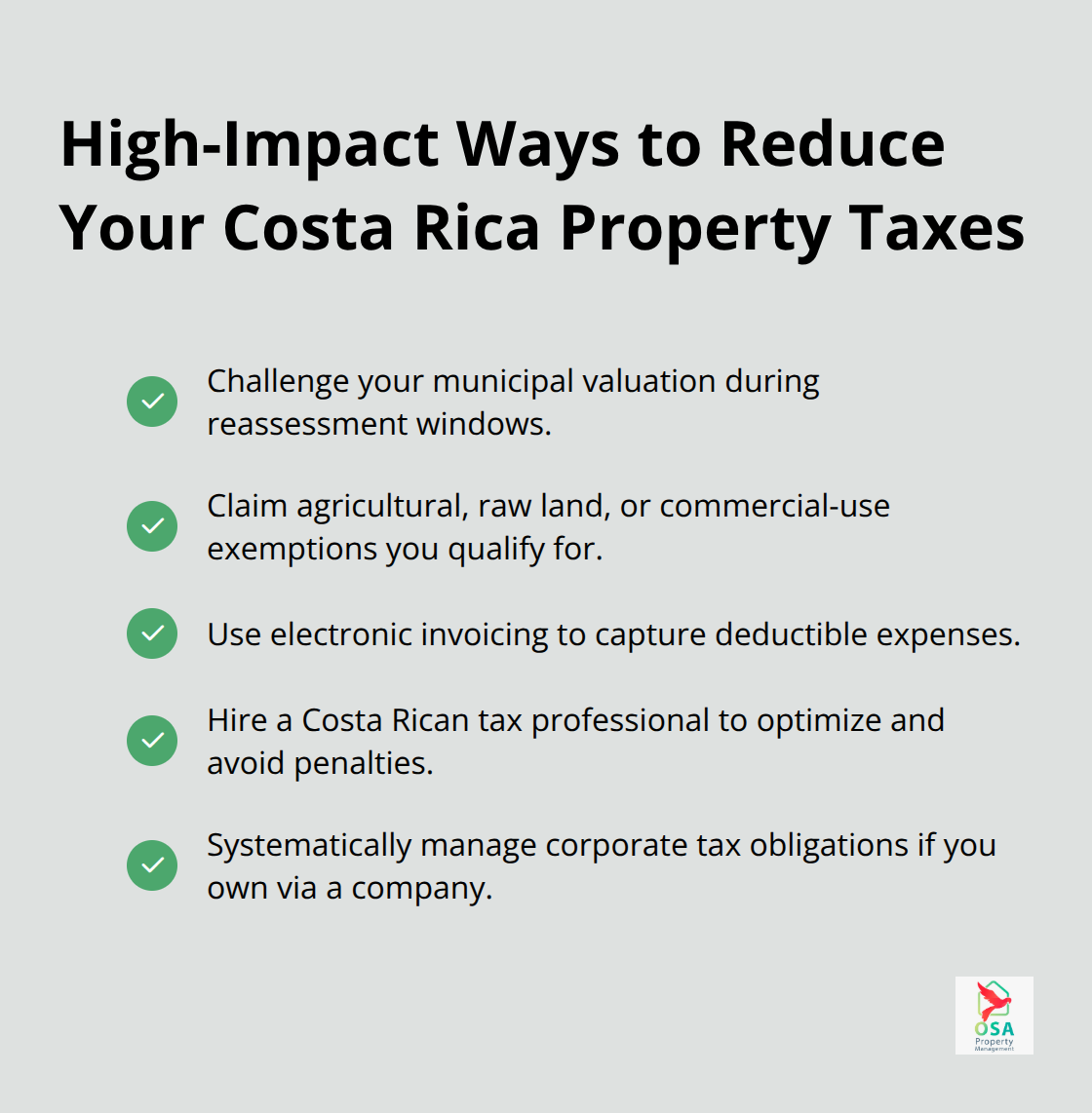
Challenge Your Municipal Valuation During Reassessment Windows
Most property owners in Costa Rica miss significant tax reduction opportunities because they treat their tax obligations as static annual expenses rather than manageable financial items. The reality is that your property's declared municipal value forms the foundation of every tax calculation, and this value can be challenged if documentation supports a lower assessment. Once every five years, home owners need to re-value their properties for property tax purposes. You have a specific window to submit evidence that their valuation exceeds comparable properties in your area or fails to account for property condition and market conditions. Gather recent appraisals, comparable sales data from your region, and documented repair costs or deferred maintenance to create a defensible case for reassessment. Property owners who skip this step pay inflated taxes on overvalued properties for five years straight.
Claim Exemptions You Actually Qualify For
If your property qualifies for exemptions-raw land with no legal dwellings, agricultural land, or commercial properties-you must actively claim these exemptions rather than assume the municipality knows your property's actual use. Many owners hold agricultural land zoned for residential use and never file the paperwork to claim agricultural exemptions, costing them thousands over a property ownership lifetime. The municipality will not volunteer this information, so you must initiate the filing process yourself.
Leverage Electronic Invoicing for Tax Deductions
Electronic invoicing through the factura electrónica system becomes mandatory the moment you register. Costa Rica's 13% Value Added Tax applies to most property services, meaning a $10,000 renovation costs $11,300. When you maintain electronic invoices for these expenses, you can claim deductions against rental income or corporate tax obligations if your property is held through a Costa Rican company. Owners who pay cash or accept paper receipts lose this deduction opportunity entirely, essentially throwing away 13% of their improvement costs.
Hire a Tax Professional to Navigate Complex Calculations
Professional tax compliance services transform property taxation from an annual scramble into a systematic process that identifies savings you cannot find alone. A qualified Costa Rican tax advisor costs between $500 and $1,500 annually but typically recovers that investment through tax optimization, corporate structure planning, and deadline management that prevents penalties. If your property exceeds the luxury tax threshold of approximately 126 million colones (roughly $247,000), the calculation becomes complex because both construction value and land value must be included, and the Manual de Valores Base por Tipología Constructiva used for valuation changes yearly. A tax professional monitors these threshold changes and ensures your valuation declaration reflects current methodology rather than outdated calculations that trigger audits.
Manage Corporate Tax Obligations Systematically
For foreign owners holding property through Costa Rican corporations, corporate tax obligations add another layer that most owners mishandle. Inactive corporations pay approximately $120 annually regardless of activity, while active corporations pay 25–50% of the monthly base salary depending on gross revenue relative to government base salary benchmarks. Without professional guidance, owners often fail to make these corporate tax payments, accumulating penalties that dwarf the original liability. Property management companies that offer tax compliance services coordinate these payments alongside your property tax deadlines, ensuring nothing falls through the cracks.
Final Thoughts
Costa Rica property taxes operate across three distinct layers: base property tax at 0.25% of municipal value, luxury tax for properties exceeding approximately $240,000, and municipal variations that create real differences in your actual bill. Understanding these layers prevents costly mistakes that accumulate into penalties and liens. The quarterly payment deadlines, five-year reassessment windows, and three-year luxury tax declaration cycles require systematic attention rather than reactive scrambling. Most owners miss significant savings by ignoring municipal valuation challenges, overlooking exemptions they qualify for, and failing to capture electronic invoice deductions on property improvements. Professional support transforms Costa Rica property taxes from an annual headache into a managed financial process. A qualified tax advisor identifies optimization opportunities you cannot find alone, monitors threshold changes that affect your liability, and coordinates corporate tax obligations alongside property tax deadlines. If your property sits below the luxury tax threshold and you own it personally, set calendar reminders for the quarterly payment deadlines and maintain organized documentation of your finca registration number, tax receipts, and municipal assessments. If your property exceeds the luxury tax threshold or you hold it through a Costa Rican corporation, engage a tax professional immediately to establish a compliance system before your next filing deadline arrives. We at
Osa Property Management handle tax compliance alongside full property management services across the southern Pacific zone, including Tarcoles, Jaco, Dominical, Manuel Antonio, Ojochal, Uvita, and Golfito.