

VAT on rental income in Costa Rica isn’t optional-it’s a legal requirement that catches many landlords off guard. The rules are specific, the deadlines are firm, and mistakes can cost you thousands in penalties.
We at Osa Property Management created this CR rental VAT guide to cut through the confusion. You’ll learn exactly what you owe, when you owe it, and how to claim deductions that actually reduce your tax burden.
How VAT Actually Works for Costa Rica Rentals
VAT in Costa Rica operates on a simple principle: short-term rentals get taxed, long-term ones often don’t. The Ministerio de Hacienda draws a hard line at 30 days. Anything under that threshold triggers a 12.75% VAT that you collect from guests and remit monthly by the 15th of the following month. Go 31 days or longer with a signed lease, and you may escape VAT entirely-but only if your monthly rent stays at or below CRC 650,000 (roughly USD 1,085).
The number 0% seems to be not appropriate for this chart. Please use a different chart type. Cross that threshold on a long-term lease, and the VAT kicks in.
This creates a stark financial split. A USD 10,000 monthly short-term rental generates USD 1,275 in VAT liability every month. That same property rented long-term and exempt from VAT saves you nearly USD 15,300 annually. Over five years, the difference approaches USD 76,500. The distinction shapes your entire pricing strategy and profit margin. Short-term operators often absorb 3–5% of VAT costs and raise nightly rates by 8–10% to stay competitive. Long-term exempt properties can price closer to actual costs and still maintain healthy returns.
Zoning Requirements for VAT Exemptions
Residential zoning is non-negotiable for exemption eligibility. Beachfront properties with tourism zoning cannot claim long-term residential exemptions regardless of lease length, according to Hacienda guidelines. Before claiming an exemption, obtain a municipal use permit confirming residential rental activity to satisfy regulatory requirements. This step prevents costly reclassifications during audits.
Registration Triggers Your First Obligation
You must register with Hacienda before your first guest arrives. Non-residents need to appoint a local representative (NIT) to handle filings. Once registered, monthly VAT returns are due by the 15th of the following month. Late payments incur penalties starting at 1% per month, capped at 20%. Miss two payments on a USD 10,000 monthly short-term rental and your VAT liability grows quickly after penalties accrue.
Platforms like Airbnb and VRBO automatically collect VAT for bookings, but you still must report all rental income for income tax purposes. Private bookings require electronic invoices through Hacienda’s system with a digital signature from a Costa Rican bank, or you can grant power of attorney to a local accountant to issue them. Most landlords stumble here. They assume platform collection handles everything. It doesn’t. Hacienda expects your monthly filings to match platform data exactly. Discrepancies trigger audits.
Bank Accounts and Documentation Alignment
Separate bank accounts for each property prevent co-mingling of funds and make reconciliation straightforward. Hacienda cross-references platform reports directly with your filings, so deposits must align with contract dates and electronic invoices must clearly indicate when VAT applies or exemptions take effect. This alignment protects you during compliance reviews.
What Registration Actually Requires
The process itself is straightforward but non-negotiable. You provide detailed property specifications, economic activity codes (separate codes for short-term versus long-term rentals), and proof of residential or commercial status. Non-residents must complete this through their NIT representative. Residents can handle it directly. Either way, ICT registration with the Costa Rican Tourism Institute is mandatory for vacation rentals.
ICT registration requires detailed property specs, amenities, and three years of rental history if available. Short-term rentals require additional ICT operating permits, safety certifications, insurance proof, and municipal business licenses. All rental income must be reported regardless of platform. The cost of hiring a Costa Rican accountant ranges from USD 300–600 per year but typically saves property owners USD 2,000–5,000 through optimized deductions, correct quarterly payments, and professional handling of electronic invoicing. The alternative-managing VAT compliance alone-costs far more in penalties and missed deductions.
Now that you understand how VAT registration works and what documentation you need, the next critical step involves understanding your monthly and quarterly filing deadlines and the specific records you must maintain to stay compliant with Hacienda’s requirements.
VAT Filings and Documentation: The Deadlines That Define Your Compliance
Monthly VAT Remittance and Penalty Mechanics
VAT compliance in Costa Rica operates on a rigid monthly schedule that treats deadlines as non-negotiable. Short-term rental VAT must reach Hacienda by the 15th of the following month according to Ministerio de Hacienda rules. Miss that date and penalties attach immediately at 1% per month, capped at 20%. On a USD 10,000 monthly short-term rental generating USD 1,275 in VAT, a single missed payment grows to USD 1,287 after the first penalty. Skip two months and you owe USD 1,560 plus USD 1,873 after the second month’s penalty compounds. These aren’t theoretical numbers-they’re direct costs extracted from your operating capital.
Income Tax Filings on a Separate Calendar
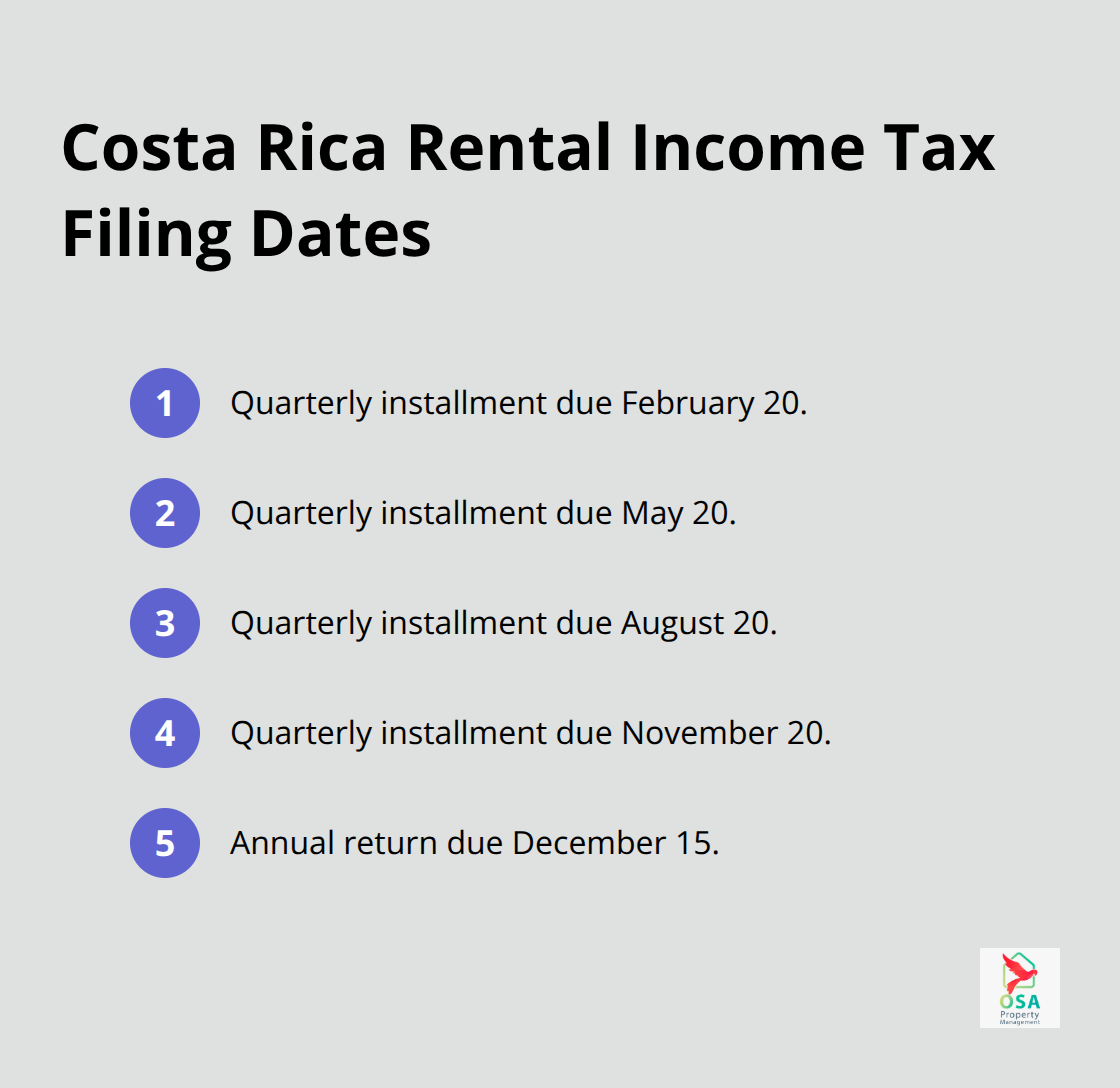
Income tax filings operate on a distinct schedule from VAT remittance. Quarterly installments are due February 20, May 20, August 20, and November 20, with the annual return due December 15 according to Ministerio de Hacienda guidelines. Many landlords conflate these deadlines or assume platform payments satisfy both obligations, neither of which is true.
Airbnb and VRBO handle VAT collection for their bookings, but you remain legally responsible for reporting accuracy. Hacienda cross-references platform data directly against your Form D-125 monthly filings. Discrepancies trigger audits.
The practical solution is automation. Set up Costa Rican bank transfers on the 14th of deadline months-February 19, May 19, August 19, November 19, and December 14-to ensure funds clear before penalties attach. Use cloud accounting software like QuickBooks Online or Xero with automatic bank feeds to reconcile deposits against tax submissions the same day they post. This removes human error from the equation entirely.
Electronic Invoices and the Four-Year Record Requirement
Documentation standards determine whether deductions survive an audit or vanish. The Ministerio de Hacienda requires electronic invoices facturas electrónicas for every deductible expense under the traditional tax regime. Handwritten receipts, cash payments without documentation, or non-electronic invoices yield zero deductions during audits. Request factura electrónica from contractors, property managers, and repair vendors the moment work is completed. Upload digital invoices to your accounting system that same day with timestamps. Maintain lease agreements, bank statements, municipal permits, property classification documents, and proof of insurance in a dedicated digital folder organized by property and year.
Separate Accounts and Seasonal Transitions
Separate bank accounts for each property prevent co-mingling of funds and make monthly reconciliations straightforward. Hacienda assumes ambiguous deposits represent fully taxable income. The remedy is strict separation. If you operate both short-term and long-term rentals, use distinct bank accounts and accounting codes for each arrangement. If you switch a property from short-term to long-term seasonally, notify Hacienda of the change immediately. Retroactive reclassifications can trigger penalties of 25% to 100% of unpaid amounts plus interest at 10% annually.
Professional Accounting Support and Cost Recovery
Hiring a Costa Rican accountant at USD 300–600 per year prevents costly mistakes by managing electronic invoicing, ensuring timely quarterly payments, and maintaining audit-ready documentation. This cost typically recovers USD 2,000–5,000 in captured deductions and avoided penalties within the first year alone. The most expensive mistake landlords make is mixing short-term and long-term income in one account or failing to align electronic invoices with lease terms. Professional guidance eliminates this risk entirely.
With your filing deadlines locked in and documentation standards clear, the next step involves understanding which expenses actually reduce your tax burden and how to claim input VAT on property-related purchases that lower your overall liability.
Deductions That Actually Reduce Your Costa Rican Rental Tax Bill
Deductions separate landlords who recover thousands in tax savings from those who leave money on the table through missed documentation. Owners who track expenses methodically reduce their taxable income by 15–20% compared to those relying on memory or incomplete records. The Ministerio de Hacienda allows deductions for maintenance, repairs, property management fees, insurance, utilities you pay for tenants, mortgage interest, property taxes at 0.25% of assessed value, and advertising costs. Starting in 2025, energy-efficient upgrades became deductible as well. Residential depreciation runs at 2% annually over a 50-year property life, providing a steady non-cash deduction that lowers taxable income without touching your bank account.
Electronic Invoices: The Foundation of Deductible Expenses
Every deduction requires a factura electrónica, not a handwritten receipt or cash payment without documentation. One property manager lost USD 3,200 in claimed maintenance deductions during an audit because invoices lacked electronic signatures. The fix was simple but costly in hindsight: request factura electrónica from every contractor, repair vendor, and property management company the moment work completes, then upload each invoice to your accounting system that same day with a timestamp. Cloud accounting software like QuickBooks Online or Xero with automatic bank feeds increases deductible capture by 15–20% versus manual spreadsheets because the software flags unmatched transactions and prevents duplicate entries or forgotten receipts.
Capital Improvements Versus Deductible Maintenance
Capital improvements cannot be deducted in the current year-they increase your property basis and depreciate over time, affecting your tax liability when you eventually sell. Mortgage interest is deductible under the traditional tax regime, but principal repayments are not; this distinction matters for cash flow planning because your accountant must separate interest from principal on each payment. The determination between deductible maintenance and capitalized improvement hinges on whether the expense preserves existing function or adds new value; a roof repair is deductible maintenance, but a roof replacement that extends the structure’s life may be capitalized. Hacienda scrutinizes this distinction closely, so document the purpose and scope of every expense in writing before work begins.
Input VAT Recovery and Property-Related Purchases
Input VAT recovery on property-related purchases becomes available only if you operate under the traditional tax regime and maintain electronic invoices proving the purchase. A landlord who buys a USD 5,000 water filtration system with a valid factura electrónica can recover approximately USD 637 in input VAT (13% of the purchase price) by claiming it as a deductible improvement, assuming the system qualifies as maintenance rather than capital improvement. This recovery directly reduces your overall VAT liability to Hacienda, improving cash flow and profitability on property investments.
Bank Account Separation and Monthly Reconciliation
Separate bank accounts for each property force discipline and eliminate the temptation to co-mingle short-term and long-term income, which triggers audit assumptions that all deposits are fully taxable. Set up dedicated Costa Rican business accounts at local banks like BAC, Scotiabank, or BCCR; most offer accounting integrations with QuickBooks Online and Xero that auto-populate transactions daily. Reconcile these accounts monthly against your tax filings to catch discrepancies before Hacienda does. Hacienda’s cross-reference of Airbnb and VRBO platform data against your Form D-125 filings means deposits must align precisely with contract dates and rental periods. If your Airbnb payout shows USD 8,000 for April but your tax filing claims USD 7,500, the mismatch triggers an audit letter within 30–60 days.
Professional Accounting Support and Cost Recovery
Professional accountants cost USD 300–600 annually but handle reconciliation automatically, flag missing invoices before filing deadlines, and manage quarterly installment payments on February 20, May 20, August 20, and November 20 so penalties never attach. The alternative-managing VAT compliance and deduction tracking alone-costs far more in penalties and audit defense fees, which average USD 1,500–3,000 per engagement with a Costa Rican tax attorney.
Final Thoughts
Costa Rica’s VAT system for rentals rewards landlords who treat compliance as a business operation, not an afterthought. Short-term rentals under 30 days trigger 13% VAT collected monthly by the 15th; long-term leases at or below CRC 650,000 escape VAT entirely. Residential zoning, separate bank accounts, electronic invoices, and aligned documentation determine whether you recover thousands in deductions or lose them to audit penalties.
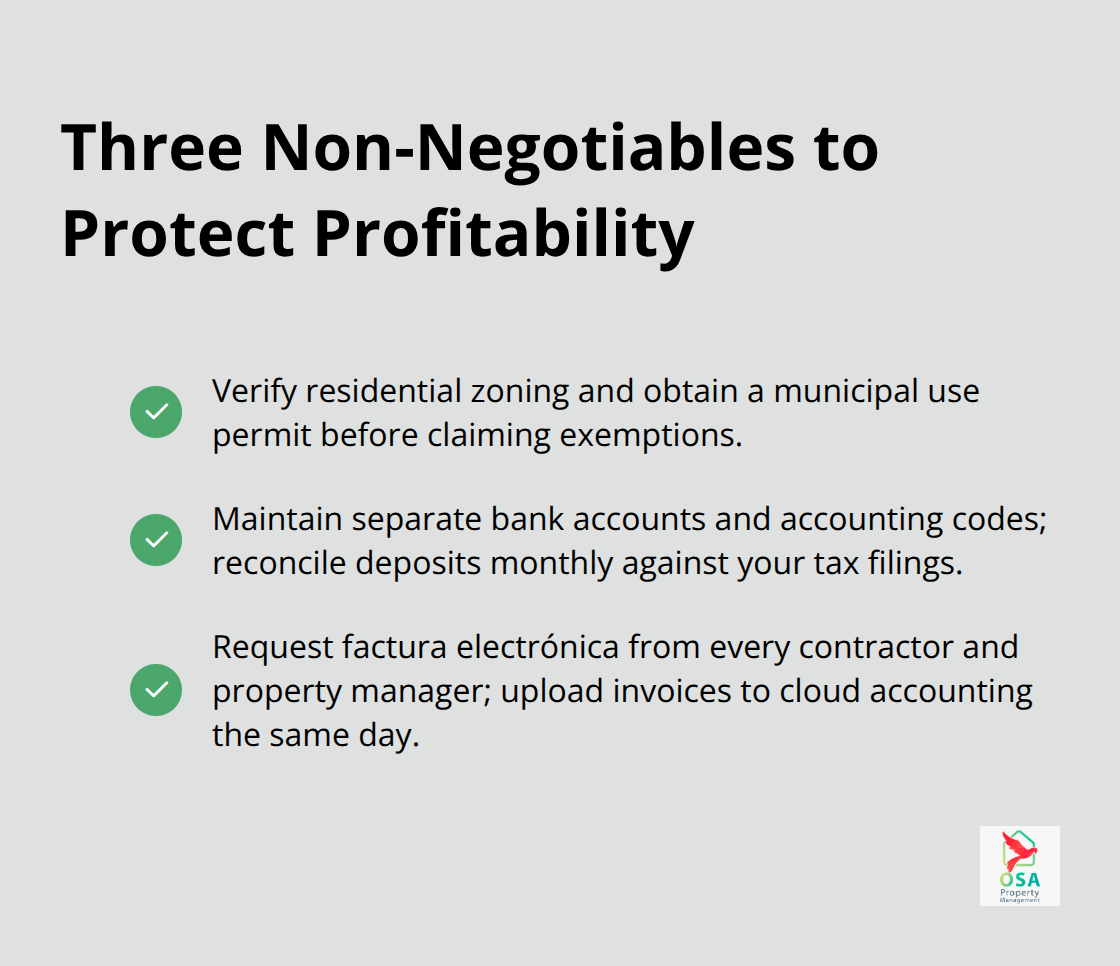
Three non-negotiables protect your profitability: verify residential zoning with your municipality and obtain a use permit before claiming exemptions, maintain separate bank accounts and accounting codes for each rental arrangement while reconciling deposits monthly against your tax filings, and request factura electrónica from every contractor and property manager, uploading invoices to cloud accounting software like QuickBooks Online or Xero the same day work completes. A Costa Rican accountant at USD 300–600 annually typically saves property owners USD 2,000–5,000 in optimized deductions and timely quarterly payments while managing electronic invoicing and audit readiness. The alternative costs far more in penalties, audit defense fees averaging USD 1,500–3,000, and lost deductions that handwritten receipts cannot recover.
Osa Property Management handles VAT compliance, accounting, and filings for landlords across Tarcoles, Jaco, Dominical, Manuel Antonio, Ojochal, Uvita, and Golfito, enabling you to focus on ownership rather than bureaucratic tasks. Open a dedicated business bank account, set up cloud accounting, request electronic invoices from contractors, and schedule a quarterly compliance review to implement this CR rental VAT guide immediately. Your profit margin depends on it.