

If you own rental property in Costa Rica, understanding IVA filing is non-negotiable. Many property owners overlook this tax obligation or misunderstand how it applies to their rental income, which can lead to costly mistakes.
At Osa Property Management, we’ve seen firsthand how confusion around IVA filing creates unnecessary stress for property owners. This guide walks you through what you need to know and how to handle it correctly.
What IVA Actually Is and How It Works for Your Rental
IVA stands for Impuesto al Valor Agregado, Costa Rica’s value-added tax, and it applies at a flat rate of 13% to most property-related transactions. If you own a short-term rental property in Costa Rica, you collect this tax from guests on every booking and remit it monthly to Hacienda, the tax authority. This isn’t optional-it’s a legal obligation tied to your rental income. The fiscal month runs from the 1st to the last day of each month, and you must file and remit between the 1st and 15th of the following month, even if you had zero bookings that month. Many property owners mistakenly believe that platforms like Airbnb or VRBO handle their IVA obligations. They don’t. You alone are responsible for declaring and paying taxes to Hacienda, and as of 2026, platforms now collect your host ID and report transaction data directly to the tax authority, making accurate bookkeeping essential. If your rental income exceeds approximately 1,000,000 colones annually, you must register as an IVA taxpayer and file monthly returns.
The number 100% seems to be not appropriate for this chart. Please use a different chart type. Below that threshold, you technically can operate without formal IVA registration, but you forfeit the ability to recover IVA paid on business expenses like maintenance, repairs, and professional fees-a significant disadvantage that costs most owners far more than registration and compliance.
Long-Term Rentals Get Different Treatment
Here’s where many owners miss a significant opportunity: long-term rentals over 30 consecutive days are exempt from IVA in Costa Rica. A 2,000,000 colone annual income from short-term rentals generates 260,000 colones in annual IVA liability, whereas the same income from month-to-month leases generates zero IVA. Some property owners successfully convert to long-term leasing to eliminate this tax burden entirely, though feasibility depends on your local market conditions. This distinction matters enormously when you evaluate whether your property strategy aligns with your tax position.
Why Compliance Beats Shortcuts Every Time
Operating informally or issuing no invoices exposes you to penalties ranging from 25% to 100% of unpaid taxes plus daily interest accrual. Hacienda audits rental properties regularly, with heightened focus on popular zones like Manuel Antonio and Uvita. The tax authority cross-checks platform-reported income against your filed returns, so mismatches trigger scrutiny. A property generating 2,000,000 colones in annual short-term rental income faces roughly 260,000 colones in annual IVA obligations; non-compliance penalties on that amount alone could exceed 65,000 colones, making informal operation financially reckless. Digital invoicing is now mandatory for all sales, and you must issue a digital invoice for each reservation with the guest’s name, reservation dates, rental amount, IVA collected, and payment method. Staying compliant protects your property from liens, your bank accounts from freezes, and your legal standing in Costa Rica.
What Happens Next: Filing Requirements and Deadlines
Understanding what IVA is forms the foundation, but the real challenge lies in meeting filing deadlines and understanding who must file. The next section walks you through registration thresholds, monthly filing windows, and the specific penalties that apply when owners miss deadlines or submit incorrect information.
IVA Filing Requirements and Deadlines for Rental Income
Registration Thresholds and What They Mean
If your annual rental income exceeds approximately 1,000,000 colones, you must register as an IVA taxpayer with Hacienda and file monthly returns. Below that threshold, you can operate without formal registration, but this choice costs you significantly. When you register, you recover 13% IVA paid on legitimate business expenses-maintenance, repairs, cleaning, utilities tied to the rental, insurance, and professional accounting fees. A 2,000,000 colone renovation generates roughly 260,000 colones in recoverable IVA when properly documented. Without registration, that deduction disappears. Most property owners operating informally spend far more in lost deductions than they would spend on registration and compliance.
The Monthly Filing Cycle and Deadlines
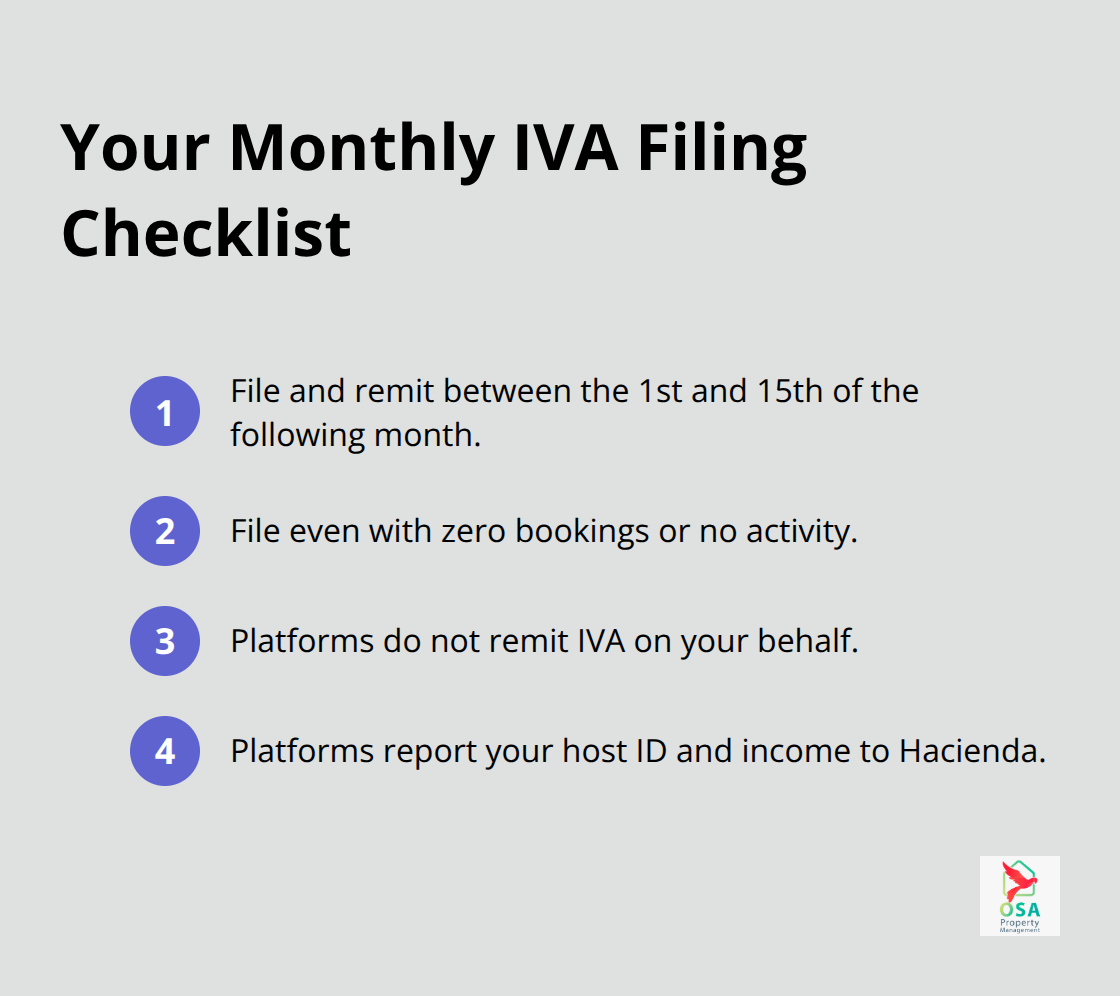
The fiscal month runs from the 1st to the last day of each month, and you must file and remit between the 1st and 15th of the following month. This deadline applies whether you had zero bookings or sold out completely-you must file even with zero activity. Platforms like Airbnb and VRBO do not remit IVA on your behalf. As of 2026, they collect your host ID and report transaction data directly to Hacienda, creating a permanent audit trail that the tax authority cross-checks against your filed returns. Mismatches trigger scrutiny immediately.
Penalties for Non-Compliance
The consequences of missing deadlines or filing incorrectly are severe enough that shortcuts make no financial sense. Penalties for non-compliance range from 25% to 100% of unpaid taxes plus daily interest accrual calculated from the original due date. A property generating 2,000,000 colones annually in short-term rental income faces roughly 260,000 colones in annual IVA liability; penalties on that amount alone could exceed 65,000 colones, and that’s before interest compounds. Hacienda audits rental properties regularly, with heightened focus on popular zones like Manuel Antonio and Uvita. Late payments trigger additional penalties and interest, and repeated misses can lead to liens on your property or bank account freezes that block all transactions. The Ministry of Finance and Public Treasury oversees IVA, and enforcement is real.
Building a System That Works
Your best defense is a structured system: file monthly without fail, document every expense with your IVA registration number on every invoice, and reconcile your income against booking records before the 15th deadline. Many property owners find that hiring a local Contador Público Autorizado-a certified public accountant-costs 150,000 to 300,000 colones annually but pays for itself through greater deductions and eliminated penalties. The alternative is managing monthly filings yourself, which requires 2 to 3 hours of organized work per month or 2 to 3 days if your records are chaotic.
Moving From Understanding Requirements to Taking Action
Knowing the filing deadlines and penalties forms the foundation, but the real challenge lies in organizing your documentation and executing the filing process itself. The next section walks you through the practical steps that transform compliance from a source of stress into a manageable routine.
How to Set Up Your IVA Filing System
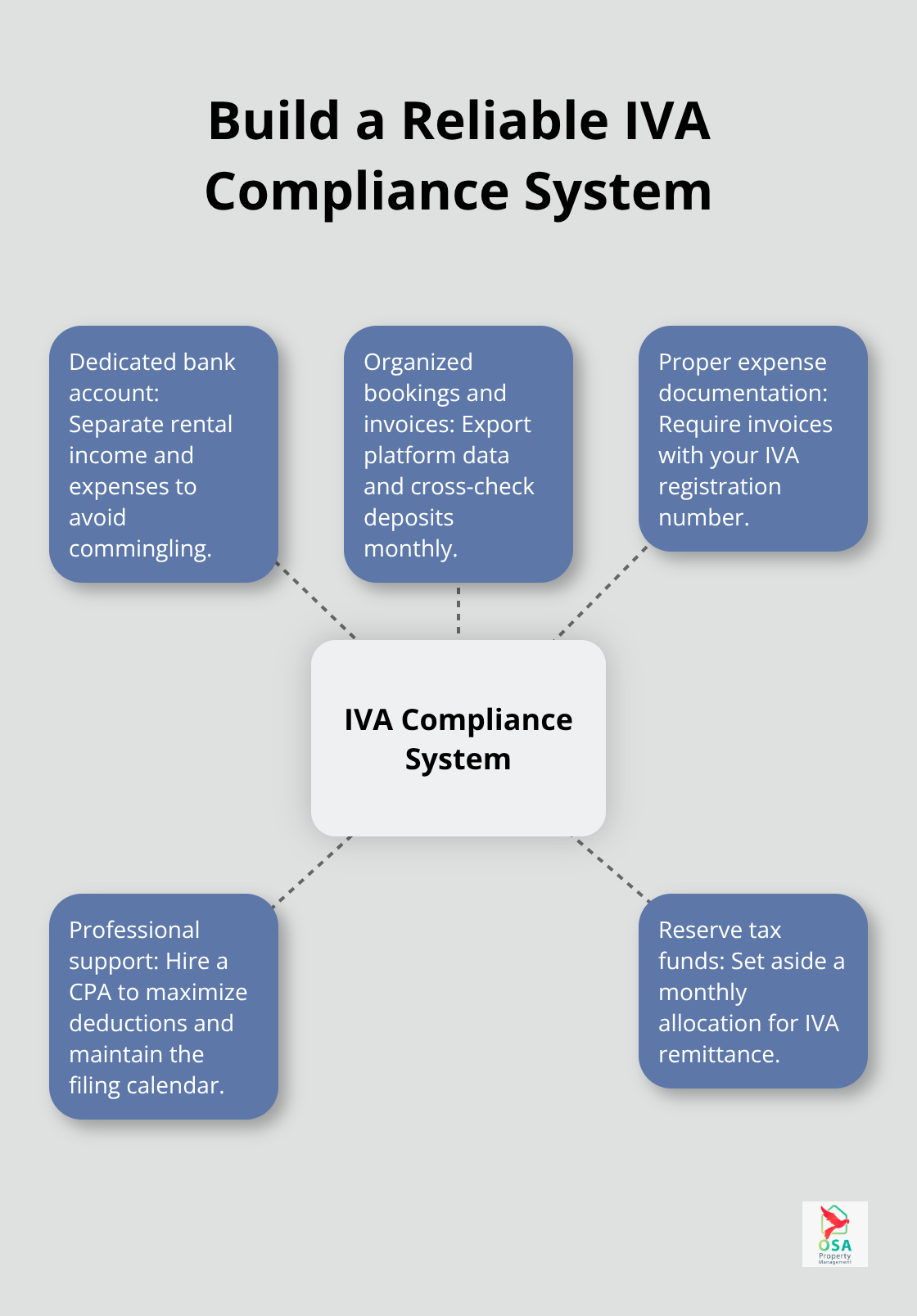
Filing IVA monthly stops being overwhelming once you establish a documented routine and assign clear responsibility. The most critical step is separating your rental business finances from personal money, which means opening a dedicated business bank account exclusively for rental income and property expenses. This single action eliminates the confusion that typically derails compliance. Every guest payment flows into this account, and every contractor invoice, utility bill, and maintenance receipt gets paid from it. When you reconcile this account against your booking records monthly, mismatches become immediately visible, and you catch missing invoices before the filing deadline arrives.
Organize Your Booking Records and Invoices
Many property owners who struggle with IVA compliance are actually struggling with commingled finances and incomplete documentation, not the filing itself. Set a calendar reminder for the 8th of each month to start reconciliation, giving yourself a week buffer before the 15th deadline. Your monthly reconciliation takes 2 to 3 hours when your records are organized. Start by exporting your booking data from Airbnb, VRBO, or your direct booking system and cross-checking every reservation against your bank deposits and issued invoices. Flag any gaps immediately.
Each invoice must include your IVA registration number, the guest name, reservation dates, rental amount, IVA collected, and payment method. Digital invoicing platforms like Wave or Zoho Books cost roughly 10,000 to 20,000 colones monthly and automatically categorize expenses while generating monthly tax summaries. These tools eliminate manual data entry and reduce reconciliation time substantially.
Document Every Business Expense Properly
The second non-negotiable step is documenting every business expense with a proper invoice that shows your IVA registration number. Contractors and service providers must issue invoices that itemize work performed and include your registration details; otherwise the expense cannot count toward IVA recovery. Never pay cash for recoverable expenses. Use bank transfers or credit cards exclusively to create an auditable paper trail. A 2,000,000 colone renovation generates roughly 260,000 colones in recoverable IVA when invoices are complete and properly filed, but zero if documentation is missing or informal.
Hire a Tax Professional or Manage It Yourself
Hiring a local Contador Público Autorizado costs 150,000 to 300,000 colones annually and represents one of the highest-return investments a property owner can make. A qualified accountant identifies overlooked deductions such as property inspections, listing photography, website hosting, internet portions tied to guest communication, and business-related travel expenses that most owners miss entirely. They maintain the filing calendar, flag discrepancies before they become penalties, and ensure your monthly returns match platform-reported data. Owners who engage professional accounting support recover 15,000 to 40,000 colones monthly in deductions they would otherwise forfeit. The accountant’s fee typically pays for itself in the first month through recovered deductions alone.
If you choose to manage filings yourself, use a Hacienda-certified digital tool to issue invoices and generate monthly tax summaries rather than attempting spreadsheets. These systems integrate directly with Hacienda’s systems, reducing manual errors and audit risk.
Reserve Monthly Funds for IVA Remittance
Set aside a dedicated monthly allocation from rental income specifically for IVA remittance to avoid cash-flow crunches that force late payments. A property generating 2,000,000 colones annually in short-term rental income owes roughly 260,000 colones in annual IVA, or approximately 21,700 colones monthly. Many owners who miss deadlines did not fail to earn income; they simply did not reserve funds for tax remittance. Treating IVA as a monthly expense line item rather than a surprise obligation transforms the filing process from chaotic to routine.
Final Thoughts
IVA filing in Costa Rica stops being a burden once you accept three non-negotiables: file monthly without exception, document every expense with your IVA registration number, and reserve funds monthly for tax remittance. Most property owners who struggle with compliance struggle with disorganized finances and incomplete documentation, not the tax itself. A dedicated business bank account, a calendar reminder on the 8th of each month, and a digital invoicing tool transform what feels chaotic into a manageable routine that takes 2 to 3 hours monthly.
The financial stakes are real. A property generating 2,000,000 colones annually in short-term rental income faces 260,000 colones in annual IVA liability, and penalties for non-compliance range from 25% to 100% of unpaid taxes plus daily interest. Hacienda audits rental properties regularly, and as of 2026, platforms report your transaction data directly to the tax authority, eliminating any margin for error or informal bookkeeping. Informal operation exposes you to far greater costs than compliance itself.
A qualified accountant identifies deductions most owners miss entirely, maintains your filing calendar, and ensures your returns match platform-reported data before Hacienda cross-checks them (the cost of 150,000 to 300,000 colones annually typically pays for itself in recovered deductions within the first month). We at Osa Property Management handle IVA filing, accounting, and tax compliance for property owners across the southern Pacific zone, including Jaco, Manuel Antonio, Dominical, Uvita, and Ojochal. Our team manages the monthly filing cycle, documentation, and reconciliation so you focus on your investment rather than tax deadlines.