

Rental tax in Costa Rica can feel overwhelming if you’re new to property ownership here. The system involves multiple layers-VAT, income tax, municipal fees-that catch many landlords off guard.
At Osa Property Management, we’ve helped countless property owners cut through the confusion and stay compliant. This guide breaks down exactly what you owe and how to minimize your tax burden.
How Rental Income Gets Taxed in Costa Rica
Short-Term vs. Long-Term Rental Tax Treatment
Costa Rica taxes rental income differently depending on how long you rent your property. Short-term rentals, typically under 30 days, are subject to VAT (IVA) at 13% on your gross rental revenue. A $2,000 monthly booking generates $260 in VAT that you owe to the government monthly. Long-term rentals, 30 days or longer, bypass VAT entirely and fall under standard income tax instead.
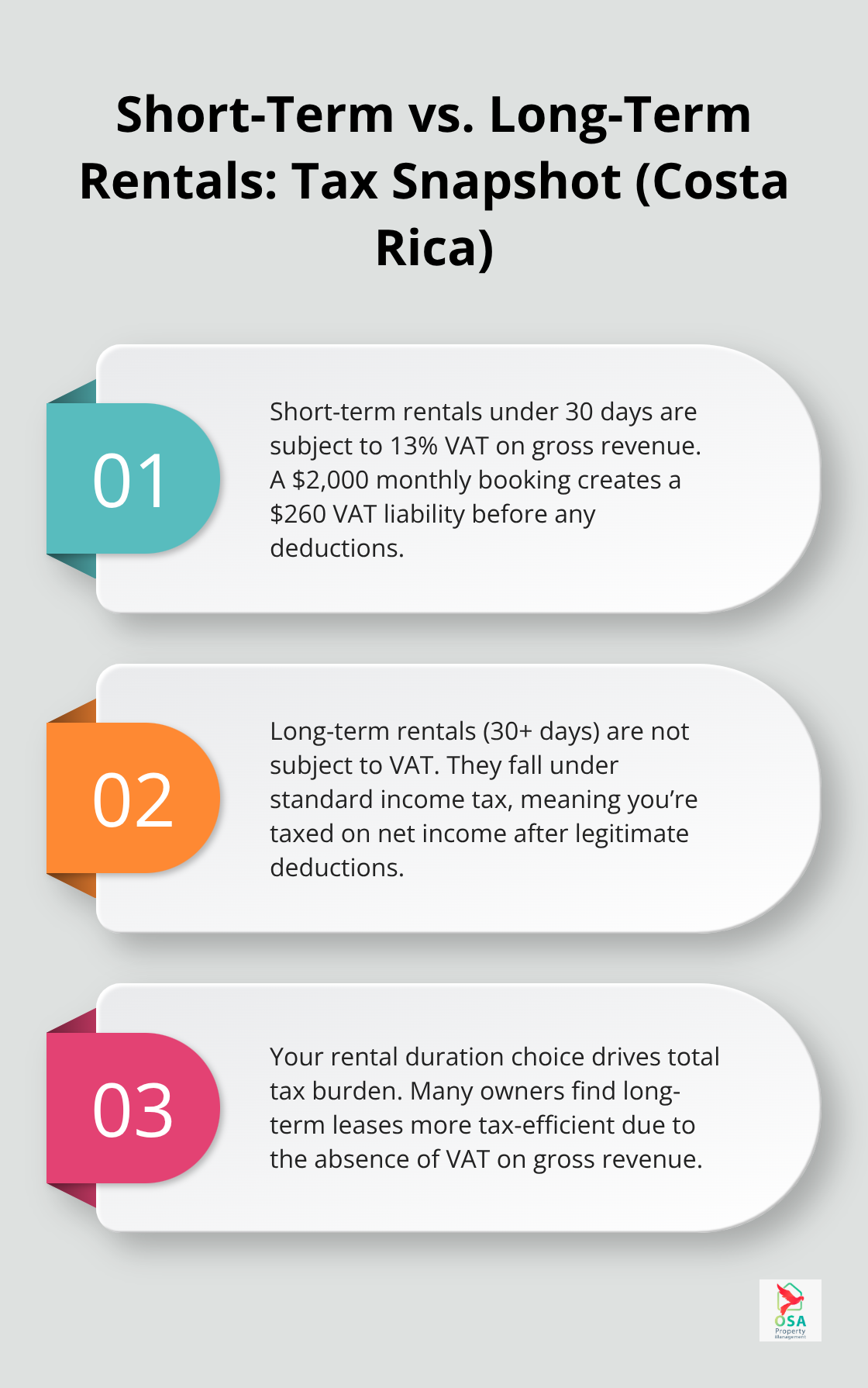
This structural difference makes long-term rentals significantly more tax-efficient for many owners.
Income Tax Brackets for Long-Term Rentals
Long-term rental income follows a progressive tax structure. Income tax rates for 2026 range from 0% to 25%, with an exempt threshold of CRC 918,000 per month for salaried workers. This exemption threshold substantially reduces your tax liability compared to short-term rental VAT obligations.
Filing Requirements and Electronic Invoicing
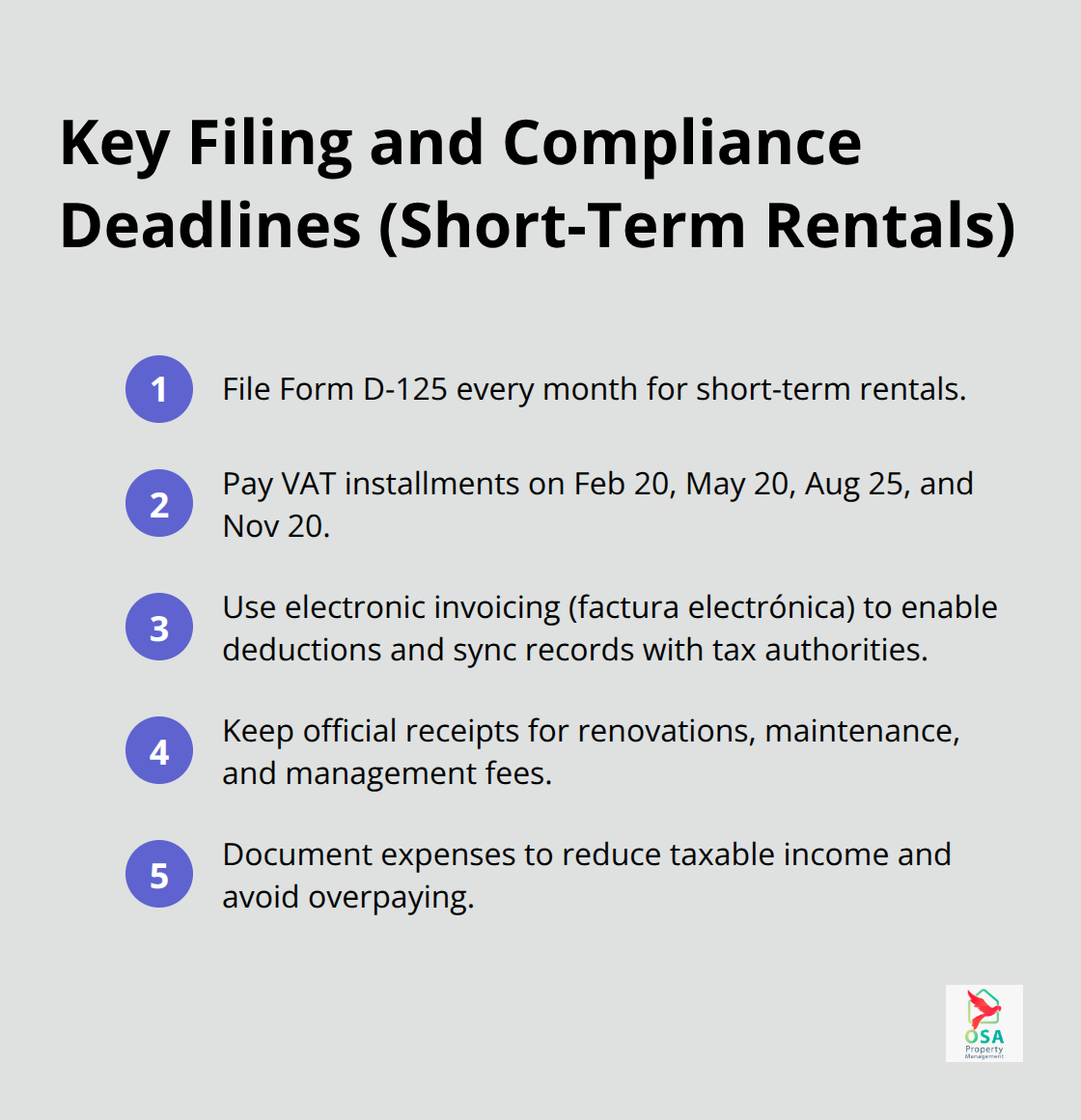
If you operate short-term rentals through platforms like Airbnb, you must file Form D-125 monthly and pay VAT in quarterly installments due February 20, May 20, August 25, and November 20. Electronic invoicing (factura electrónica) is mandatory, which automatically links your transactions to Costa Rican tax authorities and allows you to deduct legitimate expenses with official receipts. Many property owners miss this detail and overpay taxes by failing to document renovation costs, property maintenance, and management fees properly. A $10,000 kitchen remodel incurs roughly $1,300 in VAT under the electronic invoicing system, but that expense reduces your taxable income if documented correctly.
Property Tax and Luxury Tax Obligations
The tax year runs October 1 through September 30, not the calendar year, which trips up many foreign owners accustomed to different schedules. Property valuations occur every five years and directly affect your property tax rate of 0.25% on the declared value. A $300,000 property costs roughly $750 annually in municipal property tax alone. Luxury tax applies to high-value properties above approximately $250,000, adding 0.25% to 0.55% on top of standard property taxes.
Organizing Your Finances for Tax Compliance
Open a dedicated bank account for rental income to separate personal and business finances, making tax filing straightforward and audit-proof. Digital accounting software like QuickBooks Online or Xero tracks income and expenses automatically, cutting hours off your monthly filing process. These layered obligations demand precision and consistency, which is why professional guidance from a local Contador Público Autorizado with real estate experience pays for itself immediately. Understanding your specific tax obligations sets the foundation for the next critical area: VAT rates and exemptions that directly impact your bottom line.
VAT and Other Levies on Rental Properties
How VAT Hits Your Short-Term Rental Income
The 12.75% Airbnb tax strikes harder than most owners expect because it applies to every dollar of gross rental revenue, not just profit. If you rent a beachfront home for $3,000 monthly through Airbnb, you owe $382.50 in VAT each month to the Costa Rican government before you deduct a single expense. Over a year, that amounts to $4,590 in VAT alone on a property that generates $36,000 in gross income. The math becomes brutal quickly, which is why shifting to long-term rentals eliminates VAT exposure entirely. A property rented for 30+ days falls under standard income tax instead, meaning you only pay tax on net income after legitimate deductions. One owner switched a Manuel Antonio beachfront from nightly bookings to a 12-month lease at $2,200 monthly and reduced annual tax payments by roughly $3,400 simply by avoiding the VAT trap.
Maximizing Deductions Through Electronic Invoicing
Electronic invoicing (factura electrónica) is mandatory for all short-term rentals, and this system automatically flags your income to tax authorities. The upside is that official receipts for renovations, repairs, and property management fees become tax-deductible under the old method of calculating rental taxes. A $5,000 bathroom remodel documented through factura electrónica reduces your taxable rental income by that amount, creating real savings. You must file Form D-125 monthly and pay VAT in quarterly installments due February 20, May 20, August 25, and November 20. Many property owners miss this detail and overpay taxes by failing to document renovation costs, property maintenance, and management fees properly.
Municipal and Luxury Tax Obligations
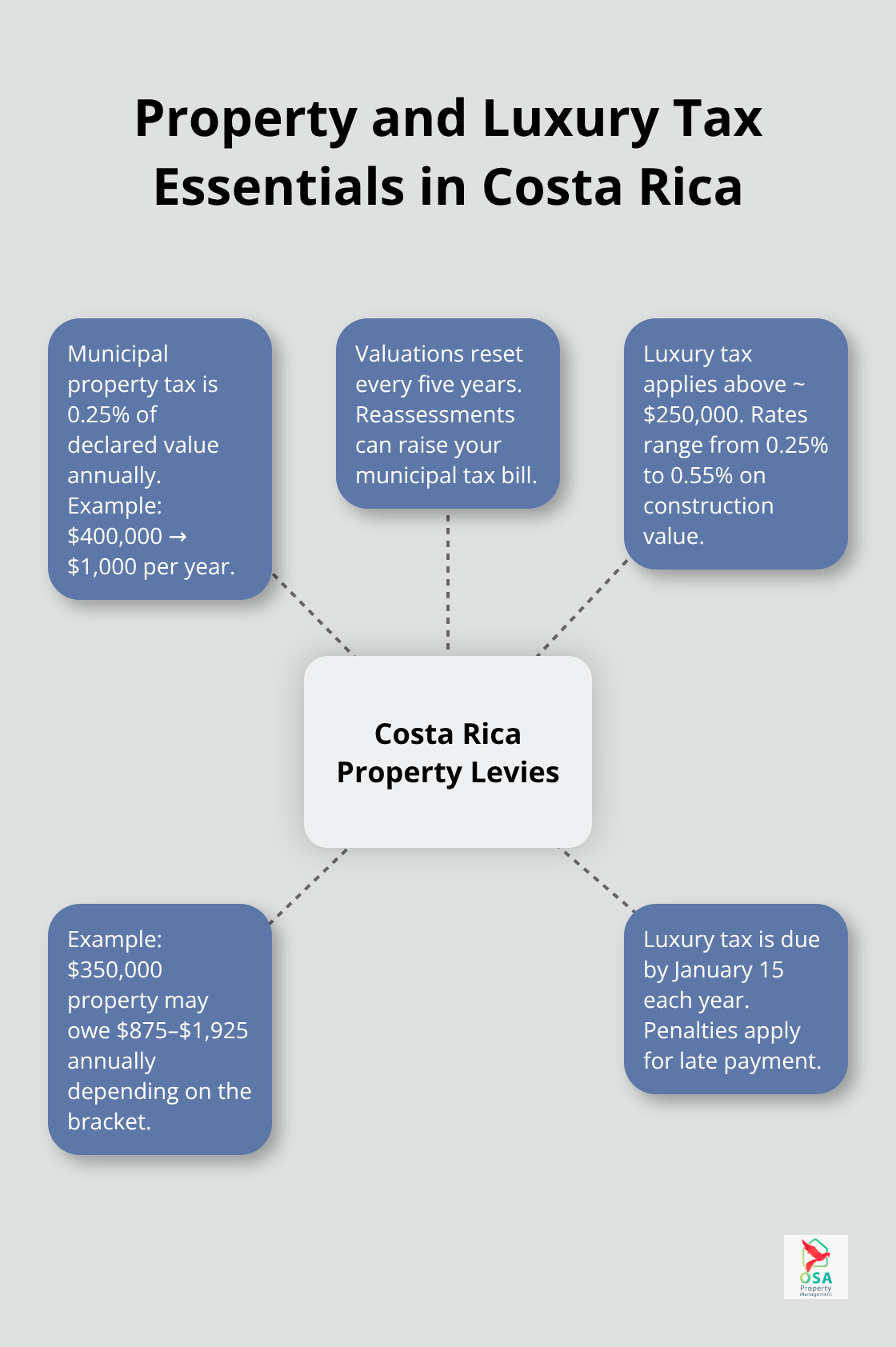
Municipal property taxes add another layer at 0.25% of your declared property value annually, meaning a $400,000 property costs $1,000 per year in municipal taxes alone. Property valuations reset every five years, so a reassessment can spike your municipal tax bill if your property value increases significantly. Luxury tax hits properties valued above roughly $250,000, adding 0.25% to 0.55% on construction value. A $350,000 property might owe $875 to $1,925 annually in luxury tax depending on the rate bracket, paid by January 15 each year with penalties for late payment.
Transfer Taxes and Closing Costs
Transfer taxes when you purchase property run 1.5% of the purchase price plus notary and registration fees totaling another 0.5% to 1%, creating closing costs of roughly 2% to 2.5% of your investment. These upfront costs matter when calculating your true investment return, especially for properties under $200,000 where percentage-based costs take a larger bite. The tax year runs October 1 through September 30, not the calendar year, which trips up many foreign owners accustomed to different schedules.
Building a Compliance System That Works
The compliance burden demands precision that most owners handle poorly alone. Monthly Form D-125 filings, quarterly VAT payments, annual property tax declarations, and mandatory luxury tax payments create a filing calendar that catches owners off-guard if they are not organized. Open a dedicated rental account and use digital accounting software like QuickBooks Online or Xero to track income and expenses in real time, ensuring you have accurate figures when filing deadlines arrive. Many owners lose thousands annually by failing to document deductible expenses properly, missing the electronic invoicing requirement that enables deductions. If you manage properties independently, hire a local Contador Público Autorizado with real estate experience to guide your tax strategy, particularly around VAT optimization and luxury tax filing deadlines. The difference between strategic tax planning and reactive compliance often equals thousands of dollars annually on a single property. Understanding how to structure your rental operations and maintain proper documentation sets the stage for the next critical step: working with tax professionals who can transform your compliance obligations into a competitive advantage.
How to Claim Deductions and Build an Audit-Ready Tax System
Capturing Deductible Expenses Through Electronic Invoicing
The difference between what you owe and what you should owe often comes down to documentation. Property owners lose thousands annually because they fail to capture deductible expenses through the electronic invoicing system. Under Costa Rica’s factura electrónica requirement, every legitimate renovation, repair, and management expense reduces your taxable rental income if documented with an official receipt. A $8,000 roof repair with proper invoicing cuts your taxable income by $8,000, potentially saving you $2,000 to $2,500 in annual taxes depending on your bracket. Maintenance costs, property management fees, utilities paid on behalf of renters, advertising expenses, and insurance premiums all qualify as deductions when you hold official receipts. The critical mistake most owners make involves paying for work cash-only or accepting informal receipts, which disqualifies the expense entirely. You must demand factura electrónica invoices from every contractor, from the plumber fixing a burst pipe to the painter refreshing exterior walls.
Automating Your Expense Tracking and Financial Records
Digital accounting software like QuickBooks Online or Xero integrates with your bank account and automatically categorizes expenses, eliminating the scramble to reconstruct your finances at tax time. These platforms generate the financial reports your Contador Público Autorizado needs to file your annual return accurately and on deadline. Automated systems reduce human error and create an audit trail that protects you if tax authorities question your filings. The time savings alone-hours each month that you reclaim-justifies the modest monthly subscription cost.
Managing Your Tax Filing Calendar
Your filing calendar determines whether you stay compliant or face penalties that compound monthly. Form D-125 filings are due monthly for short-term rentals, with VAT installments due February 20, May 20, August 25, and November 20. Luxury tax payments must clear by January 15, and municipal property tax assessments occur every five years, triggering potential rate increases that catch owners unprepared. Set calendar reminders 10 days before each deadline to gather documents and alert your tax professional, preventing last-minute scrambles that lead to missed filings.
Working With a Local Tax Professional
A local Contador Público Autorizado with real estate experience costs roughly 50,000 to 100,000 colones annually but recovers that investment immediately through legitimate deductions you would otherwise miss. This professional relationship matters more than most owners realize because tax law changes frequently. The 2019 VAT regime shift on short-term rentals caught thousands of owners off-guard, and regulatory changes around digital platform reporting continue evolving. Your tax advisor monitors these shifts and adjusts your strategy accordingly, protecting you from penalties that range from $2,000 to nearly $79,000 for violations like missing shareholder declarations on corporate-owned properties.
Final Thoughts
Rental tax in Costa Rica demands attention to detail, but the payoff justifies the effort. You now understand the structural difference between short-term VAT obligations and long-term income tax treatment, recognize municipal and luxury tax requirements, and know how to capture deductions through electronic invoicing. The owners who thrive here treat tax planning as a competitive advantage, not a compliance burden.
Your filing calendar matters more than most realize. Monthly Form D-125 filings, quarterly VAT payments due February 20, May 20, August 25, and November 20, annual luxury tax declarations by January 15, and five-year property valuations create a rhythm that catches unprepared owners off-guard. Digital accounting software like QuickBooks Online or Xero eliminates the scramble to reconstruct finances at tax time, while a local Contador Público Autorizado with real estate experience recovers their cost immediately through deductions you would otherwise miss.
The strategic decision between short-term and long-term rentals often determines your annual tax burden more than any other factor. A property generating $36,000 annually through nightly bookings owes roughly $4,590 in VAT alone, while the same property rented long-term at $2,200 monthly avoids VAT entirely and pays only income tax on net income after legitimate deductions. We at Osa Property Management handle rental tax compliance as part of our comprehensive service package across Tarcoles, Jaco, Dominical, Manuel Antonio, Ojochal, Uvita, and Golfito, transforming your rental tax Costa Rica obligations into operational efficiency.